Abstract
Roughly nine in ten drug candidates that reach clinical trials never get approved. That means a huge amount of lost time and money before a single patient benefits. Molecular docking is one way scientists try to avoid those losses, by testing how a potential medicine fits its target on a computer before anyone mixes a chemical. This guide explains how it works, where molecular docking in drug discovery pays off, which software people use, and where the method still falls short.
What Molecular Docking Actually Means
1. The lock and key picture
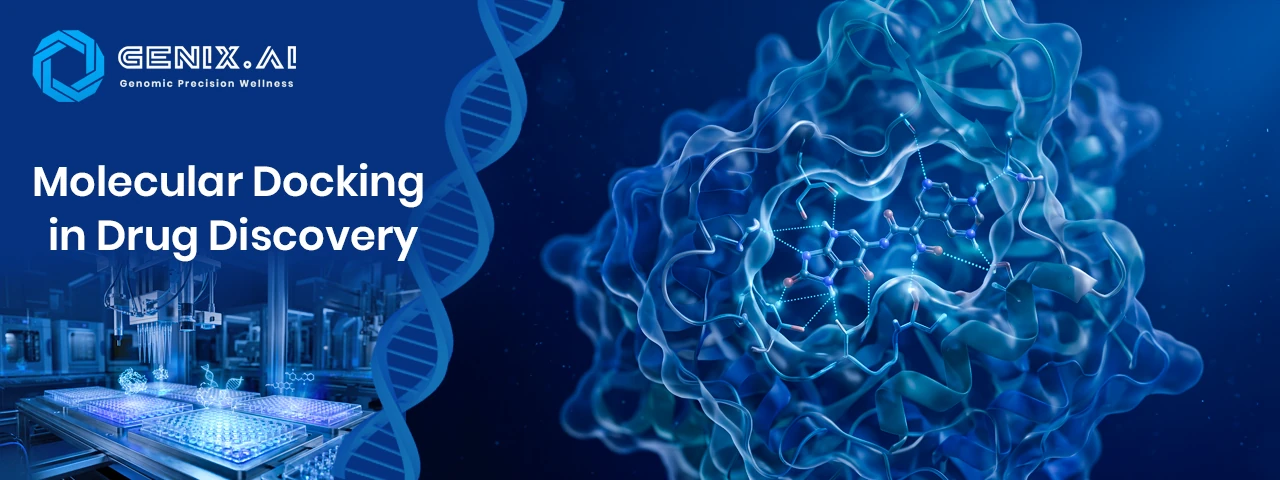
Most drugs work by attaching to a protein in the body and changing how it behaves. Think of the protein as a lock and the drug as a key. Molecular docking is a computer method that predicts whether the key fits and how snugly it sits once inside.
2. Why bother doing it on a computer
Bringing a medicine to market commonly takes ten to fifteen years. Making and testing compounds in a lab is slow and expensive, so a computer that can screen thousands of candidates in the time a lab prepares a handful is very attractive. That idea sits at the heart of computational drug discovery.
How Molecular Docking Works
1. Getting the ingredients ready
You need a 3D structure of the target protein and a 3D model of the small molecule, called the ligand. When nobody has solved the protein's structure in a lab, AI tools such as AlphaFold can predict one from its amino acid sequence. Services built around protein structure prediction and docking often start exactly here.
2. Searching and scoring
The software tries many positions and angles for the ligand inside the protein's binding pocket. Every pose gets a score that estimates how favourable the fit is. Scientists then study the best ranked poses by eye, looking at hydrogen bonds and other contacts that hold the molecule in place.
3. The workflow at a glance
Target selection → Structure prediction → Molecular docking → MD simulation → ADMET and reportingMost computational drug discovery campaigns follow roughly this path. Molecular dynamics, or MD, simulation checks whether a docked pose stays stable once everything is allowed to move. ADMET profiling then predicts how a compound might be absorbed, processed and cleared by the body, along with its toxicity risks.
Molecular Docking in Drug Discovery
1. Sifting through enormous libraries
Virtual screening docks a large library of compounds against one target and keeps only the top scorers for lab testing. Published studies have docked well over 100 million molecules in a single campaign, which no physical screen could match. Our post on how genomic platforms are cutting drug development costs shows where this fits in the wider pipeline.
2. Fine tuning and repurposing
Poses also guide medicinal chemists as they tweak a molecule to bind more tightly or more selectively. Docking can test approved drugs against new targets too, which is called repurposing. Cancer research uses both ideas heavily, as we explain in molecular docking for cancer drug development.
3. A case study worth knowing
Dorzolamide, a glaucoma drug approved in 1995, is often cited as the first marketed medicine to come out of structure based design. Researchers used the 3D shape of the target enzyme to guide the chemistry instead of relying on trial and error alone. Docking grew out of that same thinking, and modern tools now let far more teams work this way.
4. What the scores can and cannot tell you
Docking is often decent at reproducing how a molecule sits in its pocket. It is much weaker at ranking exactly how tightly molecules bind, because scoring functions are simplified. That is why teams follow up with MD simulation and then lab experiments. Many failed projects trace back to avoidable slips, which we cover in common molecular docking mistakes.
Where Computational Drug Discovery Is Heading
AlphaFold's public database now holds predictions for more than 200 million proteins, so far fewer targets lack a usable structure. Machine learning is also being used to speed up scoring and compound ranking. The strongest results still come when predictions feed into careful lab validation. Teams building these pipelines lean on a solid AI and bioinformatics stack.
Conclusion
Molecular docking will not replace the lab, but it helps teams decide which experiments deserve their time. Genix.ai runs this work as a service. The team can start from nothing more than a protein sequence, predict and validate the structure, dock your compounds, check stability with MD simulation and profile ADMET properties. The site lists open source tools such as AutoDock Vina and GROMACS in its standard toolchain, with turnaround ranging from a few days to about two weeks for individual services, and an NDA is signed before any data changes hands. Explore the molecular docking service, the wider BioCompute offering or the page for pharma and biotech teams to see what fits your project.
FAQs
1. What is molecular docking in simple words?
It is a computer method that predicts how a small molecule fits into a target protein.
2. Is molecular docking enough to prove a drug works?
No, it only predicts binding, so lab experiments must confirm the result.
3. Which software is used for molecular docking?
AutoDock Vina is the most popular free option while GOLD and Glide are common commercial ones.
4. Can docking work if the protein structure is unknown?
Yes, a predicted structure from AlphaFold or homology modeling can be used once it has been validated.
5. How accurate is molecular docking?
It often predicts binding poses well, but its binding strength scores are only rough guides.