Abstract
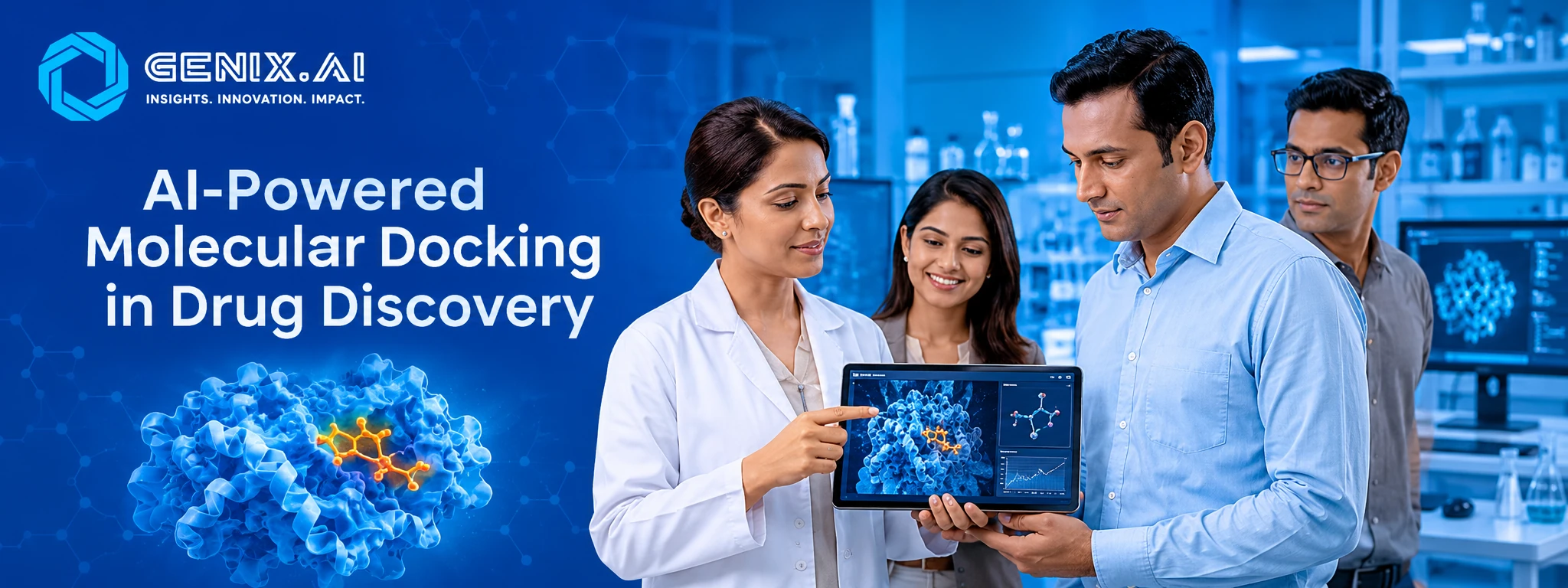
For decades, docking meant a computer patiently trying poses and scoring them with hand built formulas. Then neural networks arrived and the conversation changed almost overnight. AI in molecular docking now promises faster screens, sharper rankings and structures for proteins nobody has solved in a lab. Some of that promise is real and some of it is hype. This article sorts one from the other, shows where AI genuinely helps, and explains why the smartest teams still pair it with careful physics before they spend a rupee on synthesis.
From Classic Docking to AI Docking
1. How classic docking works
A classic docking program has two jobs. It searches for ways to place a small molecule in a protein pocket, and it scores each placement with a formula that estimates binding strength. The method has served drug discovery well, but the formulas are rough approximations, and the search can be slow when libraries get large.
2. Where AI enters the picture
AI can step into either job. Some models learn a better scoring function from thousands of known complexes. Others skip the search altogether and predict the final pose directly. A newer family, often called cofolding models, predicts the protein and ligand together in one go. AlphaFold3 belongs to this group, and it has made ligand aware structure prediction part of everyday conversation.
What AI Actually Adds
1. Speed at scale
Screening ultra large libraries is a numbers game. GPU accelerated engines such as Uni Dock and AutoDock GPU have widened throughput dramatically for virtual screening. That matters because the chemical space worth searching now runs into billions of molecules.
2. Better starting structures
Docking needs a protein structure, and plenty of targets have none. AI structure prediction closes that gap by building a model from the amino acid sequence alone. It is one reason the sequence only workflow has become so common. If you want the background, this post on AlphaFold3 and protein intelligence is a good place to start.
3. Smarter ranking
Machine learning rescoring takes the poses a classic engine produces and re ranks them with a model trained on real binding data. Done well, it pushes truly promising compounds higher up the list, which saves lab time later.
Why It Matters for Drug Development
Drug projects rarely fail loudly at the start. They fail quietly, months later, after a weak candidate has already eaten budget and bench time. Better early filtering means fewer dead ends reach the wet lab. It also lets small teams explore more ideas than their budgets would otherwise allow, including testing approved medicines against new targets. For a closer look at how this plays out in cancer research, see this piece on molecular docking for cancer drug development.
What the Evidence Says
1. A benchmark worth knowing
In one widely discussed example, MIT researchers treated docking as a generative modelling problem and built a tool called DiffDock. It reached a 38 percent success rate on a standard test, against 23 percent for traditional docking and 20 percent for earlier deep learning methods. That is a real jump, yet it comes from one benchmark and says little about your own target.
2. Why caution still matters
Benchmarks flatter AI more than real projects do. One analysis warns that benchmark RMSD scores should not be read as proof of real world readiness, especially for novel targets. Comparisons can also be unfair. Many deep learning models dock against the whole protein, while traditional tools are built to dock into a known pocket, so the two are not playing the same game. Think of any docking output, AI or classical, as a hypothesis and not a confirmed binder.
3. A short case study
AtomNet was one of the first deep convolutional networks aimed at structure based drug discovery. It contributed to early drug leads for diseases such as Ebola and cancer. Those were leads and not approved medicines, which is exactly the right way to read AI results at this stage.
A Hybrid Workflow That Works
Most careful teams end up with something like this.
- Predict and validate a 3D structure if no experimental one exists.
- Run a fast docking pass over the whole library.
- Rescore the top poses with a learned model for a second opinion.
- Test the finalists with molecular dynamics to see whether the contacts survive movement.
- Profile drug likeness and toxicity, then write the ranked report.
Before step two, it pays to read about common molecular docking mistakes, because a clever model cannot rescue a badly prepared target.
Conclusion
AI has made docking faster to scale and easier to start, yet it still works best as a partner to physics and not a replacement. Genix.ai offers molecular docking services under its BioCompute offering, pairing AlphaFold3 structure prediction with proven engines such as AutoDock Vina and GROMACS based simulation. Single target docking starts at $1,000 with a typical turnaround of 5 to 7 days, projects can start from a bare protein sequence, and every engagement begins with an NDA. Pharma and biotech teams can see how that fits their pipeline on the pharma and biotech page, or ask for a free consultation on the docking page.
FAQ's
1. What does AI in molecular docking actually do?
It uses learned models to predict poses, rescore results or build protein structures that classic docking then uses.
2. Is AI docking more accurate than classical docking?
It can win on some benchmarks, but results vary by target, so independent checks are still needed.
3. Can AI replace molecular dynamics?
No, since dynamics tests whether a pose stays stable over time and AI predictions still need that check.
4. Do I need a solved protein structure to use AI docking?
No, tools such as AlphaFold3 can predict a structure from the sequence first.
5. Is AI in molecular docking ready for real drug projects?
Yes as a screening and prioritising aid, as long as hits are confirmed in the lab.