Abstract
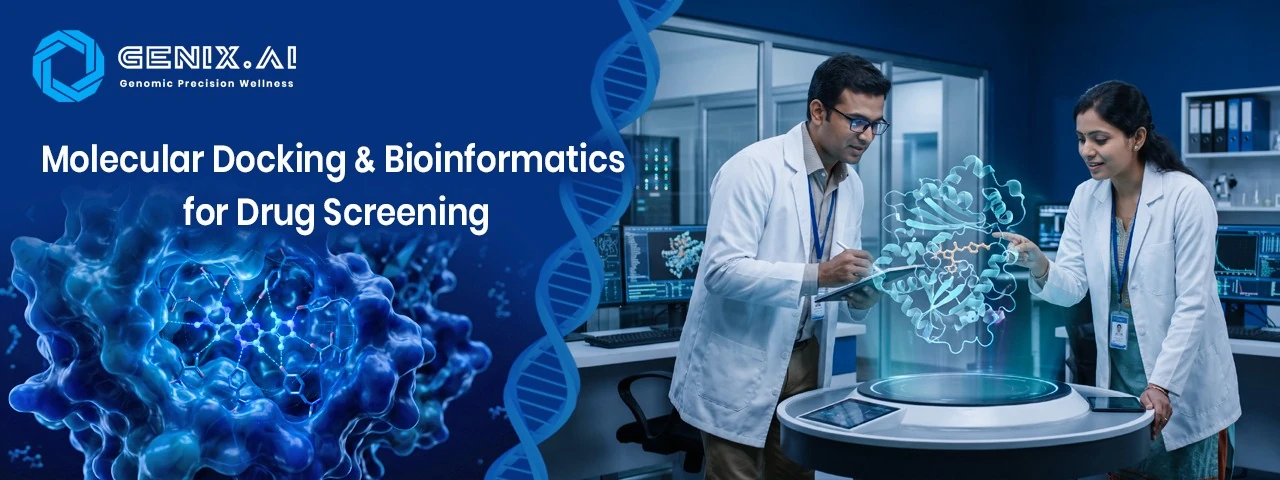
Imagine a shelf holding five thousand compounds and only a handful of lab slots. Testing every one by hand would take years and a small fortune, so teams need a smarter way to choose. Molecular docking predicts which molecules fit a target protein, and bioinformatics prepares the data that makes those predictions trustworthy. Together they shrink the list before anyone picks up a pipette. This article explains how that pairing works, where it speeds up drug development, and what to keep an eye on along the way.
Why Drug Candidate Screening Needs a Shortcut
1. The numbers problem
Compound libraries can hold thousands or even hundreds of thousands of molecules, and a lab can only test so many. Every weak candidate that reaches the bench eats into your budget and your calendar. A computational first pass changes the maths by ranking the whole library before any experiment starts.
2. Where drug development loses time
Slow screening is only one delay, but it is a stubborn one. Teams often wait on a protein structure, then wait again on compound preparation, then wait on results nobody can compare. Bioinformatics trims those waits by getting the inputs ready sooner, which is one reason it keeps showing up in the drug development process.
How Molecular Docking Does the Heavy Lifting
1. Predicting fit
Docking places each small molecule into the binding pocket of a target protein and scores how snugly it sits. You get a ranked list and the pose behind every score. If you want the basics first, this guide on what molecular docking is covers them.
2. Screening at scale
Virtual screening runs docking across a whole library.The molecular docking service page describes a funnel. A fast first pass keeps the top 1 to 5 percent of hits, then refined docking and sometimes molecular dynamics look hard at the best few. That is how costs stay manageable without cutting corners.
What Bioinformatics Adds Before and After Docking
1. Getting a usable target
Docking needs a 3D structure, and plenty of targets don’t have one. Tools such as AlphaFold3 can predict a structure from an amino acid sequence, and the model is then checked for quality. The docking page calls this sequence first route its most common workflow. For background, see AlphaFold3 and protein intelligence.
2. Preparing and judging the hits
Libraries need cleaning and formatting before docking starts. Afterwards, ADMET profiling asks whether a hit looks drug like and safe enough to chase, using filters such as Lipinski’s rule of five. A molecule that binds beautifully but can’t be absorbed is still a dead end. Many of these slips are avoidable, and this piece on common molecular docking mistakes shows how.
A Look at the Evidence
1.A screening funnel in numbers
Here is a simple illustration, not a client result. Say a team starts with 5,000 compounds. Keeping the top 1 to 5 percent leaves between 50 and 250 for closer study. That is a far lighter bench workload, and it arrives sooner.
2. A published reminder
A 2026 study in ACS Physical Chemistry Au docked ten approved HIV protease inhibitors against a West Nile virus protease and then ran molecular dynamics. Several scored well in docking yet showed only brief binding in simulation. Docking narrows the field, and a second check keeps it honest. The difference is explained in docking versus dynamics.
Structure Prediction (3–5 Days): Builds a three-dimensional (3D) protein model from its sequence and validates the structure for further analysis.
Single-Target Molecular Docking (5–7 Days): Ranks compounds based on their predicted binding affinity to a specific protein target.
Library Screening (7–14 Days): Screens a large collection of compounds against a single protein target to identify promising drug candidates.
Molecular Dynamics Simulation (7–14 Days): Performs a 100-nanosecond simulation to evaluate the stability of protein–ligand interactions over time.
ADMET Profiling (3–5 Days): Predicts a compound’s absorption, distribution, metabolism, excretion, and toxicity to assess its drug-like properties.
Full Drug Discovery Campaign (4–8 Weeks): Combines all the above steps into a comprehensive computational workflow to identify and evaluate potential drug candidates.
Note: These timelines are estimates based on the provided pricing table. Actual durations may vary depending on project complexity, computational resources, and the number of compounds analyzed.
3. Limits Worth Knowing
A docking score is an estimate and not a guarantee. If the protein model is poor, the poses will be poor too. Flexibility and water are often simplified, so a promising hit can still fall apart once it moves. Lab testing remains the final judge.
Conclusion
Faster screening comes from a good pairing and not from one clever tool. Genix.ai supports that pairing through its BioCompute services, from AlphaFold3 structure prediction and docking to molecular dynamics checks and ADMET reporting. Single target docking starts from $1,000, a full CADD campaign starts from $10,000, and an NDA is signed before any data is shared. Teams can request a quote on the molecular docking page or see where this fits on the pharma and biotech page.
FAQ’s
1. How do docking and bioinformatics differ in screening?
Docking predicts how well a molecule fits a target, while bioinformatics prepares the structures and data and helps read the results.
2. How many compounds can be screened?
The docking page says screening can run from hundreds to hundreds of thousands of compounds.
3. Do I need an experimental crystal structure?
No, a 3D structure can be predicted from a protein sequence and validated before docking.
4. Does a high docking score prove a compound will work?
No, it is a prediction that still needs simulation and lab testing.
5. How long does docking take?
Single target docking is listed at 5 to 7 days and library screening at 7 to 14 days.