Abstract
Drug development can take more than a decade and a bill well past a billion dollars once the failures are counted. Much of that waste comes from chasing molecules that were never going to work. Computational biology moves a good share of that failure onto a screen, where it costs days instead of years. Here is how it works, where it helps most and where it still falls short.
Why Drug Discovery Is So Slow and Costly
1. Where the Time Goes
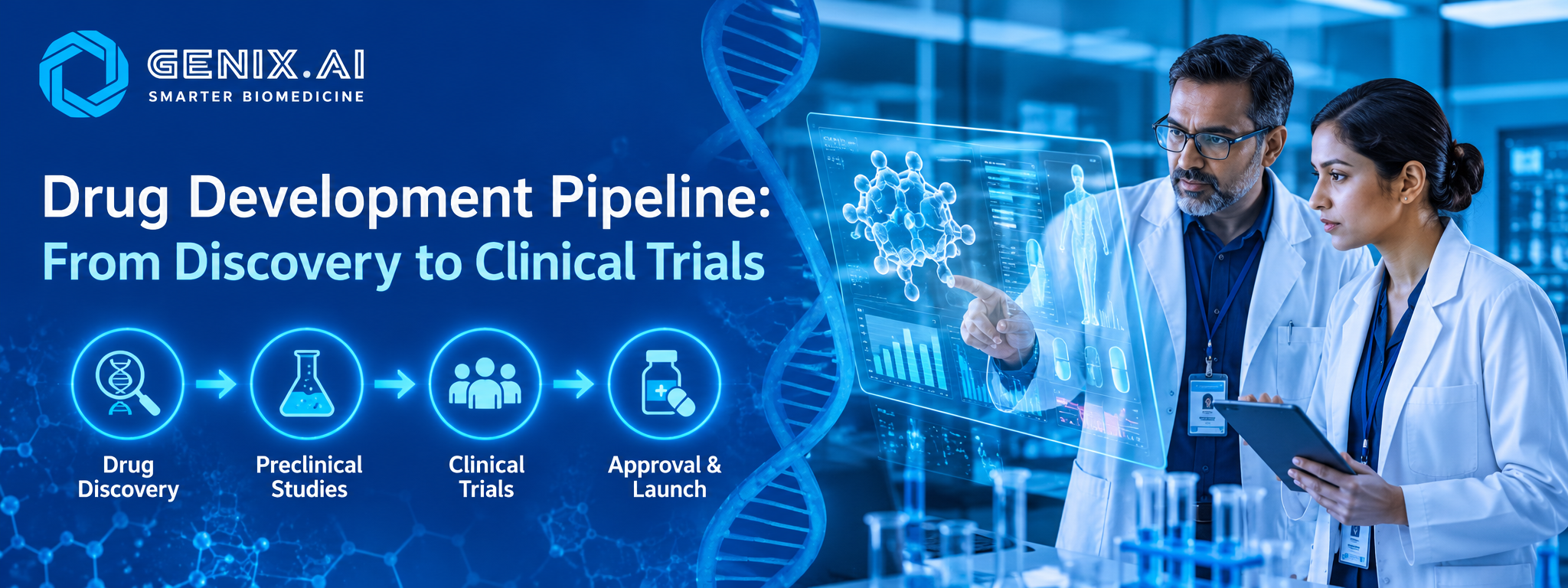
Most people picture a lab full of beakers. In reality, a lot of the delay is simply repetition. A team picks a target, makes compounds and tests them. Most fail, so the cycle starts again. Typical estimates put a full programme at 10 to 15 years, and around nine in ten candidates that reach human trials never get approved.
2. The Hidden Cost of Late Failure
A molecule that fails in a dish costs little. One that fails in a late stage trial costs a fortune. That gap explains why so much effort now goes into failing earlier and cheaper. A published review of computational biology and AI in drug design describes these methods as a way to expedite discovery by cutting both time and financial cost. For the cost side in particular,see how genomic platforms are cutting drug development costs.
What Computational Biology Actually Does
1. Reading Biology as Data
Computational biology uses code and models to make sense of biological data. In drug work that means mining genomic datasets for promising targets, then predicting what a protein looks like and how a molecule might grip it. Raw sequencing reads are the starting point, and NGS data analysis turns them into something a team can act on.
2. Predicting Protein Structures
Knowing a protein’s 3D shape used to take months of lab work. AlphaFold changed that by predicting structures across the human proteome, which handed drug hunters starting points almost overnight. A good structure means a team can aim at a target with far more confidence.
How Computing Cuts Time
1. Virtual Screening With Molecular Docking
Instead of testing a huge compound library in the lab, researchers can test it on a computer first. Molecular docking ranks molecules by how well they are predicted to fit the target. Only the best performers go on to real experiments, which saves reagents and weeks of bench time.
2. Simulation Before Synthesis
Molecular dynamics simulations show how a drug and its protein move together over time, so weak binders can be dropped before anyone makes them. Early predictions of absorption and toxicity, grouped under the name ADMET, trim the dead ends further. Services such as BioCompute package these steps for teams that lack the infrastructure to run them.
3. A Simple Workflow
Target → Structure prediction → Virtual screening → Simulation → ADMET filter → Lab testing of top picksThe key idea sits at the right end of that line. Lab work still happens, but it happens on far fewer candidates.
Real Examples and Numbers
1. A Case Study in AI Assisted Discovery
In a 2022 preprint, researchers at Insilico Medicine combined AlphaFold predicted structures with AI platforms to find a first in class molecule against CDK20, a target linked to liver cancer. They reported reaching a first hit after synthesising only a handful of compounds, which is tiny by traditional standards. It is a proof of concept rather than a finished medicine, but it shows what a computation first approach can do to the early stages.
2. What Turnaround Looks Like in Practice
Speed is easier to picture with real numbers. BioCompute lists protein structure prediction at 3 to 5 days, a docking campaign at 5 to 10 days and MD simulation at 7 to 14 days. Compare that with the months an in house team might need to build the same capability from scratch. If you want to weigh the choice, read about in house versus outsourced biocompute.
Where It Falls Short
1. Predictions Are Not Proof
A docking score is a prediction. It can rank molecules, but it cannot promise a drug will work in a person. Models can also inherit bias from the data they learned from. That is why validation and explainability matter so much, and why clinical trials can never be skipped.
2. The Skills and Data Gap
Good results need clean data and careful workflows. They also need people who can read the output. Many labs find that building all of this in house is slow and hard to scale, and bioinformatics pipeline development is often where the bottleneck sits.
Conclusion
Computational biology does not replace the lab or the clinic. It decides what deserves their time. By predicting structures, ranking molecules and flagging weak candidates early, it trims the cycles that eat years and budgets from drug development.
Genix.ai supports this through BioCompute, a computational biology service that pairs sequencing analysis with protein modelling and docking. Custom pipeline engineering sits alongside it, and a PhD reviews each deliverable under NDA. The company says its model costs 50 to 70 percent less than traditional contract research organisations, with turnaround measured in days. Pharma and biotech teams can also explore the wider pharma and biotech platform, or request a demo to see where it fits their work.
FAQ's
1. How does computational biology reduce drug discovery time?
It predicts which targets and molecules are worth testing so labs run fewer failed experiments.
2. Does computational biology replace laboratory experiments?
No, it narrows the field but lab work and clinical trials are still required.
3. What is virtual screening?
It is ranking large numbers of compounds on a computer by how well they are predicted to bind a target.
4. Can computational methods really lower research costs?
Yes, because weak candidates get dropped before the expensive lab and trial stages.
5. What data does computational drug discovery use?
It draws on genomic data and protein structures along with libraries of chemical compounds.