Abstract
Picture a pharma team holding ten thousand compounds and a deadline that will not budge. Most of those compounds will fail. A widely cited estimate says around nine in ten candidates that enter clinical trials never win approval, and the road to market often takes a decade or more. AI is changing how teams decide what deserves their time and money. This article shows where AI fits into drug development, what pharma companies gain from it, where it still stumbles, and how to begin without burning budget.
Where AI Fits in Drug Development
1. Finding the right target
Every program starts with one question. Which protein or pathway is actually worth attacking? AI models read genomic data and protein networks side by side, then rank targets by how likely they are to matter in disease. A weak target is the costliest mistake in the whole pipeline, so this early filter pays for itself. Services like target identification and validation do this work before a single wet lab experiment begins.
2. Screening and designing molecules
Once a target is chosen, the job is to find molecules that bind it well. Docking ranks thousands of candidates quickly, and molecular dynamics then checks whether the best ones keep their grip when everything starts moving. If that difference is new to you, this explainer on molecular docking versus molecular dynamics is a good starting point. A dedicated molecular docking service covers the first step.
3. Planning smarter trials
AI also helps decide who belongs in a trial. Biomarker signatures can separate likely responders from everyone else, and pharmacogenomic data shows how different people process the same drug. The result is fewer surprises halfway through a study. You can read more about patient stratification in clinical research.
What Pharma Companies Actually Gain
1. Focus instead of guesswork
The biggest gain isn’t magic. It’s focus. When a computational filter removes weak candidates early, scientists spend their weeks on the few that deserve it. Teams stop chasing leads that look great on paper and collapse in the lab.
2. Cheaper failures
A bad idea that dies in a simulation is a cheap lesson. The same idea dying in a late stage trial is not. Computational validation costs far less than wet lab work, and it tells you sooner.
3.Second lives for approved drugs
Repurposing is another win. Approved drugs already come with a safety history, so testing them against new targets can shorten the early groundwork. The case below shows how that looks in practice.
A Look at the Evidence
1. A published case
In 2026, researchers reported a study in ACS Physical Chemistry Au on repurposing HIV protease inhibitors against the West Nile virus protease. They docked ten approved inhibitors using AutoDock Vina and then ran molecular dynamics on them. Several drugs scored well in docking yet showed only brief binding in simulation. Indinavir and Atazanavir stood out as promising candidates for lab testing. The lesson is simple. A single computational score is a hypothesis and not a verdict.
2. How the work maps across a program
Computational biology supports pharmaceutical research throughout the clinical trial lifecycle, from early discovery to post-trial analysis. Before a trial begins, it helps identify potential drug targets within 4–8 weeks and discover biomarkers within 6–12 weeks. During the trial, pharmacogenomic response analysis typically takes 3–6 weeks, helping researchers understand how genetic variations influence treatment responses. After the trial, computational biology supports real-world evidence analysis and regulatory bioinformatics documentation, with regulatory support taking approximately 4–8 weeks. By integrating computational methods across these phases, pharmaceutical companies can generate valuable insights, support informed decisions, and improve the efficiency of drug development.
The Challenges Nobody Should Skip
1. Biased or thin data
AI learns from whatever it is fed. If the reference data comes mostly from European populations, results can miss variants that matter elsewhere. That is a real concern for trials in India, where allele frequencies differ and can change how a drug is metabolised. See how bias and population intelligence is handled on the platform.
2. Explainability and regulation
A model that can’t explain itself is hard to defend in front of a regulator. Teams need clear records of how a result was reached and how it was validated. These guiding principles of good AI practice in drug development are worth a read, and the validation and explainability page covers the technical side.
3. Confidential data
Compounds and patient data are the crown jewels of any pharma program. A partner should sign an NDA before any data changes hands and be open about storage and deletion.
Starting Small Without Overspending
Think of the workflow as one connected line.
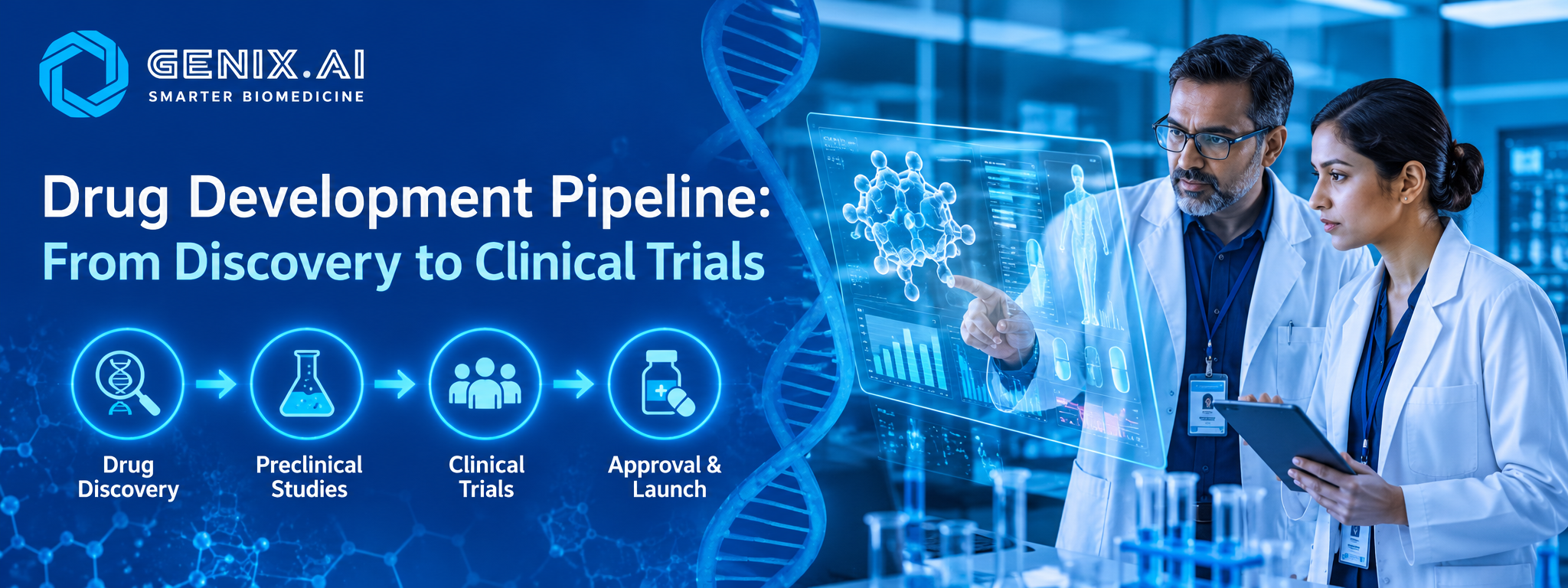
Target identification → Docking and screening → Molecular dynamics → Biomarkers and patient stratification → Regulatory reportYou don’t need to buy the whole line at once. Pick one step, test it on one target or one cohort, and judge the result before scaling. For the wider picture,see the drug development process explained.
Conclusion
AI will not replace scientists, but it can stop good ones from spending months on weak leads. Genix.ai supports pharma teams through its BioCompute services, from target identification and docking all the way to biomarker discovery and regulatory documentation. Engagements start from $15K, a mutual NDA is signed before any data is shared, and a paid pilot is available for first projects. Pharma and biotech teams can explore the pharma and biotech page or request a confidential briefing on the pharma computational biology page.
FAQ’s
1. How does AI help in drug development?
It filters targets and candidates early so teams spend lab time on the strongest options.
2. Can AI replace clinical trials?
No, it improves planning and selection, but trials are still needed to prove safety and effect.
3. What is the biggest challenge of using AI in pharma?
Poor or biased data, because a model can only be as reliable as what it learns from.
4. Is proprietary data safe with an outside partner?
It should be, provided an NDA is signed first and storage and deletion terms are clear.
5. How should a pharma company begin?
Start with a small paid pilot on one target or cohort before committing to a larger project.