Abstract
Around nine in ten drug candidates that enter human trials never reach patients, and the road behind that number usually takes more than a decade. Most people never see any of it. This guide walks through the full drug development pipeline in plain language, from the first idea about a disease target to the final trial results, and shows where better data is starting to improve the odds.
Why the Drug Development Pipeline Takes So Long
1. A Decade of Work Behind Every Medicine
Drug development is slow on purpose. Each step answers a safety or effectiveness question before a larger group of people is exposed to any risk. Common estimates put the whole journey at 10 to 15 years. An often quoted industry figure says thousands of compounds are screened for every medicine that finally reaches a pharmacy shelf. That sounds wasteful until you think about what is at stake.
2. Why Most Candidates Fail
Most failures come down to a simple split. Either the drug does not work well enough in patients, or it is not safe enough. Sometimes the molecule itself is the culprit because it never reaches the right tissue. Catching these problems early saves years of effort, and that is the whole logic of the pipeline. For a wider look at the hurdles, see challenges and future trends in drug development.
The Discovery Stages
1. Target Identification and Validation
Everything starts with a biological target, usually a protein that plays a part in a disease. Researchers dig through genetic studies and patient samples to find one worth chasing. Validation follows. Scientists switch the target off or alter it in cells and animals to see whether the disease behaviour really changes. Published analyses suggest that targets backed by human genetic evidence are roughly twice as likely to succeed in trials, which explains the attention this step gets. Many teams read those genetic signals with next generation sequencing.
2. Hit Discovery and Lead Optimization
With a target in hand, chemists hunt for molecules that bind to it. Libraries can hold millions of compounds, so computers do the first round of sorting. Molecular docking predicts how a molecule fits into a protein pocket before anyone orders a chemical. The strongest hits become leads, and chemists then adjust them to improve potency and safety.
Preclinical Testing Before Any Human Dose
1. Lab and Animal Studies
Before a person takes a single dose, the lead candidate is tested in cells and in animals. Researchers study how the body absorbs and clears it and what harm it could cause at higher doses. Regulators expect this evidence before they allow a first human trial, so gaps here can stall everything.
2. Where Computation Earns Its Keep
Simulation now sits beside the lab bench. Molecular dynamics shows how a drug and its protein behave over time, which helps teams drop weak candidates before costly experiments begin. Computational services such as BioCompute exist for exactly this kind of early filtering.
The Clinical Trial Phases
1. Phase 1 to Phase 3 at a Glance
Human trials run in phases, and each one is bigger than the last.
- Phase 1: Typically involves 20 to 100 volunteers to evaluate the treatment's safety, dosage, and how the body responds to it. Data analysis helps identify appropriate doses and potential safety concerns.
- Phase 2: Includes up to several hundred patients to assess early signs of treatment effectiveness. Biomarker analysis helps researchers identify patients who are more likely to respond.
- Phase 3: Involves several hundred to approximately 3,000 patients to determine whether the treatment is more effective than existing care. Cohort selection and subgroup analysis help researchers understand differences in treatment outcomes.
- Phase 4: Begins after the treatment is approved and made available to the public. It involves thousands of patients to monitor long-term safety and effectiveness in real-world settings.
Patient selection matters enormously at the later phases. Genomic stratification of trial participants is one way teams try to put the right people in the right group.
2. Regulatory Review and Phase 4
After Phase 3, the sponsor submits its evidence to regulators such as the US FDA or India’s CDSCO. Approval is not the finish line. Phase 4 monitoring continues once thousands of people use the drug, because rare side effects sometimes show up only then. For a deeper stage by stage view, read this walkthrough of the drug development process in clinical research.
3. The Pipeline as a Simple Workflow
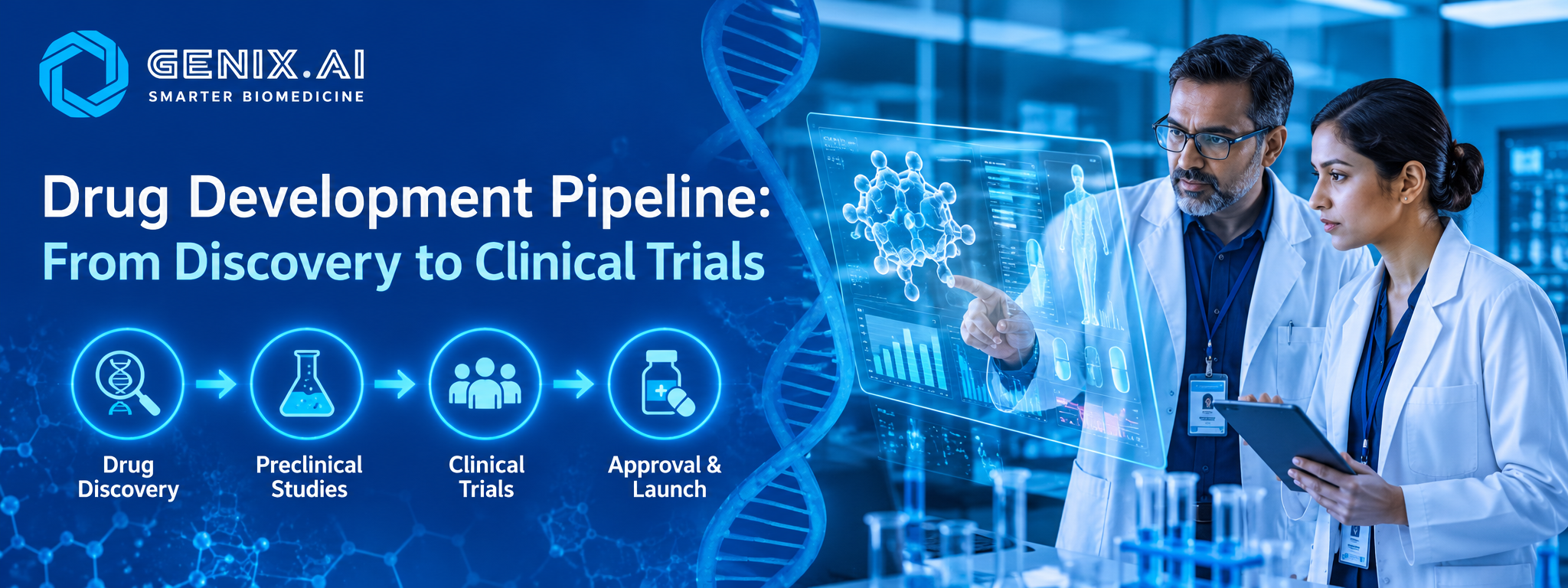
Target identification → Target validation → Hit discovery → Lead optimization → Preclinical testing → Phase 1 → Phase 2 → Phase 3 → Regulatory review → Phase 4 monitoringNotice how many exits there are. A candidate can leave the pipeline at any arrow, and most do.
A Real Example That Shows the Pipeline Working
Imatinib and Chronic Myeloid Leukaemia
Imatinib is a clear example. Scientists had linked chronic myeloid leukaemia to an abnormal protein created by a chromosome change. Once that target was understood, researchers designed a molecule to block it. Early trials showed strong responses and the US FDA approved imatinib in 2001. It remains a textbook case of what a well chosen, well validated target can do.
Where Better Data Is Changing the Pipeline
Smarter Targets and Smarter Trials
The weakest points sit at the two ends. Early on, teams can pick the wrong target. Late in the process, trials can enrol patients who were never likely to respond. Genomic data helps at both ends by pointing to targets with human evidence and by grouping participants by biology. Teams exploring this can browse the pharma and biotech solutions page or read how genomic data is accelerating pharma R&D. Building the analysis workflows behind it is its own challenge, which is where bioinformatics pipeline development comes in.
Conclusion
The drug development pipeline is long because every stage protects the next group of people it touches. Targets are chosen and molecules are tested. Trials then grow from a handful of volunteers to thousands of patients. Knowing that map makes news about new treatments far easier to read.
Genix.ai builds a genomics platform for pharma and biotech teams that connects genomic data, biomarker analysis and clinical evidence, from early target identification to trial readiness. Its workflow runs from data integration through analysis to expert review and insight delivery, with explainable outputs and flexible deployment for sensitive data. If your team wants to see how that fits your programme, you can request a demo.
FAQs
1. How long does drug development take?
Most programmes run 10 to 15 years from the first target to an approved medicine.
2. What is target identification?
It is the search for a protein or gene that plays a real part in a disease and could be changed by a drug.
3. Why do so many drugs fail in clinical trials?
Most fail because they are not effective enough or not safe enough in people.
4. What is the difference between Phase 2 and Phase 3?
Phase 2 looks for early signs of benefit while Phase 3 confirms it in a much larger group against current care.
5. Can computers speed up drug development?
They speed up sorting and prediction in the early stages but they cannot replace trials in people.