Abstract
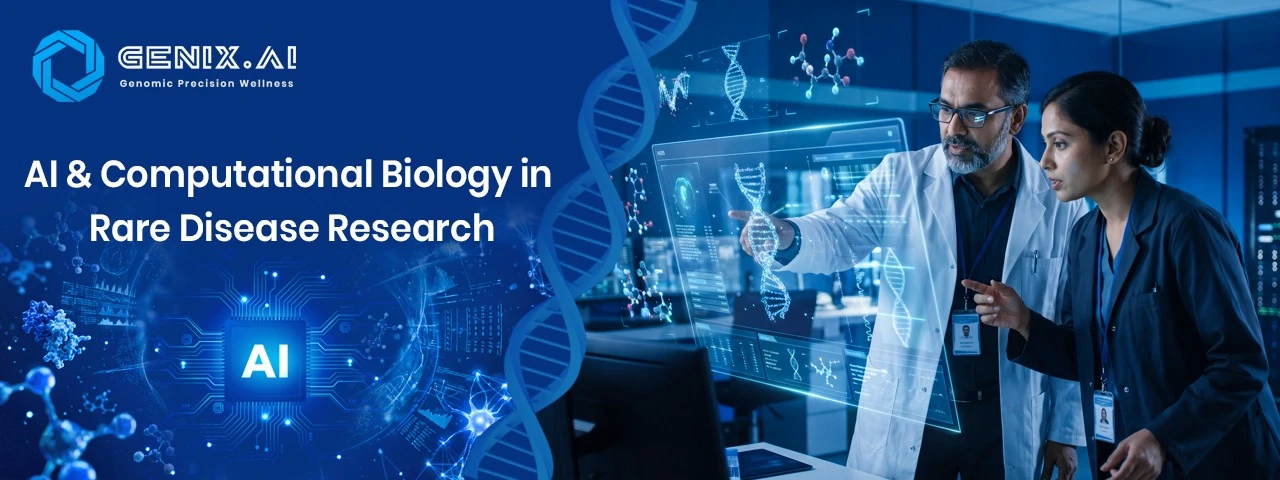
For most rare diseases, the problem is not that nobody cares. It is that the data is thin. A condition may affect a few hundred people spread across the world, so no single clinic sees enough cases to spot a pattern. Computational biology, helped by AI, changes the maths by pooling what is known and predicting what is not. This article looks at where these tools help in rare disease research, a real example of prediction at scale, and the limits every reader should keep in mind.
Why Rare Disease Research Needs Computers
1. Few Patients, Lots of Data
A rare disease affects only a small number of people, yet thousands of them exist and about eight in ten have a genetic cause. Each patient produces a huge amount of data, but each disease offers few patients to compare. That is exactly the kind of problem computing handles well, because it can combine small clues from many places.
2. Computational Biology and AI in Plain Words
Computational biology builds models and simulations to predict how living systems behave. AI, and machine learning in particular, finds patterns in large datasets. They work as a pair. The models give patterns a biological meaning, and the patterns give the models something to learn from. If you want the fuller picture, our article on computational biology versus bioinformatics draws the line between the two fields.
Where AI and Computational Biology Help in Rare Disease Research
1. Spotting the Causal Variant
A genome carries millions of differences, yet only one or two may explain a rare disease. Software filters and ranks variants, and AI models now help score how damaging they are. The average person carries more than 9,000 missense variants, which are changes that swap one amino acid in a protein, and most of them are harmless. Sorting the few that matter from the rest is the first big job.
2. Predicting Protein Shape and Behaviour
Once a gene is implicated, the shape of its protein often explains why things go wrong. Prediction tools can now estimate that shape from sequence alone, and the AlphaFold database holds more than 200 million predicted structures. Our post on AlphaFold3 and protein intelligence looks at what this means for clinical genomics.
3. Finding Treatments for Tiny Patient Groups
Developing a drug for a few hundred patients is costly, so any shortcut helps. Computational methods can test how candidate molecules fit a target before anyone orders a chemical, and they can ask whether an existing drug might suit a new target. Molecular docking is one such method, and our molecular docking page explains how it is used.
A Case Study in Prediction at Scale
1. What AlphaMissense Showed
In 2023 DeepMind released AlphaMissense, a model built on AlphaFold that scores missense variants. It looked at all 71 million possible missense variants in human proteins. At a setting chosen for 90 percent precision, it classed 89 percent of them, with 57 percent likely benign and 32 percent likely pathogenic. The rest stayed uncertain.
Before this, experts had confirmed only about 0.1 percent of those variants. The team also worked with Genomics England to check the predictions against real data, and the results were consistent.
2. What It Does Not Do
The authors describe it as a tool that complements existing clinical methods and does not replace them. It also does not predict how a change reshapes the protein. A prediction is a lead for a scientist, and the final call still belongs to evidence and clinicians.
From Data to Decisions
1. The Workflow in Plain Steps
Here is how the pieces usually fit together.
Patient sequencing data -> Cleaning and variant calling -> Annotation and AI scoring -> Candidate gene and protein modelling -> Docking or simulation of possible treatments -> Laboratory testing and clinical reviewNotice that the lab and the clinic sit at the end and not the beginning. Computing narrows the field so that costly experiments go where they are most likely to pay off. Our look at how computational biology can accelerate drug discovery and development walks through that loop in more detail.
2. Making AI Trustworthy
A model nobody can explain is hard to trust in medicine. Clear reasoning, honest uncertainty and checks for population bias all matter. Our posts on explainability, data privacy and bias in healthcare AI and on guardrails for AI in medical research explain why.
Conclusion
Computational biology and AI will not replace the lab bench, but they help rare disease research spend its limited time and money wisely. Genix.ai offers this through BioCompute, a service that pairs NGS data analysis with protein modelling and docking and also builds custom pipelines. Its Pharma Computational Biology page lists turnaround times such as five to ten days for a docking campaign and seven to fourteen days for a molecular dynamics run. The Pharma and Biotech solution adds biomarker discovery and patient stratification with explainable outputs, and teams can also start with the NGS data analysis service. To talk through a project, request a demo.
FAQ's
1. What is computational biology?
It uses computer models and data analysis to understand and predict how living systems work.
2. How does AI help with rare disease research?
It finds patterns in large datasets and helps rank which genetic variants are likely to cause disease.
3. Can AI diagnose a rare disease on its own?
No, its predictions are leads that clinicians and laboratory evidence must confirm.
4. Why are rare diseases so hard to study?
Each one affects few people, so there is little data to compare.
5. Does computational work replace laboratory testing?
No, it narrows the options so lab and clinical testing can focus on the best candidates.