Abstract
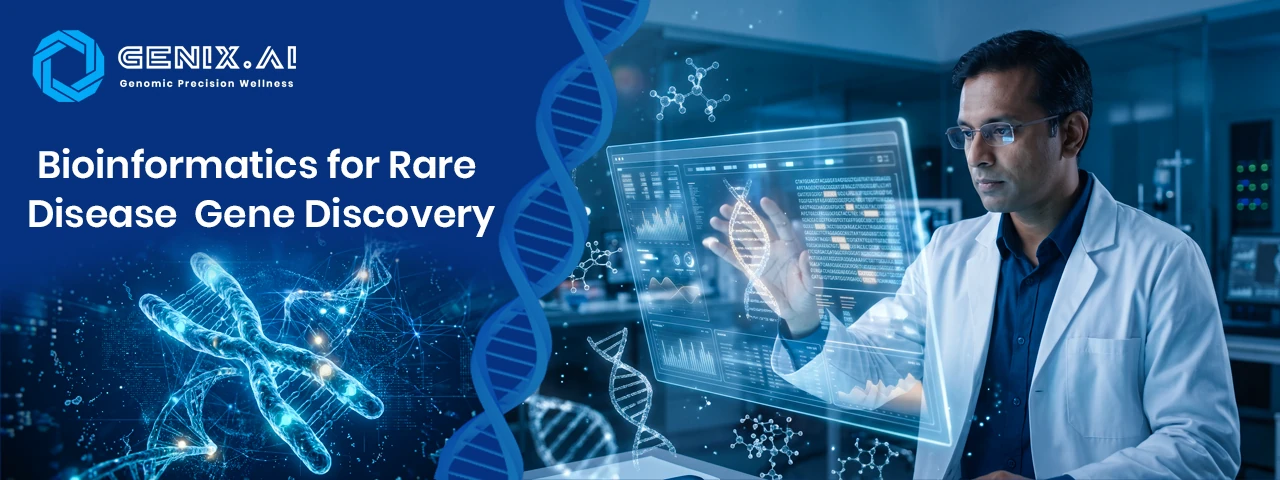
A human genome holds about three billion letters of DNA, and any two people differ at roughly one in every thousand of them. That sounds tiny until you realise it still leaves millions of differences in a single person’s data. Somewhere in that pile may sit the one change behind a child’s rare disease. Bioinformatics is the craft of finding it. This article explains how researchers move from raw sequencing files to a short list of suspect variants, where the method works well, and where human judgement still has to take over.
Why Finding the Right Variant Is So Hard
1. A Needle in a Very Large Haystack
Every person carries roughly four to five million differences compared with the standard reference genome. Almost all of them are harmless. Only a tiny handful, sometimes just one, drives a rare disease. Thousands of rare diseases are known and about eight in ten have a genetic cause, so the search matters to a lot of families. Nobody can read that many differences by eye, which is why bioinformatics sits at the centre of the work.
2. What Bioinformatics Actually Is
Put simply, bioinformatics uses software and statistics to make sense of biological data. It overlaps with computational biology, though the two are not identical, as our piece on computational biology versus bioinformatics explains. In variant work, bioinformatics cleans the data, lines it up against a reference, spots the differences and helps rank which ones matter.
How Researchers Go From Raw Reads to Candidate Variants
1. The Workflow in Plain Steps
Most people imagine a single button that returns a diagnosis. In practice there is a chain of steps, and each one removes noise.
Raw sequencing files
↓
Quality control and trimming
↓
Alignment to a reference genome
↓
Variant calling
↓
Annotation against public databases
↓
Filtering and ranking
↓
ACMG classification and expert review
The early stages follow the validated workflow described on our next generation sequencing analysis page. The later ones decide whether a result is useful or just noise. For a technical walk through, see our DNA sequencing data analysis guide.
2. Where Annotation Comes In
Calling a variant only says it exists. Annotation says what it might do. Software checks whether the change falls inside a gene, alters a protein or sits in a region known for trouble, then compares it with public resources such as ClinVar and gnomAD. ClinVar collects reports linking variants to health effects, while gnomAD shows how often a variant turns up in large groups of people. A change seen in many healthy people is rarely the cause of a rare disease.
Filtering Strategies Researchers Rely On
Why Population Context Matters
Frequency filters are only as fair as the databases behind them. Many large datasets lean toward European ancestry, so a variant that is common in South Asian families may look rare and get flagged wrongly. The NGS page mentions South Asian population frequency integration in its clinical genomics platform, which speaks to exactly this gap. Our page on bias and population intelligence goes into the wider issue.
A Case Study That Proved the Method
Miller Syndrome and a Single Gene
In 2010 a research team sequenced the exomes of four people from three families affected by Miller syndrome, a rare condition that shapes the face and limbs. Instead of hunting through every gene, they filtered out variants already seen in public databases and kept only changes that were new and likely to alter a protein. That narrowed the field to one gene, called DHODH.
It was a landmark moment for exome sequencing and careful filtering, and the same logic still powers variant work today. The tools are faster now, but the thinking has not changed.
Classifying What You Find
1. From Suspicious to Pathogenic
Once filtering is done, each candidate gets a grade. The widely used ACMG and AMP guidelines sort variants into five groups, running from pathogenic and likely pathogenic through uncertain significance to likely benign and benign. The middle group is the awkward one. An uncertain variant is not a diagnosis, and it can be reclassified as evidence grows.
2. Why Pipelines Need to Be Repeatable
A finding nobody can reproduce is hard to trust. Versioned workflows and documented settings let another team rerun the analysis and get the same answer. Our guide to building scalable bioinformatics pipelines covers how research teams keep that discipline as projects grow.
3. What Bioinformatics Cannot Do
Software narrows the search but it cannot prove cause. A promising variant still needs a clinician who knows the patient, and sometimes lab work to test its effect. Some causes also hide in places that basic analysis handles poorly, such as large structural changes. Good pipelines report copy number and structural variants as well, and a negative result is worth revisiting later as knowledge improves. For a broader look at the field, our post on the role of bioinformatics in genome sequencing and genetic research is a useful companion.
Conclusion
Bioinformatics turns an overwhelming genome into a short, reasoned list, and that shortens the road from sequencing data to an answer for rare disease families. Genix.ai supports researchers and clinicians on that road. Its NGS data analysis service takes WGS and WES files from raw reads through to ACMG classification, with annotation against ClinVar and gnomAD, copy number detection and a filtered variant report among the deliverables. Turnaround is listed from three to seven days across assays, and teams that already hold a VCF can ask for interpretation alone. Groups needing something bespoke can explore pipeline development, and the Bioinformaticians solution is aimed at people who work with this data every day. To see how it fits your project, request a demo.
FAQ's
1. What is bioinformatics in simple terms?
It uses software and statistics to make sense of biological data such as DNA sequences.
2. What is a genetic variant?
A variant is a spot where a person’s DNA differs from the reference sequence.
3. Why are most variants filtered out?
Most are common and harmless, so removing them leaves a short list of real suspects.
4. What does uncertain significance mean?
It means current evidence cannot say whether the variant causes disease, and it may be reclassified later.
5. Can bioinformatics alone diagnose a rare disease?
No, a clinician must review the findings alongside the patient’s symptoms and history.