Drug discovery carries a difficult truth science can still fail late, after years of spending. A molecule may look strong in the lab, only to show weak efficacy, safety concerns, or poor patient fit during trials. For pharma and biotech teams, that failure affects budgets, timelines, investor confidence, and access to treatment.
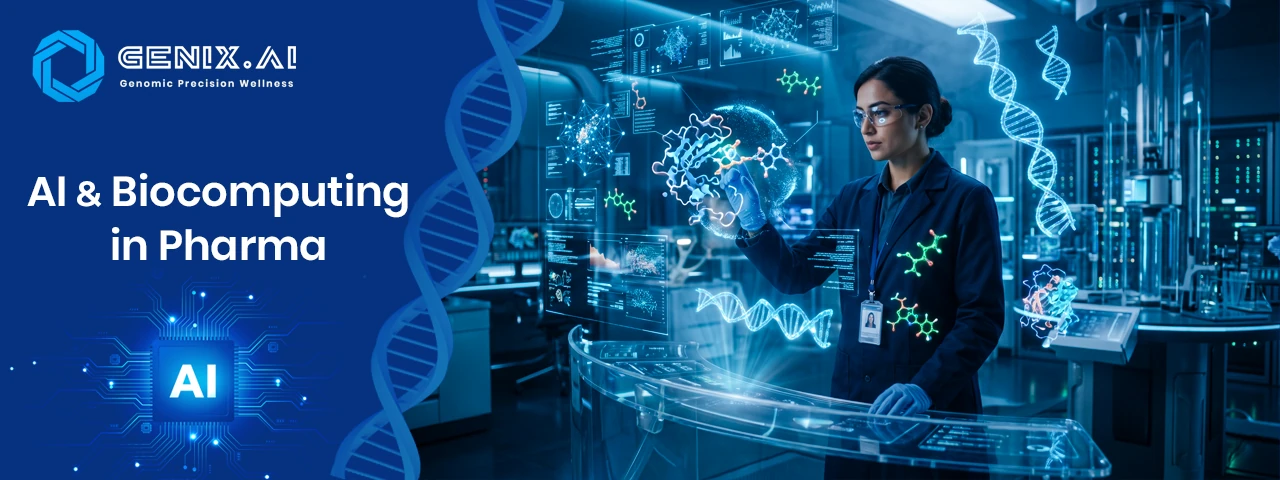
This is where AI in the pharmaceutical industry research is becoming more relevant. When artificial intelligence is paired with genomic platforms, teams can study disease biology earlier, select stronger targets, and design trials around patients who are more likely to respond.
Abstract
Drug development has a costly problem. Science can look promising for years, only to fail late, after the budgets are spent, the timelines are set, and investor confidence is on the line. This blog explores how AI in the pharmaceutical industry is starting to change that story, especially when paired with genomic platforms. Instead of starting with a hunch and years of lab validation, teams can now start with what human biology already shows, including DNA sequencing, gene expression, and biomarker data, to prioritise stronger drug targets, design trials around patients who are more likely to respond, and catch safety risks earlier. For India, where genetic diversity is high, this shift matters even more since insights from one population rarely apply cleanly to another. The piece breaks down exactly where AI reduces waste across the pipeline, from target discovery to trial design, and makes the case that the real win isn't replacing scientists, but giving them clearer evidence before the most expensive decisions are made.
Why Drug Development Costs So Much
Drug development is costly because it is built around uncertainty. Many clinical candidates still fail before approval.
The largest cost driver is not one lab experiment. It is the repeated cycle of testing ideas that later prove unsuitable. Common reasons include:
- The disease target is not central to the condition.
- A compound works in models but not in humans.
- Side effects appear at higher doses.
- The trial includes mismatched patient groups.
- Data arrives too late to change the study design.
The use of AI in pharmaceutical industry workflows is gaining attention. AI can scan large datasets faster than manual review, but its value depends on good biological inputs. Genomic data is one such input because it links drug research to inherited variation, gene activity, disease pathways, and patient subgroups.
How Genomic Platforms Change the Starting Point
Traditional drug discovery often begins with a disease area, a suspected target, and years of laboratory validation. Genomic platforms ask a sharper question: what does human biology already tell us?
A genomic platform may bring together DNA sequencing, gene expression, biomarker data, clinical records, and research. AI models then look for patterns across this information.
This supports teams in three ways:
- It can identify genes or pathways strongly linked to disease.
- It can highlight patient groups with shared biological traits.
- It can reveal safety signals linked to certain variants.
If genetic evidence shows that a pathway is active in a patient subgroup, researchers can prioritise targets connected to that pathway. In India, where population diversity is high, such analysis matters because findings from one group may not apply equally to another.
Where AI Reduces Cost Across the Pipeline
The applications of AI in pharmaceutical industry research are not limited to one stage. Cost savings come from smaller gains.
Stage | How AI and genomics can reduce waste |
Target discovery | Prioritises disease linked genes and pathways before heavy lab spend. |
Lead selection | Filters compounds for activity, toxicity, and developability earlier. |
Biomarker strategy | Finds measurable signals that show whether a drug is working. |
Trial design | Matches patients by biology, not broad symptoms alone. |
Safety review | Flags genetic factors that may raise adverse reaction risk. |
Ending a poor programme before a large trial is often more valuable than making one experiment faster.
AI Driven Target Discovery
A drug target should have a clear role in disease. If that role is weak, even a well designed molecule may fail. Genomic platforms can compare genetic variants, disease associations, protein networks, and patient data to rank targets by biological confidence.
This is one of the strongest areas of AI driven drug discovery. AI can connect signals that would be difficult to review manually, such as rare variants, gene expression changes, and pathway interactions. Scientists still need to validate the finding, but they start with a shorter, better ranked list.
Target selection influences everything that follows. A poor target can waste years of chemistry, toxicology, and trial investment. A stronger target may not ensure success, but it improves the odds before large budgets are committed.
Better Trial Design Through Patient Stratification
Clinical trials become expensive when they are too broad. Many diseases, including cancer, diabetes, autoimmune conditions, and neurological disorders, contain subtypes that look similar in symptoms but differ biologically.
Genomic platforms support patient stratification. Patients can be grouped by biomarkers or variants linked to drug response. For Indian pharma and biotech teams, this is relevant because India has wide genetic diversity and a clinical research base.
Better stratification can improve the chance of detecting true efficacy, reduce noise in trial results, support smaller study groups, reduce exposure for patients unlikely to benefit, and strengthen evidence for regulators and clinicians.
This is a major reason AI in drug development is moving beyond discovery and into clinical planning.
Faster Biomarker Discovery
Biomarkers are measurable signs that show what is happening inside the body. They may include a gene variant, protein level, or expression pattern. In drug development, biomarkers can show whether a medicine is reaching the right pathway or whether a patient is likely to respond.
AI can search genomic and clinical datasets to find biomarker candidates. These markers can then guide trial inclusion, dose decisions, and response monitoring.
When teams know what to measure early, they can make faster go/no go decisions. They can also design trials that answer sharper questions, rather than waiting years for broad clinical outcomes alone.
What Pharma and Biotech Teams Should Watch
The use of artificial intelligence in the pharmaceutical industry can sometimes sound bigger than reality. AI is useful, but it is only as reliable as the data, validation, and governance behind it.
Teams should assess data quality, diversity, explainability, clinical relevance, data security, regulatory readiness, audit trails, and human review.
Poorly trained models can create false confidence. A model trained mainly on non Indian datasets may miss signals relevant to Indian patients. This is why population aware genomic intelligence is becoming essential.
The India Opportunity
India is well placed for genomic led pharma innovation. The country has strong pharmaceutical manufacturing, growing biotech capability, clinical talent, and rising interest in precision medicine. National genomic initiatives are also improving the understanding of the Indian population diversity.
For local pharma and biotech companies, the opportunity is to design research around Indian biology, disease patterns, and healthcare needs. That can improve relevance for diabetes, cardiovascular disease, cancer, rare inherited disorders, and response variability.
The Bottom Line
AI and genomic platforms are not magic buttons for affordable medicines. Drug development will remain complex, regulated, and evidence heavy. Yet they can change where money is spent.
By improving target selection, molecule screening, biomarker discovery, and patient stratification, genomic platforms can reduce late stage surprises.
They allow pharma and biotech teams to ask better questions earlier, test stronger hypotheses, and move resources away from programmes with weak biological support.
That is the real promise of AI in pharmaceutical industry innovation not replacing scientists, but giving them clearer evidence before the most expensive decisions are made.