Abstract
Whole Genome Sequencing (WGS) analysis has moved from a research curiosity to a clinical necessity. By reading every single nucleotide across all 3.2 billion base pairs of the human genome, WGS uncovers the full landscape of genetic variation, germline mutations, somatic changes, structural variants, copy number alterations, and rare pathogenic alleles that targeted panels routinely miss. When paired with AI-driven annotation engines, WGS data transforms into actionable clinical intelligence: precise disease risk, pharmacogenomic guidance, rare disorder diagnosis, and population-calibrated variant interpretation. This blog breaks down exactly what WGS analysis involves, why it outperforms alternatives, and how platforms like Genix.ai are making it accessible for researchers, hospitals, diagnostic labs, and individuals at scale.
What Is WGS Analysis and Why Does It Matter in 2026?
Whole Genome Sequencing (WGS) analysis is the computational process of aligning, processing, and interpreting raw sequencing reads generated from an individual's complete genome. Unlike Whole Exome Sequencing (WES), which covers only the protein-coding 1–2% of the genome, WGS captures intronic regions, regulatory elements, non-coding RNA loci, and structural variant breakpoints that carry significant clinical meaning.
The pipeline begins with raw FASTQ files from the NGS sequencer. These reads are aligned to a reference genome using tools such as BWA-MEM2, followed by duplicate marking, base quality score recalibration, and variant calling via GATK HaplotypeCaller or DeepVariant. The resulting VCF file is then annotated against ClinVar, gnomAD, dbSNP, and COSMIC databases, filtered by ACMG classification criteria, and delivered as a structured clinical or research report.
At 30x coverage, WGS offers sufficient depth for germline variant detection with high sensitivity. At 60x or tumour-normal pairing, it enables somatic mutation profiling relevant to oncology. The entire genome-wide view makes WGS the gold standard for rare disease diagnosis, hereditary cancer risk assessment, and precision medicine programme design.
WGS vs WES When Whole Genome Wins
The debate between WGS and WES comes down to completeness versus cost. WES is cheaper but structurally blind it cannot detect large deletions, inversions, copy number variants, or intronic pathogenic variants with reliability. Studies show that 25–30% of clinically significant findings in rare disease patients lie outside the exome entirely. In paediatric rare disease panels, diagnostic yield has been shown to increase by up to 20% when WGS replaces WES as the primary sequencing strategy.
WGS also eliminates the capture bias inherent to exome kits, delivering more uniform coverage across GC-rich regions and complex loci like HLA, repeat-expansion zones, and imprinted regions. For cancer genomics, only WGS reveals the full mutational signature landscape essential for immunotherapy eligibility and tumour evolution tracking.
Genix.ai's BioCompute WGS analysis service supports both 30x germline and tumour-normal WGS workflows, starting at $300 per sample for 50+ sample batches, with a 5–7 day turnaround including annotated VCF, CNV detection, IGV screenshots of key variants, and a publication-ready methods section.
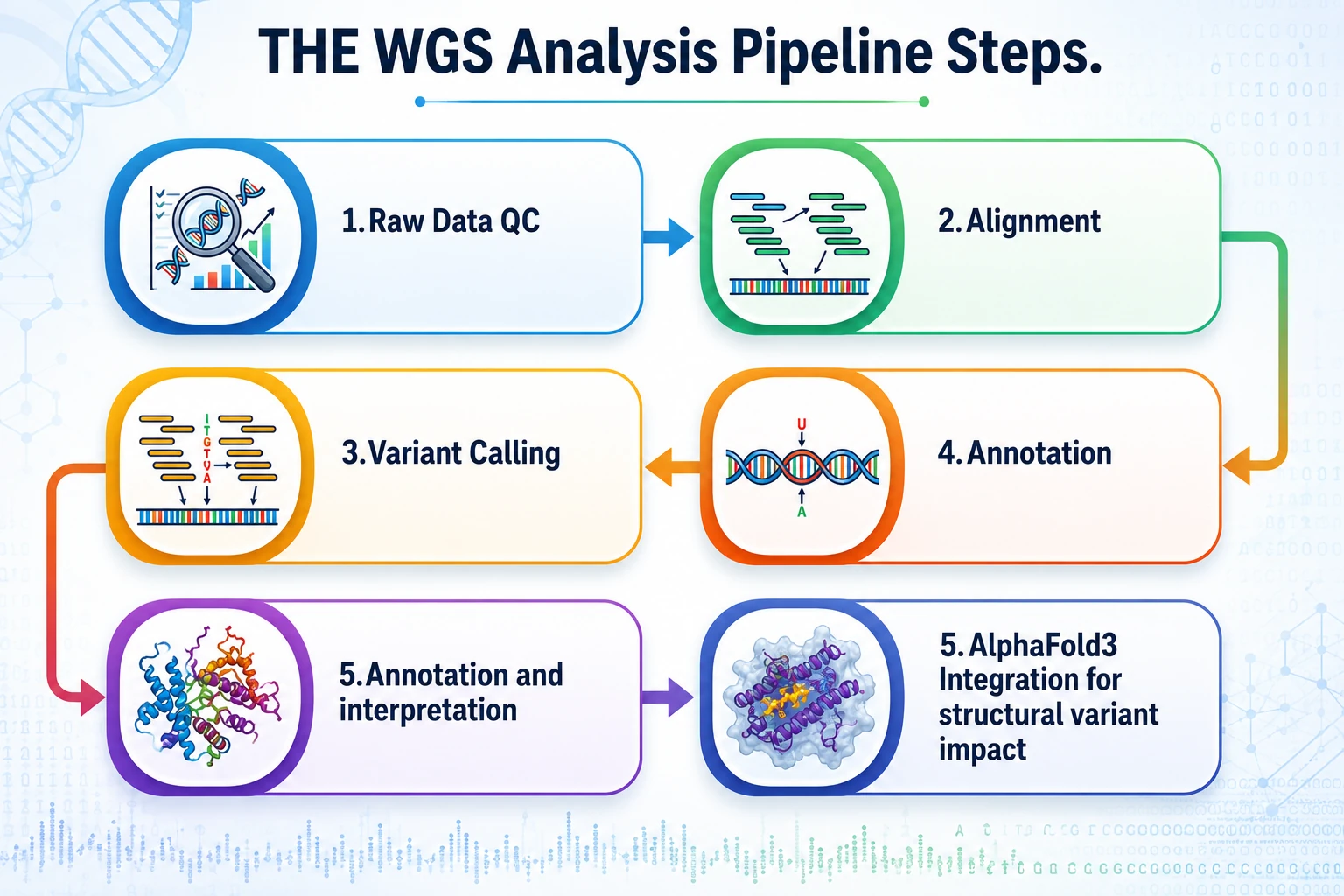
Step 1 Raw Data QC
FASTQ files are assessed using FastQC and MultiQC. Adapter trimming and quality filtering remove low-confidence reads before alignment, ensuring downstream results are not contaminated by sequencing artifacs
Step 2 Alignment
High-quality reads are aligned to GRCh38 (or any custom reference genome) using BWA-MEM2, the current standard for short-read alignment. Long-read data from Oxford Nanopore or PacBio is handled via Minimap2 Genix.ai supports both platforms.
Step 3 Variant Calling
Germline variants are called using GATK HaplotypeCaller in GVCF mode or DeepVariant. Somatic variants in tumour-normal paired samples use Mutect2. Structural variants are called using DELLY or Manta, while CNVs are detected via CNVkit or GATK's gCNV pipeline.
Step 4 Annotation and Interpretation
Every identified variant is annotated using ANNOVAR or Ensembl VEP, cross-referenced against ClinVar, gnomAD v4, COSMIC, and OMIM. ACMG/AMP criteria are applied for pathogenicity classification separating pathogenic, likely pathogenic, VUS, likely benign, and benign calls. Genix.ai's AI Clinical & Annotation engine adds an additional population intelligence layer calibrated for South Asian allele frequencies, reducing VUS overcalling that occurs with Western-centric databases.
Step 5 AlphaFold3 Integration for Structural Variant Impact
When a missense or novel variant is identified in a protein-coding gene, AlphaFold3 (Artificial Intelligence-Powered Protein Structure Prediction System, Version 3) predictions can be integrated to assess structural impact at the protein expression or function level. This layer is particularly valuable for VUS reclassification, a mutant protein structure that diverges significantly from the wild type,and also add functional evidence toward pathogenicity. Genix.ai's protein structure prediction service, priced at $500 per target, can be paired with WGS findings for research-grade structural modelling.
Key Applications of WGS Analysis
Rare Disease Diagnosis: WGS is the highest-yield single test for paediatric rare disease, particularly when trios (proband + parents) are sequenced together. De novo mutations, compound heterozygotes, and recessive variants across the entire genome become visible.
Hereditary Cancer Risk: BRCA1/2, Lynch syndrome genes (MLH1, MSH2, MSH6, PMS2), and dozens of additional cancer predisposition loci are captured in full iincluding deep intronic pathogenic variants that BRCA panel tests miss.
Pharmacogenomics: WGS covers all pharmacogenes in a single run. CYP2D6, CYP2C19, CYP3A5, DPYD, TPMT, and SLCO1B1 star allele calling can be derived from a single WGS dataset, informing drug selection and dosing without repeated targeted testing. Genix Rx™ translates pharmacogenomic findings from WGS into actionable drug-gene interaction reports.
Infectious Disease and Metagenomics: Low-coverage WGS can simultaneously identify pathogen sequences in clinical samples while profiling the host genome, a single-assay diagnostic approach gaining traction in sepsis and unknown infectious disease workup.
Population and Research Genomics: Genix.ai's Research & Public Health solution supports cohort-scale WGS analysis for epidemiological studies, biobank-linked research programmes, and population frequency database development with a specific focus on South Asian genomic diversity.
Why AI Changes Everything in WGS Interpretation
Raw variant calling produces tens of thousands of variants per individual genome. Without AI-driven triage, clinical interpretation is impossible within practical timelines. Genix.ai's Genomic Intelligence Platform applies machine learning models trained on validated clinical datasets to rank variants by pathogenicity probability, flag gene-disease associations missed by keyword-based filtering, and integrate phenotype ontologies (HPO terms) to narrow differential diagnoses.
The Bias & Population Intelligence layer addresses one of WGS analysis's most persistent problems Western database bias. The gnomAD v4 is still skewed toward European ancestry, meaning South Asian, African, and East Asian allele frequencies are underrepresented. Variants common in an Indian population may be flagged as rare or pathogenic when they are in fact benign population polymorphisms. Genix.ai corrects for this with India-specific population calibration, directly reducing false-positive clinical reports.
Certified clinical geneticist review is embedded as the final step, ensuring every WGS report delivered through Genix.ai carries human expert oversight not just algorithm output.
Conclusion WGS Analysis Powered by Genix.ai
Whole Genome Sequencing analysis has crossed the threshold from research tool to clinical standard. The challenge now is not sequencing capacity, it is intelligent, fast, population-calibrated interpretation at scale. Genix.ai's BioCompute NGS platform handles the full WGS pipeline: raw FASTQ to annotated, ACMG-classified, publication-ready results in 5–7 days, with optional AlphaFold3 protein structure modelling, pharmacogenomics interpretation via Genix Rx™, and AI-powered clinical annotation calibrated for South Asian genomics.
For hospitals and diagnostic laboratories, the Genomic Intelligence Platform enables institution-scale WGS programmes with HIPAA-compliant cloud storage and FHIR R4-compatible data delivery. For researchers and bioinformaticians, Genix.ai's BioCompute service removes the compute infrastructure burden by submitting your FASTQ files, receiving reproducible results and copy-paste methods sections.
WGS is the full picture. Genix.ai is the intelligence layer that makes that picture clinically meaningful.
👉 Request a WGS Analysis Quote - Click here
FAQ
1. What is the difference between WGS and WES analysis?
WGS sequences the entire genome including non-coding regions, while WES covers only the protein-coding exome (~1–2%), making WGS more comprehensive for structural variants and rare disease diagnosis.
2. How long does WGS analysis take with Genix.ai?
Genix.ai delivers WGS analysis results in 5–7 business days from FASTQ upload, including annotated VCF, CNV detection, and a publication-ready report.
3. What sequencing platforms does Genix.ai support for WGS?
Genix.ai supports Illumina NovaSeq, Oxford Nanopore, PacBio, BGI DNBSEQ, and Ion Torrent platforms across FASTQ, BAM, CRAM, and VCF input formats.
4. How does Genix.ai handle South Asian population-specific variant interpretation?
Genix.ai's Bias & Population Intelligence layer uses India-specific allele frequency data to reduce VUS overcalling caused by Western-centric databases like gnomAD.
5. Can WGS analysis data be integrated with Genix.ai's consumer DNA reports?
Yes,WGS-derived pharmacogenomic and hereditary risk findings can inform Genix Rx™ and Genix Shield™ reports for comprehensive personalised health intelligence.