Abstract
Nine out of ten cancer drug candidates that enter clinical trials never reach a pharmacy shelf. That failure rate is expensive, slow and hard on everyone involved, from researchers to patients waiting for better treatment options. Molecular docking will not fix that number on its own, but it does something valuable earlier in the process, helping scientists spot which compounds are worth pursuing before millions get spent chasing a dead end. This blog breaks down how docking actually works, why cancer targets make it particularly useful, and where it sits within the wider computational drug discovery process.
The Real Cost Of Guessing In Drug Development
Drug discovery has traditionally relied on a lot of trial and error. Researchers synthesize a compound, test it against a target, and hope for a result worth pursuing further.
Why Cancer Makes This Harder
Cancer targets are rarely simple. A protein driving tumor growth might have several mutated forms across different patients, and a compound that binds well to one version might do almost nothing against another. This variability multiplies the number of experiments needed just to understand whether a molecule has any real potential.
Where Computational Methods Step In
Instead of testing every compound physically, researchers can now simulate the interaction first. This is where molecular docking enters the picture, offering a way to filter a large pool of candidates down to the ones actually worth synthesizing and testing in a lab.
Breaking Down What Molecular Docking Does
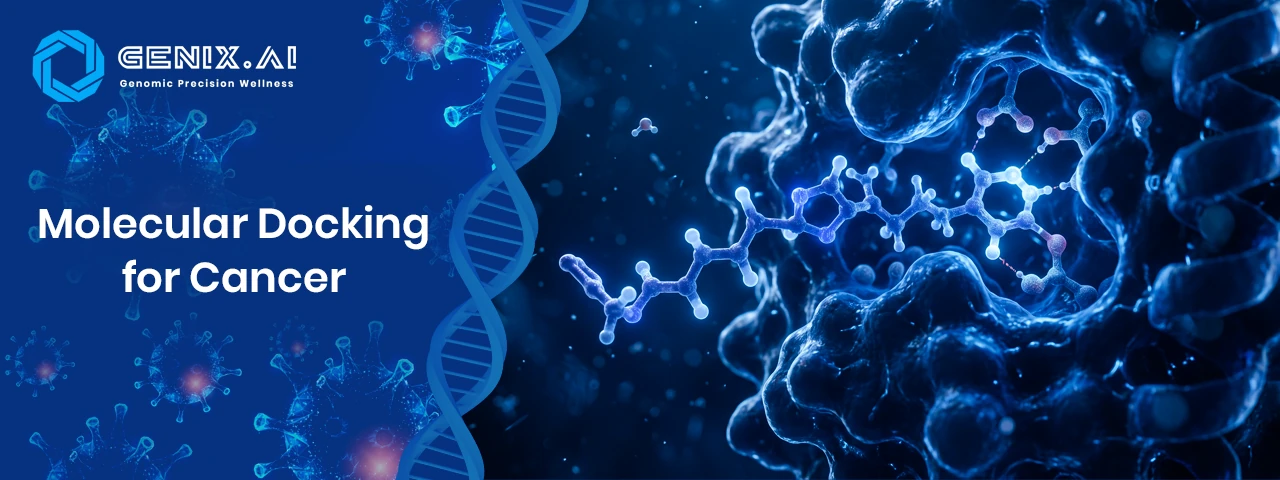
At its core, docking predicts how a small molecule fits into the three dimensional binding pocket of a target protein, and how strongly that interaction is likely to hold.
Reading The Shape Of A Protein
Every protein has a specific shape, and cancer related proteins often have binding sites shaped by mutation or structural changes tied to the disease. Docking software analyzes this shape and estimates whether a candidate molecule can settle into it correctly.
Predicting Strength Not Just Fit
A molecule might technically fit a binding pocket but still bind weakly. Docking studies also estimate binding affinity, giving researchers a rough sense of how strong that interaction could be, which helps rank candidates rather than simply sorting them into fits or does not fit.
The Role Of AI Structure Prediction
For a long time, docking depended on experimentally solved protein structures, something that took years to obtain through methods like X-ray crystallography. AI based structure prediction tools such as AlphaFold have changed that, generating usable structural models for proteins that never had an experimentally solved structure before, which has opened up docking studies for a much wider range of cancer targets.
Why Cancer Drug Discovery Leans On This Method So Heavily
Cancer research produces an unusually large number of potential drug targets, partly because so many different mutations can drive tumor growth.
Screening Large Compound Libraries Quickly
A single research project might need to test a compound library against a specific kinase or receptor associated with a tumor type. Physically synthesizing and testing every one of those molecules would take years. Docking allows that same screening to happen computationally within days, narrowing the list down to a manageable number of true candidates.
Handling Mutation Specific Targets
Because cancer proteins often mutate, a compound designed against the normal version of a protein may not work against its cancer associated mutant. Running separate docking studies against both forms lets researchers see exactly where a candidate might fail before committing further resources to it.
Supporting Combination Therapy Research
Many cancer treatments today work best in combination rather than alone. Docking can help researchers understand whether a new compound is likely to interact well with a target already being addressed by an existing therapy, which matters when designing combination regimens.
Where Docking Sits In The Bigger Discovery Pipeline
Docking is one part of a longer computational workflow, not a standalone solution.
From Target Selection To Candidate Ranking
The process typically begins with identifying a protein target tied to tumor biology. Once a structure is available or predicted, docking studies help rank a pool of candidate molecules based on predicted fit and binding strength.
Following Up With Molecular Dynamics
A docking result is essentially a snapshot, showing one possible binding pose at one moment. Molecular dynamics simulations pick up from there, modeling how that same interaction behaves over time as the protein and molecule move naturally, which gives a more realistic sense of whether the binding will actually hold up.
Connecting Structural Work To Genetic Data
Once a promising compound is identified, researchers often look at genetic and biomarker data to understand how patients with different genetic backgrounds might respond. This step is especially relevant for cancer treatment, where drug response can vary significantly from one patient to another based on their genetic profile.
What This Means For Labs Without In House Computational Teams
Not every research group has the infrastructure or specialized staff needed to run these simulations internally.
The Practical Case For Outsourcing
Setting up high performance computing resources, licensing docking software and hiring structural biology expertise is a significant investment, one that many academic labs and early stage biotech companies simply cannot justify for a single project. Outsourcing this work to a computational biology partner lets teams get results without building that infrastructure themselves.
What A Good Partner Should Offer
Reproducibility, clear turnaround timelines and the flexibility to expand from a single docking study into deeper work like molecular dynamics or full pipeline development all matter when choosing who to work with, especially since results eventually need to withstand peer review or regulatory scrutiny.
Conclusion
Molecular docking cannot replace the lab work, clinical trials or years of validation that any cancer drug still has to go through, but it does bring some much needed precision to the earliest stage of that journey. It helps researchers spend their time and budget on molecules that have a real scientific reason to succeed rather than a long list of guesses. Genix.ai offers molecular docking as part of its BioCompute service, alongside protein structure prediction, molecular dynamics simulation and custom pipeline development, supporting pharma and biotech teams working through exactly this kind of structural drug discovery work.
FAQs
1. What problem does molecular docking solve in drug discovery?
It predicts which candidate molecules are likely to bind a target protein before any lab synthesis begins.
2. Why is docking particularly useful for cancer targets?
Cancer proteins often mutate, and docking helps researchers test compound fit against multiple mutated forms quickly.
3. Does docking replace lab testing entirely?
No, it narrows down candidates, but lab based validation is still required to confirm real biological activity.
4. What comes after a successful docking result?
Researchers usually follow up with molecular dynamics simulations to see how the interaction holds up over time.
5. Can docking be done without an experimentally solved protein structure?
Yes, AI predicted structures from tools like AlphaFold now make docking possible for proteins without a solved structure.