Abstract
Whole Genome Sequencing (WGS) analysis has moved from an experimental luxury to a core requirement across academic research, clinical genomics, pharma drug discovery, and precision medicine. Yet the most consequential decision teams face is not which sequencer to buy or which variant caller to run it is whether to build and operate WGS infrastructure in-house or to outsource it to a Contract Research Organization (CRO). This blog breaks down both models across cost, turnaround time, expertise depth, scalability, and long-term ROI and explains why purpose-built bioinformatics platforms like Genix.ai are changing the calculus entirely for research teams in 2025 and beyond.
WGS Analysis In-House vs Outsourced CRO: Which Model Actually Delivers Better Results?
What Is WGS Analysis and Why Does the Delivery Model Matter?
Whole Genome Sequencing (WGS) is the comprehensive sequencing and computational analysis of an organism's complete DNA, covering all ~3.2 billion base pairs in the human genome. Unlike targeted panels or Whole Exome Sequencing (WES), WGS captures both coding and non-coding regions, structural variants (SVs), copy number variants (CNVs), single nucleotide polymorphisms (SNPs), and insertions/deletions (InDels) at full resolution.
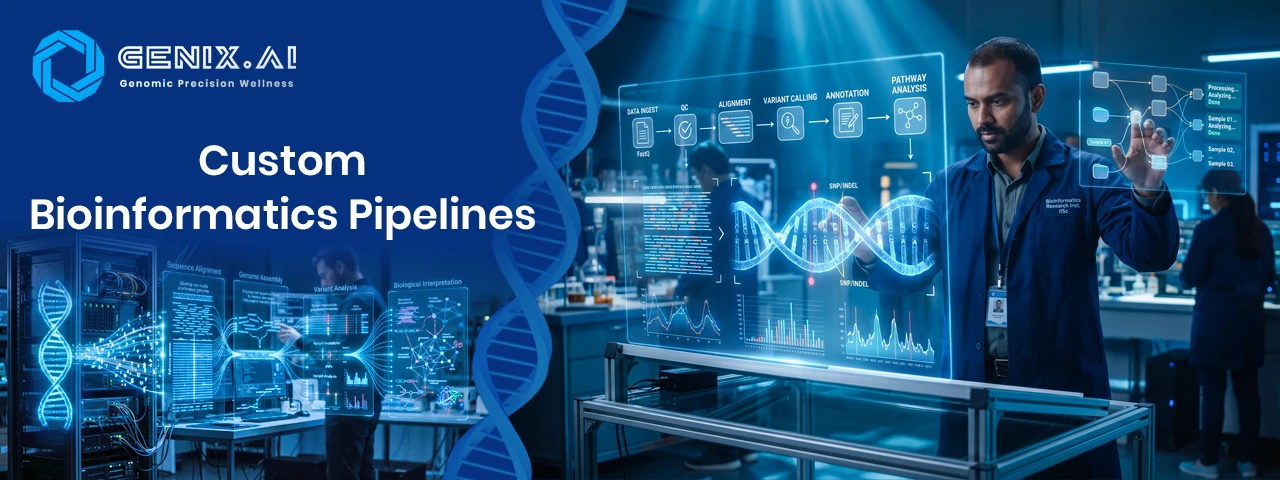
The computational pipeline that follows raw sequencing is where cost and complexity explode. A standard WGS analysis workflow runs FASTQ files through quality control (FastQC, MultiQC), alignment (BWA-MEM2), variant calling (GATK HaplotypeCaller or DeepVariant), annotation (ANNOVAR, VEP against ClinVar, gnomAD, dbSNP), ACMG pathogenicity classification, and structural variant detection producing multi-gigabyte outputs requiring expert interpretation.
The choice between running this pipeline in-house or outsourcing it to a CRO shapes everything from time-to-publication to budget allocation and scientific reproducibility.
The In-House WGS Model Full Control, Full Cost
What In-House WGS Actually Requires
Building an in-house WGS bioinformatics capability is not simply installing a few tools. It demands high-performance computing (HPC) infrastructure or dedicated cloud compute (AWS, GCP), licensed or curated reference databases, validated pipeline software (Nextflow, Snakemake), and most critically PhD-level bioinformaticians who can build, maintain, debug, and scientifically interpret the outputs.
Infrastructure costs alone run into tens of thousands of dollars annually. A single analyst's fully loaded salary in the US or EU adds $80,000–$150,000 per year. For smaller research groups, biotech startups, or academic labs with inconsistent sample volumes, the in-house model frequently means paying full-time costs for part-time capacity utilization.
When In-House Makes Sense
In-house infrastructure justifies itself when sample volumes are consistently high (100+ samples per month), when proprietary pipeline customization is a scientific necessity, or when regulatory and data sovereignty requirements make external data transfer non-negotiable. Large pharmaceutical companies, national genomics initiatives, and established academic genome centers typically fall into this category.
The Outsourced CRO Model Speed, Expertise, and Cost Efficiency
What Outsourcing WGS Analysis Delivers
Outsourced CROs like Genix.ai's BioCompute service provide a managed, end-to-end WGS analysis pipeline that begins the moment raw FASTQ, BAM, or CRAM files are transferred. The researcher does not manage and compute infrastructure, does not hire or train analysts, and does not spend weeks debugging pipeline failures.
Genix.ai's WGS/WES analysis service starts at $200 per sample, scaling to $300 per sample at 50+ samples for WGS (30x coverage) with a 5–7 day turnaround. Every deliverable includes an annotated VCF file, ClinVar and gnomAD annotation, ACMG pathogenicity classification, CNV detection, IGV screenshots of key variants, coverage and QC statistics, and a filtered variant report. A copy-paste-ready methods section is included as standard directly manuscript ready for journal submission.
The Cost Comparison That Changes Decisions
For a research team processing 20 WGS samples per year, the in-house model requires infrastructure, software licenses, and analyst time that conservatively exceeds $150,000 annually for a task Genix.ai BioCompute would deliver at under $8,000 total. Even at 100 samples annually, the outsourced model at volume pricing remains 50–70% lower than equivalent Western CRO rates.
AlphaFold3 Full Form and Integration in WGS Workflows
AlphaFold3 stands for Alpha Fold Version 3, the third generation of DeepMind's deep learning protein structure prediction system. While AlphaFold3 is primarily a protein structure tool, its relevance to WGS analysis has grown significantly: once WGS identifies a missense variant of uncertain significance (VUS) in a protein-coding gene, AlphaFold3 predictions can model how that amino acid substitution distorts the protein's three-dimensional structure providing functional evidence to reclassify the variant.
Genix.ai's BioCompute platform integrates structural prediction capabilities, including protein structure prediction services starting at $500 per target, which can be ordered in parallel with WGS variant analysis. For researchers working on rare disease genomics, oncogenomics, or pharmacogenomics, this combined approach WGS variant identification paired with structural impact modeling produces richer, clinically actionable findings than variant annotation alone.
Scalability, Turnaround Time, and Scientific Reproducibility
Scalability on Demand
In-house teams hit a ceiling when sample volumes spike common scenario in clinical trials, population studies, or multi-site research collaborations. CROs absorb volume increases without additional capital expenditure on the researcher's side. Genix.ai's infrastructure is designed for burst capacity, accepting multi-sample project uploads via SFTP, AWS S3, Google Cloud Storage, or direct cloud link.
Turnaround Time Comparison
Metric | In-House | Genix.ai BioCompute CRO |
WGS Setup Time | Weeks–Months | 0 (immediate) |
Per-Sample TAT | 2–6 weeks | 5–7 days |
Analyst Availability | Fixed headcount | On-demand |
Methods Documentation | Manual | Included |
Reproducibility and Validation
Genix.ai uses standardized, version-controlled pipelines BWA-MEM2, GATK, DeepVariant, ANNOVAR, VEP ensuring that two samples analyzed six months apart are processed identically. Every deliverable includes raw analysis files and reproducible R/Python code. In-house teams frequently face reproducibility gaps when analysts change tools, update reference genome versions, or switch pipeline parameters without systematic documentation.
Data Privacy, Compliance, and IP Protection
A recurring concern with outsourced WGS analysis is data security. Genix.ai addresses this directly NDA execution precedes any data transfer, all files are stored on encrypted servers with access restricted to assigned analysts, and data is deleted upon project completion upon request. Researchers retain 100% ownership of all results, code, and deliverables,no authorship requirements, no intellectual property claims.
Genix.ai's security architecture aligns with HIPAA compliance standards, making it suitable for research teams operating under institutional data governance frameworks.
The Genix.ai BioCompute Advantage for WGS Analysis
Genix.ai is not a generic sequencing vendor, it is an AI-native clinical genomics platform whose BioCompute division is purpose-built for research teams that need rigorous WGS analysis without the operational burden of running their own infrastructure.
Key differentiators that matter for WGS specifically:
PhD-level review on every deliverable : Every WGS analysis result is reviewed by a PhD bioinformatician before delivery not a junior analyst running automated scripts.
South Asian population frequency integration : Genix.ai's Bias & Population Intelligence layer incorporates population-specific variant frequencies, a critical accuracy advantage for research involving South Asian cohorts, where gnomAD data remains underrepresented.
Clinical-grade annotation : For teams working at the research-clinical interface, Genix.ai's AI Clinical & Annotation Engine adds a clinical interpretation layer that standard bioinformatics CROs do not provide.
Integrated multi-omics : WGS analysis can be paired with RNA-Seq ($150/sample), molecular docking ($1,000), MD simulations ($2,000/run), or custom pipeline development ($5,000) making Genix.ai a single-vendor solution for complex, multi-modality research projects.
Conclusion The Right Model for the Right Research Stage
The in-house vs outsourced CRO decision for WGS analysis is not ideological it is operational. Early-stage researchers, growing biotech teams, academic labs with variable sample volumes, and pharma discovery teams running targeted studies all benefit from the cost efficiency, speed, and expert depth that an outsourced CRO model delivers.
Genix.ai's BioCompute service brings publication-ready WGS analysis starting at $200 per sample, with 5–7 day turnaround, PhD-reviewed deliverables, full NDA protection, and a manuscript-ready methods section included as standard. For teams considering whether to build or buy their WGS capability, the numbers are unambiguous at most sample volume levels.
Request a free WGS analysis quote from Genix.ai at genix.ai/biocompute and receive a clear, itemized quote within 24 hours.
FAQs
Q1. What does WGS analysis include when outsourced to Genix.ai?
Genix.ai delivers QC, alignment, variant calling, ACMG classification, CNV detection, annotated VCF, IGV screenshots, and a manuscript-ready methods section.
Q2. How much does WGS analysis cost at Genix.ai BioCompute?
WGS (30x) starts at $400/sample, scaling to $300/sample at 50+ samples, with all analysis and deliverables included.
Q3. How long does outsourced WGS analysis take at Genix.ai?
Standard turnaround for WGS analysis is 5–7 business days from file receipt.
Q4. Is my genomic data safe when outsourced to a CRO like Genix.ai?
Yes, Genix.ai signs an NDA before data transfer, uses encrypted servers, and deletes data on project completion upon request.
Q5. Can Genix.ai combine WGS analysis with protein structure prediction?
Yes, WGS variant analysis can be paired with AlphaFold3-based protein structure prediction starting at $500 per target through the BioCompute platform.