Abstract
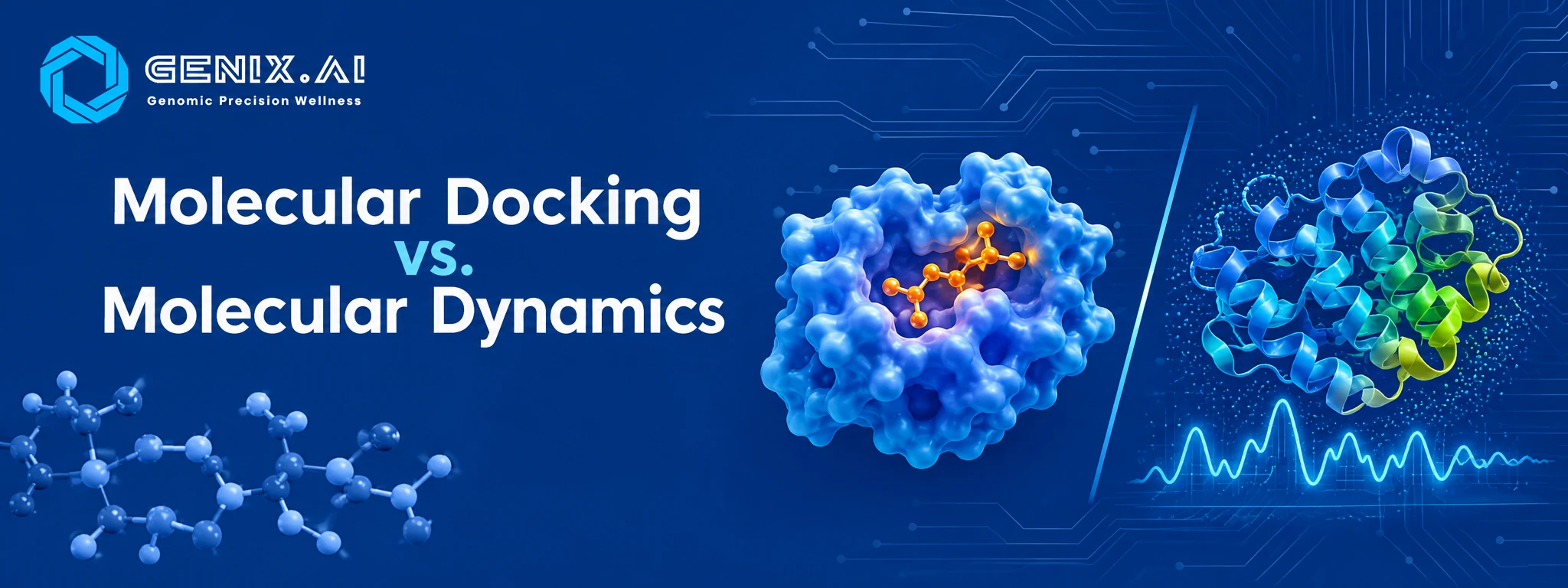
A photograph and a video can show the same scene, yet they answer very different questions. Drug discovery has the same split. Molecular docking takes a quick photograph of how a drug candidate sits inside a protein, while molecular dynamics films what happens next. Most candidates that reach clinical trials never win approval, so any method that screens out weak ones early earns its place. Teams that confuse the two either waste weeks simulating weak candidates or trust a single snapshot far too much. This article explains what each method does, where each one falls short, and why the best drug discovery projects use them as a pair.
Two Methods That Ask Different Questions
1. Docking gives you the snapshot
Docking asks a simple question. Where does this molecule fit, and how well? The software tries many positions inside the protein pocket, scores each one, and returns a ranked list. Because the protein is treated as mostly rigid, the job is quick, which is why docking can chew through thousands of compounds in a single campaign.
2. Molecular dynamics gives you the movie
Molecular dynamics, often shortened to MD, asks a harder question. Does that fit last once everything starts moving? The program calculates how every atom pushes and pulls on its neighbors over tiny time steps, then strings those steps together into a trajectory. Real proteins wobble, and water gets in the way, so this view is much closer to life inside a cell.
3. Reading the results
The outputs look different, so they need different eyes. A docking score is an estimate of binding strength, and it only makes sense next to the pose that produced it. In MD, RMSD shows how far the complex drifts from its starting shape, and RMSF shows which parts of the protein wobble the most. Binding free energy methods then give a more physical ranking of the finalists. A ligand that sits calmly through a long run earns far more trust than one that slides out of the pocket.
Why Drug Discovery Uses Both
1. The funnel logic
Computing time is not free, so teams spread it wisely. A common funnel docks everything first, keeps roughly the top one to five percent, and sends only those hits to deeper checks. MD then tests whether the surviving complexes stay stable. This order saves money because the expensive method only touches candidates that already earned the attention.
2. What each one can miss
Docking can overlook flexibility and the role of water, so a high score does not always mean a lasting fit. MD has its own blind spot. It cannot sensibly screen a huge library, and it depends on its starting pose. If docking placed the molecule badly, the simulation begins from a bad place. That is exactly why avoiding common molecular docking mistakes matters before any simulation starts.
A Real Example and a Typical Workflow
1. A published case
A 2026 study in ACS Physical Chemistry Au explored repurposing HIV protease inhibitors against the West Nile virus protease made of the NS2B and NS3 proteins. The researchers used AutoDock Vina for docking and then ran molecular dynamics, and they stressed that static docking alone can miss unstable binding that simulation reveals.
2. The workflow in five steps
Here is how a combined project usually flows.
- Choose the target and build a validated 3D structure if none exists.
- Dock the compound library and rank the poses.
- Keep the top slice and study the best poses by eye.
- Run molecular dynamics on the finalists and read the stability plots and binding free energy.
- Profile drug likeness and toxicity, then write the ranked report.
Choosing Between Them
1. When docking alone is fine
Early triage is the classic case. If you have thousands of compounds and need a rough ranking by the end of the week, docking does the job. It also suits quick hypothesis checks and student projects where time and budget are tight.
2. When dynamics is worth the extra time
Reach for MD when the stakes rise. Picking leads for synthesis is one such moment. Another comes when several ligands score almost the same, or when the binding site is known to flex, or when water seems to bridge the contacts. In those situations the extra days of simulation can save weeks in the lab.
Time and Cost Compared
Speed differences show up in real project quotes. On the published figures for outsourced services, single target docking takes about 5 to 7 days and starts at $1,000. A standard 100 nanosecond MD run takes about 7 to 14 days and starts at $2,000. Longer runs of 200 to 500 nanoseconds take proportionally more time. If you are curious how this fits a wider AI pipeline, this read on docking and AI powered drug development is a good next step.
Conclusion
Docking and dynamics are partners and not rivals. One narrows the field quickly, and the other tests whether the winners hold up. Genix.ai covers both under its BioCompute offering, from AlphaFold3 structure prediction through molecular docking services and GROMACS or NAMD based MD with stability and binding free energy analysis through to ADMET profiling and a ranked report. Docking starts at $1,000 and a 100 ns MD run starts at $2,000, with an NDA before any data is shared. Pharma and biotech teams can see where this fits on the pharma and biotech page, or request a quote on the docking page.
FAQ's
1. What is the main difference between docking and molecular dynamics?
Docking predicts how a molecule fits a protein, while molecular dynamics checks whether that fit holds as everything moves.
2. Which one should I run first?
Docking usually comes first for screening, and dynamics follows on the best hits.
3. Is docking enough on its own?
For important decisions it rarely is, since the protein is treated as mostly rigid and scores are approximate.
4. Why is molecular dynamics slower?
It calculates atom movements over countless tiny time steps, which takes far more computing than placing a molecule once.
5. Do I need both for a drug discovery project?
Not always, but combining them gives stronger evidence before lab work begins.