Abstract
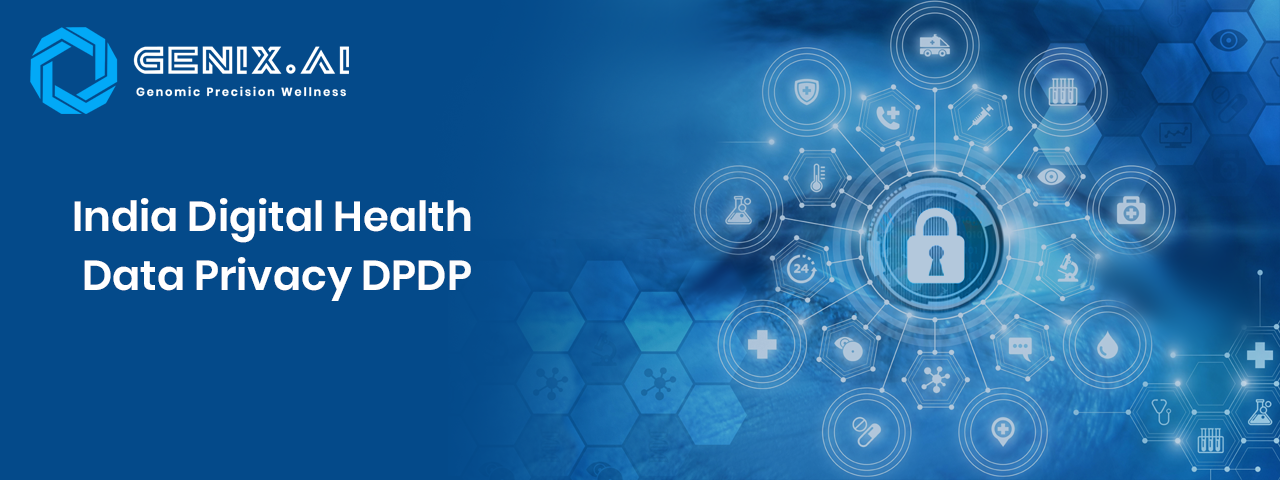
India's digital health infrastructure is now one of the largest in the world with over 799 million unique ABHA health accounts, 418,964 registered health facilities, and 671.9 million linked health records as of August 2025, the Ayushman Bharat Digital Mission (ABDM) has fundamentally changed how patient data moves across India's healthcare system. As clinical AI and genomic platforms enter this ecosystem, the question is no longer just about capability it is about compliance. The Digital Personal Data Protection (DPDP) Act 2023, the ABDM consent gateway, and emerging biocomputing architectures are converging into a new standard for how health data, especially genomic data, must be processed. This blog explores that convergence and what it means for AI-powered platforms operating at the intersection of precision medicine and digital public health.
How Does the DPDP Act Impact Genomic Data and Clinical AI in India?
The Digital Personal Data Protection Act classifies genomic and health data as highly sensitive personal data, enforcing strict, explicit, and revocable citizen consent for any processing activity. For clinical AI platforms, this is not a bureaucratic hurdle it is an architectural requirement.
Under the ABDM technical stack, this consent mandate is operationalized through a decentralized consent-manager gateway. Rather than allowing health applications to accumulate patient data indefinitely, the gateway operates on a time-bound, granular authorization model. A patient can grant a diagnostic lab access to their genomic report for a single consultation window and revoke it the moment that window closes. No permanent data hoarding. No passive data accumulation.
Organizations operating in India's health tech sector from startups and hospitals to insurers and digital platforms must now align with a trifecta of frameworks: the National Digital Health Mission architecture, the DPDP Act 2023 with its Draft Rules 2025, and the ABHA consent framework. For genomic platforms, this triple compliance requirement is especially demanding, because genomic data carries inheritable risk information that goes beyond the individual patient. A single FASTQ file can reveal predisposition data relevant to an entire family lineage. This is why the DPDP Act's treatment of genomic data as a special category is both scientifically appropriate and technically consequential.
For AI-driven platforms like Genix.ai which processes NGS outputs, variant calls, and clinical annotations the compliance surface is significant. Every inference pipeline that touches a patient's genomic profile must satisfy consent verification, data minimization principles, and audit trail requirements simultaneously.
The Technical Blueprint for Compliant Genomic Computing
Translating regulatory intent into engineering reality requires a clear data flow architecture. The compliant model looks like this:
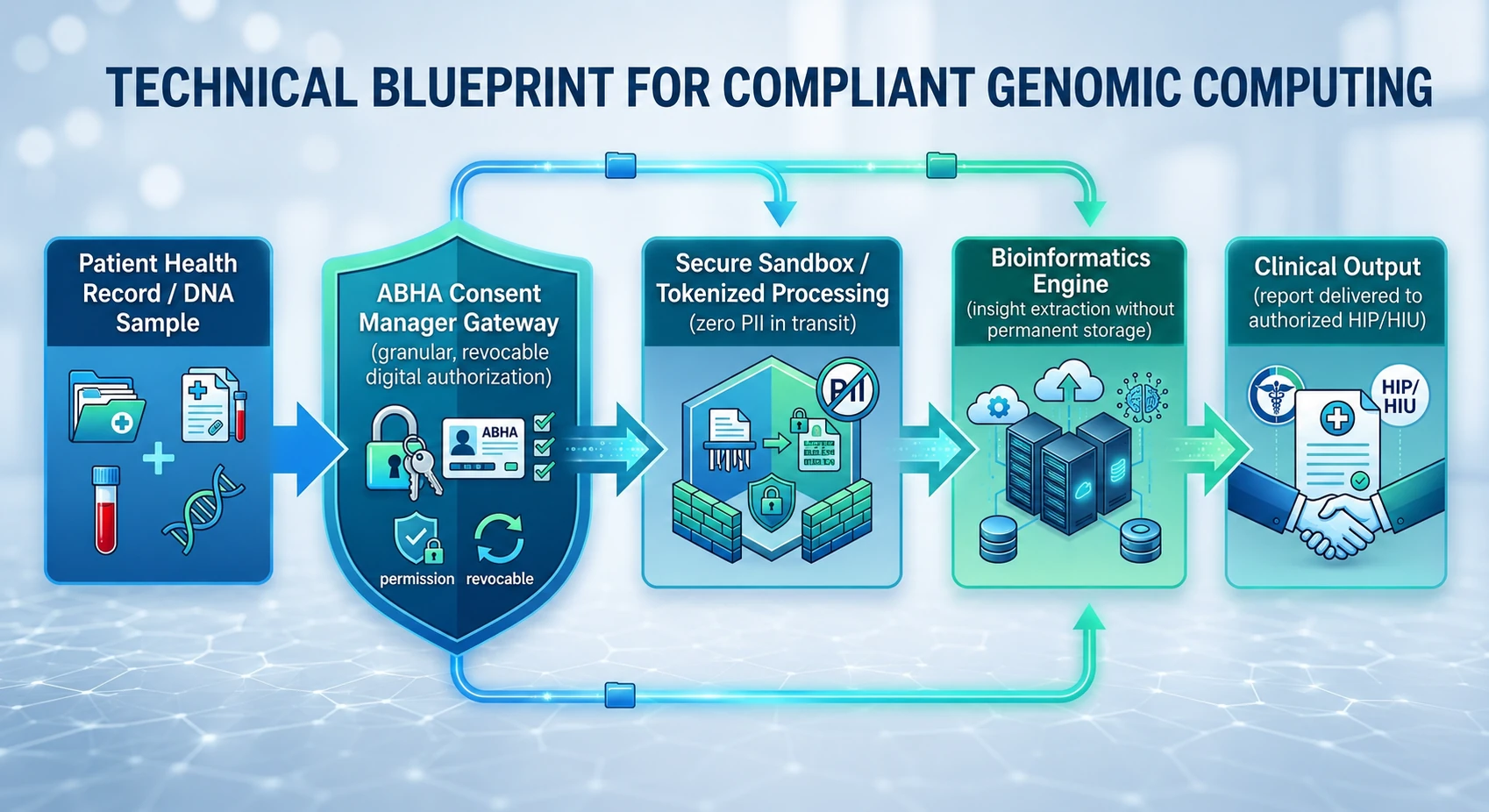
[Patient Health Record / DNA Sample] → [ABHA Consent Manager Gateway] (granular, revocable digital authorization) → [Secure Sandbox / Tokenized Processing] (zero PII in transit) → [Bioinformatics Engine] (insight extraction without permanent storage) → [Clinical Output] (report delivered to authorized HIP/HIU)
Three principles anchor this architecture:
Decentralized Storage with Federated Processing.
Following ABDM Core v3 API frameworks, clinical data remains encrypted at source within the health provider's infrastructure and is decrypted only temporarily during active analysis. Genomic files (FASTQ, BAM, VCF) never exist in plaintext within a cloud compute layer longer than the processing window requires.
Anonymization and Tokenization Before Variant Interpretation.
Before any genomic file enters a cloud-based variant calling or annotation engine, it must be fully decoupled from personally identifiable information. Sample identifiers are replaced with cryptographic tokens, and re-linkage to the patient record happens only after analysis is complete, within a permission-gated environment.
Verifiable Audit Trails for Regulatory Accountability.
Every instance of AI model inference, clinical decision support query, or variant interpretation must be logged cryptographically. This satisfies not only DPDP Act accountability requirements but also international standards including HIPAA's audit control safeguards and GDPR's data processing records mandate.
Why Consent Architecture Is the Foundation of Trustworthy Genomic AI
In 2026, the ABDM mission has evolved into a Digital Public Good, creating a seamless highway between patients, doctors, and insurers where no doctor or hospital can view a patient's past records unless the patient explicitly approves the request. This design philosophy patient as data principal is not unique to India, but India has implemented it at a scale no other country has attempted.
For clinical genomics, this matters beyond regulatory compliance. Trust is a clinical variable. When patients understand that their DNA analysis happens inside a consent-gated, tokenized environment, they are more likely to share complete family history data, consent to longitudinal follow-up, and engage with preventive genomics recommendations. The technical architecture directly influences clinical data quality.
Platforms operating under ABDM's Health Information Exchange must register as Health Information Providers (HIPs) or Health Information Users (HIUs) and demonstrate integration with the consent manager before accessing any linked health records. This creates a verified trust chain from the patient's ABHA ID through to the bioinformatics processing layer.
Secure Bio-Computing in Practice: HIPAA, GDPR, and DPDP Alignment
India's DPDP Act draws conceptual parallels with both HIPAA and GDPR but introduces India-specific provisions relevant to public health platforms. The key differences matter for genomic AI deployments:
HIPAA focuses on covered entities and business associates within the US healthcare system, with technical safeguard requirements around PHI. GDPR introduces data minimization, purpose limitation, and the right to erasure across EU operations. The DPDP Act adds explicit consent requirements for sensitive personal data processing, a Data Protection Board for adjudication, and significant penalties for data fiduciaries who process data without valid consent.
For a genomic platform with Indian clients and international research collaborations, operating to the most stringent standard across all three frameworks is not optional it is the baseline for institutional trust. Hospitals, pharma partners, and public health agencies will not onboard AI tools that cannot demonstrate this multi-framework compliance posture.
Genix.ai: Building Compliance Into the Core, Not the Margins
Genix.ai approaches data governance as an engineering discipline, not a compliance checkbox. The platform's bioinformatics architecture is designed for ABDM integration, with tokenized genomic processing pipelines, HIPAA and GDPR-compliant data storage, and support for DPDP-aligned consent workflows across its NGS analysis, molecular docking, and biocompute service layers.
As India's precision medicine ecosystem matures under the ABDM framework with hospitals, diagnostic labs, and research institutions all operating within the same interoperable health data infrastructure the platforms that will earn institutional trust are those that can demonstrate not just analytical capability but governance-by-design.
If your organization is building or scaling a genomic AI workflow that needs to operate within ABDM's consent architecture, or needs to satisfy DPDP, HIPAA, and GDPR requirements simultaneously, connect with Genix.ai to explore how compliant bio-computing infrastructure is built.
FAQ
1. What does the DPDP Act require for genomic data processing in India?
It mandates explicit, revocable consent from patients before any genomic or health data can be collected, stored, or processed by AI platforms.
2. How does ABDM's consent gateway work for clinical AI applications?
It acts as a decentralized broker that grants time-limited, patient-authorized access to health records for verified Health Information Users only.
3. Is genomic data treated differently from general health data under Indian law?
Yes, genomic data is classified as sensitive personal data under the DPDP Act, requiring stricter consent and data minimization safeguards than general health records.
4. How does Genix.ai align with both HIPAA and DPDP Act requirements?
Genix.ai deploys tokenized genomic pipelines, encrypted storage, and consent-compliant workflows that satisfy HIPAA, GDPR, and DPDP Act standards simultaneously.
5. What is a Health Information Provider (HIP) under ABDM, and why does it matter for bioinformatics?
A HIP is a verified entity authorized to share patient health records via the ABDM gateway, forming the trust anchor for compliant data exchange in clinical genomics workflows.