Abstract
India carries one of the world's largest rare disease burdens, driven by a distinct population genetic architecture shaped by centuries of endogamy. Yet most patients, especially children, face a diagnostic odyssey spanning four to seven years before receiving an accurate diagnosis. In 2026, the convergence of India's Ayushman Bharat Digital Mission (ABDM) with AIpowered genomic platforms is creating a real opportunity to close this gap. This article examines why India needs a dedicated rare disease genomic pipeline, how digital health registries can accelerate early detection, and how platforms like Genix.ai are positioned to translate policy intent into clinical action.
Why Does India Need a Dedicated Genomic Pipeline for Rare Diseases?
India's population genetic structure is unlike that of any other country. Centuries of communitylevel endogamy, the practice of marrying within defined social or geographic groups have created isolated gene pools across thousands of subpopulations. This increases the frequency of homozygous recessive mutations, many of which cause rare and often severe genetic disorders. Conditions such as spinal muscular atrophy (SMA), Gaucher disease, Wilson disease, and a range of lysosomal storage disorders appear at higher rates in specific Indian communities than in outbred global populations.
India's ABDM ecosystem, which has now registered over 400 million beneficiaries and linked more than 273 million health records, provides the digital infrastructure that can begin to surface these patterns at scale. However, digital registration alone does not solve the clinical problem. What India lacks is a specialized computational layer, a genomic pipeline capable of interpreting the variants that matter most within the context of Indian population allele frequencies.
Standard international genomic databases, built primarily on European ancestry cohorts, systematically underrepresent Indian genetic diversity. A variant flagged as pathogenic in a South Asian individual may not appear in ClinVar or gnomAD with sufficient frequency to trigger a clinical alert. This is where populationaware AIdriven variant interpretation becomes essential. Without it, even wellfunded clinical genomics labs risk reporting variants of uncertain significance (VUS) in cases where functional evidence already exists in Indian research literature.
With over 67 crore Ayushman Bharat Health Accounts (ABHA) already created and 42 crore health records linked to these accounts, India now has a foundational digital health identity layer. The next logical step is integrating NextGeneration Sequencing (NGS) outputs into this system so that genomic data flows through the same consent based infrastructure that governs clinical records with privacy, interoperability, and longitudinal tracking built in from the start.
Accelerating the Diagnostic Odyssey via AI and NGS
The clinical reality for most families dealing with a rare genetic condition in India is sobering. A child presenting with developmental delays, unexplained metabolic crises, or recurrent hospitalizations may be seen by five to ten specialists across years before a genetic cause is identified. Each misdiagnosis compounds medical costs, delays appropriate management, and in many cases causes irreversible harm.
The Clinical Gap
Most primary care physicians and even general pediatricians lack the specialized training to recognize ultra rare monogenic conditions. Clinical presentations overlap with more common diagnoses cerebral palsy, epilepsy, nutritional deficiencies and genetic testing is not yet a routine part of the Indian diagnostic cascade. The result is systematic underdiagnosis of rare inherited conditions, particularly in tier2 and tier3 cities where specialist access is limited.
Digital Registries as Catchment Systems
ABDM's architecture is designed to create seamless, interoperable platforms that leverage open, standards based digital systems while ensuring security, confidentiality, and privacy of health related personal information. For rare diseases, this infrastructure can function as a national symptom catchment network. Regional anomaly clusters for example, an unusual pattern of hypotonia and hepatomegaly presenting across pediatric wards in a single district become visible at a population level when structured health data flows through ABHAlinked records. What was previously invisible in isolated hospital data becomes a detectable signal in a national federated system.
This is the epidemiological layer that India currently lacks. ABDM's Health Facility Registry and Healthcare Professionals Registry together create the institutional backbone for aggregating deidentified clinical phenotypes. When combined with a rare disease genomics workflow, these registries can help prioritize which patients are most likely to benefit from wholeexome or wholegenome sequencing.
AI Driven Variant Prioritization
This is where Genix.ai's computational pipeline directly addresses the bottleneck. NGS produces millions of variant calls per sample. Without a clinical AI layer that understands Indian population genetics allele frequencies, founder mutations specific to South Asian communities, phenotype genotype correlations from Indian cohort studies the data volume becomes unmanageable for clinical teams.
Genix.ai's bioinformatics platform integrates populationaware variant filtering using tools calibrated for South Asian genomic context. The pipeline prioritizes de novo variants, known pathogenic mutations, and novel variants with strong functional prediction scores flagging the most clinically actionable findings for rapid geneticist review. In pediatric rare disease cases, this compression of the interpretation timeline from weeks to hours can be genuinely lifealtering.
Genix.ai: Bridging India's Rare Disease Gap with Clinical Genomic Intelligence
Genix.ai is built precisely for this intersection of public health urgency and computational precision. As an AInative clinical genomics platform recognized by Apollo Hospitals Group with the THIT 2024 Best AI Platform for Genomics award, Genix.ai brings together NGS analysis, clinical AI annotation, and ABDM compatible deployment models under one platform.
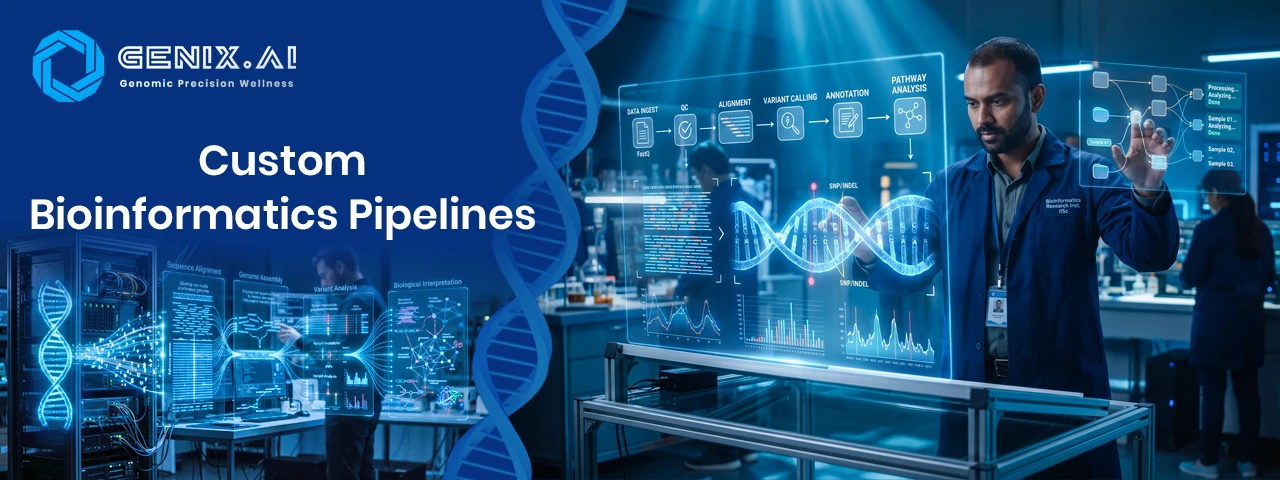
For rare disease diagnostics, Genix.ai offers complete NGS pipeline services from raw FASTQ processing through variant calling (GATKbased), annotation, and clinically structured reporting. The platform supports WES and WGS workflows optimized for pediatric rare disease panels, with variant interpretation informed by Indian population databases and published South Asian cohort literature. Reports are structured for direct clinical use, reducing the burden on molecular geneticists and enabling faster patient communication.
For hospitals and diagnostic labs operating within the ABDM ecosystem, Genix.ai's deployment models are designed for HIPAA, GDPR, and DPDP Act compliance ensuring that genomic data remains protected while enabling the kind of longitudinal followup that rare disease management requires.
If your institution is working to reduce diagnostic delays for pediatric rare conditions, or if your lab is seeking a validated NGS analysis partner aligned with India's digital health infrastructure, explore Genix.ai's clinical genomics capabilities or request a platform demo.
Frequently Asked Questions
1. What makes India's rare disease burden unique compared to other countries?
India's high degree of community endogamy concentrates recessive mutations within subpopulations, significantly raising the prevalence of rare monogenic disorders compared to outbred populations.
2. How does ABDM support rare disease identification?
ABDM's federated digital health registries enable populationlevel symptom tracking across facilities, helping surface anomalous clinical clusters that may signal undiagnosed rare genetic conditions.
3. What is a diagnostic odyssey in rare diseases?
It refers to the prolonged multiyear process often four to seven years in India that families endure moving between specialists before receiving a correct rare disease diagnosis.
4. How does AI improve variant interpretation in NGSbased rare disease testing?
AI driven pipelines filter millions of genetic variants per sample and prioritize clinically actionable mutations using population specific allele frequencies, reducing interpretation time from weeks to hours.
5. Is Genix.ai's platform compatible with ABDM and India's data privacy regulations?
Yes Genix.ai's deployment models are designed to align with ABDM's interoperability standards and comply with HIPAA, GDPR, and India's DPDP Act for secure genomic data handling.