Abstract
Sequencing a human genome once cost around 100 million dollars. Today it costs well under a thousand dollars, based on cost tracking by the US National Human Genome Research Institute. That sounds like the end of the story, but it really isn't. Cheap data simply moved the bottleneck from the lab bench to the computer. This is where the debate around biocomputing vs bioinformatics begins. Both work with biological data, yet they ask very different questions. Here is how they differ and why that matters to you.
Two Fields That Sound Alike
1. What traditional bioinformatics does
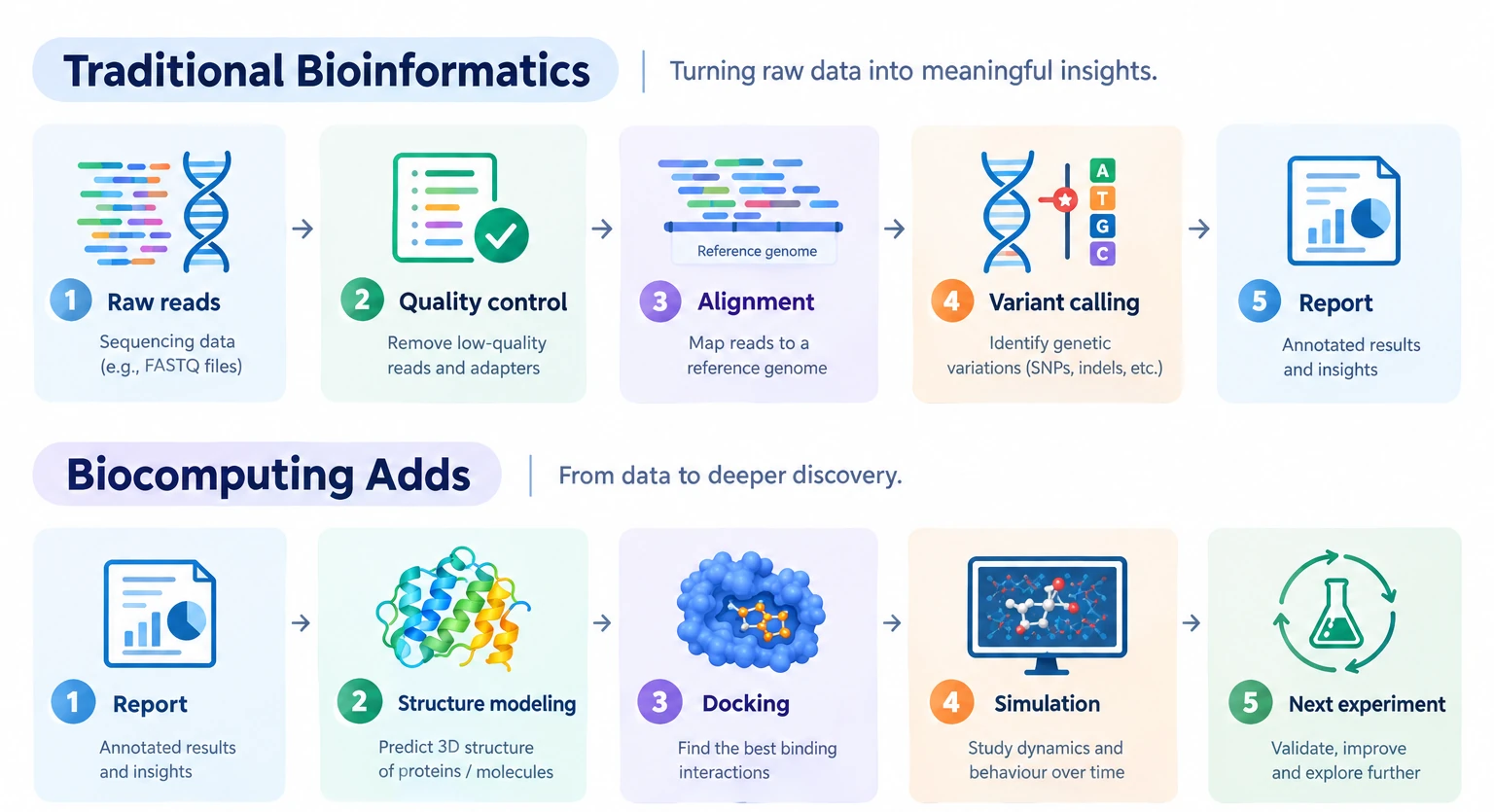
The word bioinformatics goes back to the 1970s, and the job has barely changed in spirit. It organizes biological data and makes sense of it. Picture lining up huge numbers of short DNA reads against a reference genome, or spotting which genes switch on in diseased tissue. A single human genome holds about 3 billion base pairs, so nobody does this by hand. Clinical labs lean on it daily when they turn sequencer output into a variant list a doctor can read.
2. What biocomputing adds
Biocomputing in life sciences starts from the same data but goes further. It simulates how a protein folds, or how a drug might sit inside its target. A quick note on terms. Some people use biocomputing for computers built from DNA itself. Here it means the wider computational approach used in modern drug and genomic research.
How the Two Approaches Differ in Practice
1. The questions they ask
Traditional bioinformatics asks what the data shows. Biocomputing asks what could happen next. One describes what is already in a sample. The other tests ideas before anyone picks up a pipette.
2. A simple workflow view
Where Each Approach Shines
1. Reading data well
Strong analysis matters most when you need answers from raw data. Sequencing projects depend on careful next generation sequencing analysis and on custom pipelines that give the same result every time. Skip that groundwork and every prediction built on top of it wobbles.
2. Predicting what comes next
Biocomputing earns its place when experiments are slow or costly. The AlphaFold database now holds over 200 million predicted protein structures, and the 2024 Nobel Prize in Chemistry recognized computational protein design and structure prediction. Tools such as molecular docking let teams screen compounds on a computer first. Prediction does not replace the bench. It narrows what deserves bench time. For the academic angle, our earlier piece on computational biology vs bioinformatics makes a good companion, and the AlphaFold3 overview shows where protein modeling is heading.
A Short Illustrative Case Study
1. The scenario
This is a made up example, not a client story. A university lab has 12 bulk RNA sequencing samples from treated and untreated cells. A standard analysis finds a handful of genes that react to the treatment. That is classic bioinformatics. Step one is analysis. Step two is prediction. Neither step is wasted, and the second only makes sense because the first came out clean.
2. What the numbers look like
Using the published BioCompute pricing, 12 samples at $150 each comes to $1,800, with a listed turnaround of 3 to 5 days. The lab then wants to know whether a candidate compound binds one of those proteins. A docking campaign is listed at $1,000 and 5 to 10 days. Together that is about $2,800, assuming the protein structure already exists. Complex projects get custom quotes, so treat this as a rough guide.
Why This Matters Beyond the Lab
1. For researchers and students
Knowing which approach you need saves money and time. A lab that books docking before its sequencing data is clean can burn a budget fast, which is exactly the trap described in why bioinformatics costs spiral.
2. For everyday readers
If you have ever read a DNA report or a headline about a new drug, you have already met both fields. Understanding the split makes those stories easier to judge.
Conclusion
Biocomputing does not replace traditional bioinformatics. It stands on top of it. Genix.ai reflects that thinking through BioCompute, an analysis service that handles sequencing data on one side and protein modeling with docking on the other. It also builds custom pipelines for teams that need repeatable work. Projects are listed with a turnaround of 3 to 7 days, and a PhD founder reviews every deliverable. NDA protection is standard, and the first 30 minute consultation is free. The service also states costs 50 to 70 percent lower than traditional CROs. If your project sits between reading data and predicting from it, explore BioCompute or read what research labs should know about in house versus outsourced biocompute before you decide.
FAQ's
1. Is biocomputing the same as bioinformatics?
Not quite, because bioinformatics analyzes biological data while biocomputing also models and predicts from it.
2. Does biocomputing replace traditional bioinformatics?
No, it builds on it, since good predictions need clean, well analyzed data.
3. Who uses biocomputing in life sciences?
Drug discovery teams and research labs use it most.
4. Do I need coding skills to benefit from either field?
No, many labs hand the analysis to a specialist service.
5. How long does a typical analysis take?
It depends on the project, though a standard bulk RNA sequencing job is listed at 3 to 5 days.