Every drug that reaches a pharmacy shelf started as a question, will this molecule actually bind to its target the way researchers hope. Molecular docking software is how that question gets answered computationally, long before a compound ever touches a lab bench. This piece walks through what molecular docking software actually does, the main categories of tools researchers rely on today, and how to think about choosing the right one for a project. For anyone new to computational drug discovery, the sheer number of available tools can feel overwhelming at first.
Abstract
Picking the right molecular docking software has become a real challenge for drug discovery teams, since the field now splits into two main directions. Traditional engines like AutoDock Vina, Schrödinger's Glide, and GOLD rely on well established physics based scoring and remain dependable choices, while newer AI driven tools like DiffDock generate binding poses directly from learned patterns instead of relying on search and scoring. The article also explains why docking never works in isolation. Structure prediction tools such as AlphaFold are needed first, since a protein structure has to exist before docking is possible, and once results come back, tools like PyMOL and RDKit help researchers visualize and refine what the docking run actually produced. The piece closes with a practical point: a solo academic researcher screening a small set of compounds has very different needs than a pharma team screening a million molecules, and factors like budget, timeline, and required validation shape which tools actually make sense. It ends by mentioning Genix.ai's Biocompute service as an option for teams who prefer a ready made CADD pipeline over building one from scratch.
What Molecular Docking Software Actually Does
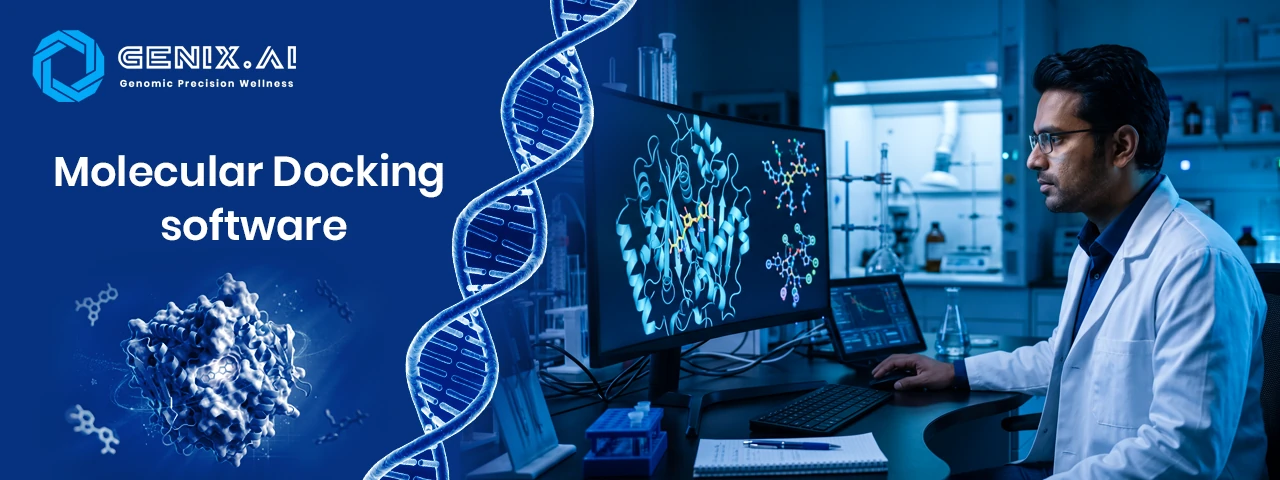
At its simplest, molecular docking software predicts how a small molecule, usually a potential drug candidate, fits into the binding site of a target protein. It estimates the pose the molecule is likely to take and scores how strong that interaction might be, giving researchers a ranked shortlist of candidates worth testing further instead of guessing blindly.
Docking vs Virtual Screening
Docking looks at one molecule and one target in detail. Virtual screening scales that same idea across thousands or millions of candidate compounds, using docking as the underlying engine to quickly filter out molecules that clearly will not work, leaving a much smaller, more promising set for closer study.
The Core Categories of Docking and CADD Tools
Computer aided drug design brings together several types of software, and most modern drug discovery tools fall into two broad camps, traditional physics based docking engines and newer AI driven approaches trained on large datasets of known protein ligand interactions.
Structure Based Docking Engines
Tools like AutoDock Vina, Schrodinger Glide, and GOLD remain widely used because they are well validated and relatively fast, relying on scoring functions built from established physical and chemical principles. Gnina extends this approach further by adding a deep learning scoring layer on top of a traditional docking framework, often improving accuracy on difficult targets.
AI Driven Docking Approaches
Newer tools such as DiffDock take a different route, using generative models trained on large structural datasets to predict binding poses directly rather than relying purely on search and scoring. These approaches are still maturing, but they are already changing how quickly early stage virtual screening can move.
Supporting Tools That Make Docking Useful
Docking software rarely works in isolation. A useful CADD workflow usually depends on several supporting tools working together before and after the actual docking step takes place, and skipping any one of them tends to weaken the reliability of the final result.
Structure Prediction Before You Dock
You cannot dock a molecule against a protein structure you do not have. This is where tools like AlphaFold and RoseTTAFold have changed the field, generating reliable structural models for proteins that previously had no experimentally solved structure, opening up targets that were essentially untouchable a few years ago.
Visualization and Cheminformatics
Once docking results come back, researchers still need to actually look at them and work with the underlying chemistry. PyMOL is widely used for visualizing binding poses and interactions, while RDKit handles the cheminformatics side, things like molecule preparation, filtering, and property calculation that happen before and after the docking run itself.
Choosing the Right Software for Your Project
There is no single best molecular docking software for every situation. The right choice depends on the target, the size of the compound library, the computational resources available, and how much validation the project actually needs before moving forward. Cost is often the deciding factor too, since licensed platforms can carry significant subscription fees that smaller labs and early stage biotech teams simply cannot justify for a single project.
Academic Research vs Pharma Scale Screening
A single PhD student studying one target with a small compound library has very different needs than a pharma team running virtual screening across a library of a million molecules. Smaller academic projects often do well with open tools like AutoDock Vina, while larger pharma scale screening frequently benefits from licensed platforms or outsourced computational biology support built to handle that scale reliably and within a realistic timeline.
In Closing
Molecular docking software has become one of the most practical tools in modern drug discovery, letting researchers filter thousands of possibilities down to the handful worth pursuing further, well before a single physical experiment begins. Genix.ai supports this work directly through its Biocompute molecular docking service, combining AlphaFold and Rosetta based structure prediction, AutoDock Vina driven virtual screening, MD simulations, and ADMET prediction into a full CADD pipeline for pharma teams, academic researchers, and AYUSH drug developers who need reliable results without building this capability in house.
FAQs
1.What is molecular docking software used for?
It predicts how a candidate molecule binds to a target protein and ranks how strong that interaction might be.
2.What is the difference between docking and virtual screening?
Docking evaluates one molecule at a time, while virtual screening applies docking across thousands of candidates at once.
3.Is AutoDock Vina still widely used ?
Yes, it remains a common structure based docking engine due to its speed and strong validation history.
4.Why does structure prediction matter for docking?
You need a reliable protein structure before docking is possible, which is where tools like AlphaFold help.
5.Do I need multiple tools for a full drug discovery workflow?
Yes, most projects combine structure prediction, docking, and cheminformatics tools rather than relying on one program alone.