Abstract
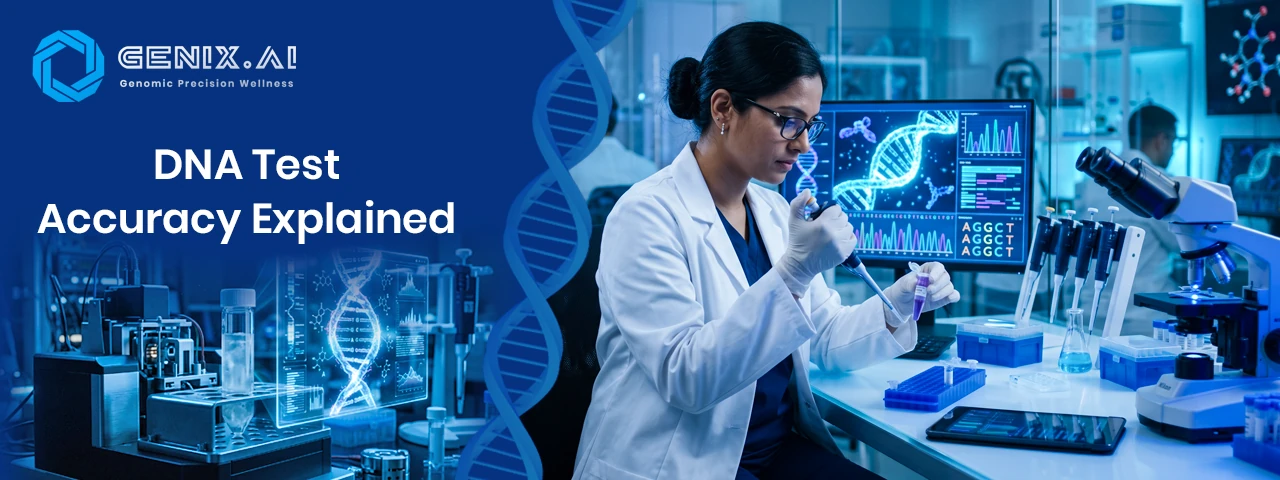
Ask ten people whether DNA tests are accurate and you'll hear ten different answers. The honest reply is that it depends on what you mean by accurate. A lab can read your DNA almost perfectly and a report can still leave you with more questions than answers. Knowing where the real strengths and weak spots sit helps you trust a result when it deserves trust and question it when it doesn't. That's what this guide is for.
What accuracy really means
1. Three questions hiding in one word
When people ask about accurate DNA tests, they're really asking three things at once. Did the lab read my DNA correctly? Did the report explain what it found in a sound way? And does the result actually predict anything about my life? The answers aren't the same. A test can score brilliantly on the first and only modestly on the third, so it helps to judge each layer on its own.
2. A quick look at the numbers
A common quality benchmark in sequencing is called Q30. It means roughly a one in a thousand chance that any single letter gets read wrongly. That sounds tiny until you remember your genome is about three billion letters long. If every letter were read only once, you'd expect millions of slips. Labs get around this by reading each position many times over and comparing the reads, which is why method and quality control matter so much. If you'd like more background, this piece on how to ensure DNA tests are accurate covers the basics.
Where the weak spots hide
1. Sample and handling
Mistakes can start before the lab ever sees your DNA. A saliva sample that's contaminated or labeled wrongly can throw off a result. That's why reputable providers use sealed kits, one per person, and track each sample through the process. Follow the instructions closely, and don't eat or drink right before you spit if the kit tells you not to.
2. Whose data it is compared against
Your reading gets interpreted against reference databases, and those have historically leaned toward people of European ancestry. If your background lies elsewhere, a finding can be less precise for you, and ancestry estimates can be fuzzier too. It's a fair question to ask a provider how it handles diversity. One approach is described on the bias and population intelligence page.
3. Uncertain and shifting results
Science keeps moving. A variant that's unclear today may be reclassified next year, and an ancestry breakdown can change when a company updates its reference panel. Clinicians even have a name for the first situation, a variant of uncertain significance. It isn't a flaw in the test. It's the honest edge of what's known, so ask whether a provider will tell you when your result is updated.
Not every result is equally solid
1. How different results compare
The table below gives a rough sense of how much weight each kind of result can carry. These are general patterns, and individual tests vary.
2. When to confirm with a doctor
Accuracy has a practical edge too. A DNA test result is not a diagnosis, and anything serious should be confirmed with a clinical test ordered by a doctor. Here's a made up example. Anil, 52, gets a report flagging a variant linked to higher cholesterol. Worried, he books a lipid test, and his blood work comes back normal. His doctor still uses the finding to plan regular checkups. The report read his genes correctly. It just didn't mean he had a problem today. For the wider picture on inherited findings, see whether DNA testing can detect hereditary diseases.
How to judge a provider
1. Questions worth asking
You don't need a science degree to size up a provider. Start by asking which lab runs your sample and what method it uses. How results are reviewed before they reach you matters just as much, and so does what happens if a result is updated later. A provider that answers plainly is usually confident in its work. Whether the lab holds recognised quality certifications is a fair question too. The validation and explainability page shows what that kind of openness can look like.
2. What a careful path looks like
Here's the route a careful provider follows.
Sealed kit → Saliva sample → Sequencing → Quality checks → Expert review → Your report
If a provider can't describe these steps, that's worth noticing. For the customer side of the story, this step by step guide to using a DNA kit at home walks through what happens after you order.
Conclusion
So are DNA tests accurate? Often very, provided you judge the lab reading apart from what the report predicts. Genix.ai offers 12 DNA test reports, and one report page states that samples are analyzed in a CLIA certified lab using next generation sequencing. Kits ship free in India and results come through a mobile app and a PDF. The company states that its reports are for awareness and are not a medical diagnosis. At least one report offers an optional video consultation with a genetic counselor, and you can download a sample report before you buy.
FAQ's
1. Are DNA tests accurate?
Lab readings from quality providers are very reliable, though interpretation and prediction are less certain.
2. Can a DNA test give a false result?
Yes, errors can come from sample problems or interpretation, which is why serious findings should be confirmed.
3. Are home DNA tests as accurate as clinical ones?
Quality varies, so check the lab and method, and confirm any serious finding clinically.
4. Does an accurate reading mean a certain prediction?
No, it still shows tendencies and never certainty.
5. How can I check if a DNA test is reliable?
Ask which lab runs it, how results are reviewed and how updates are handled.