Abstract
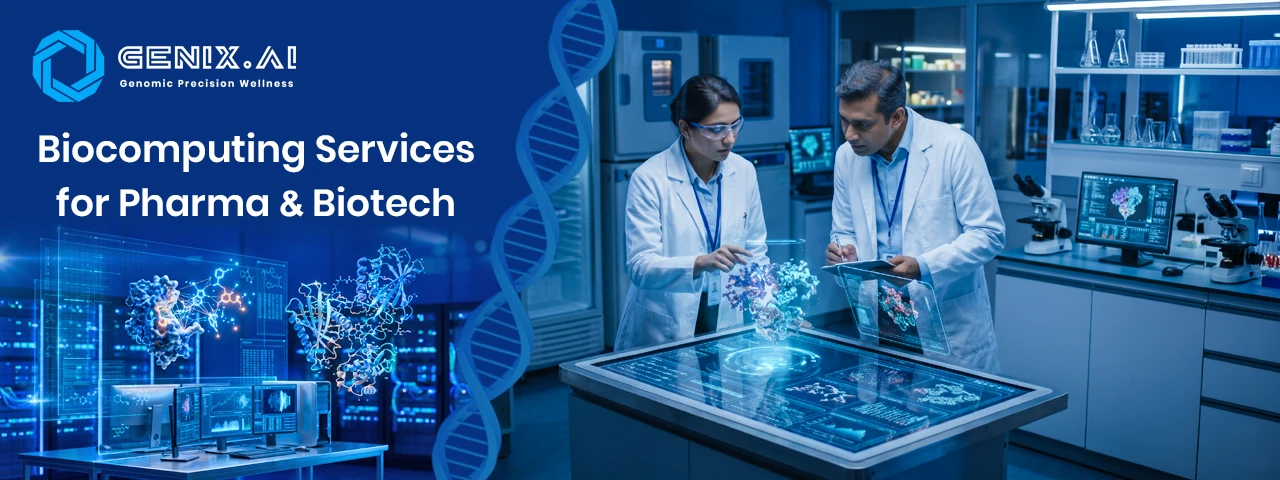
A drug candidate can look wonderful on paper and still fail years later, after most of the money is gone. Pharma and biotech teams know that pain well. Computing is one of the few levers that moves risk earlier, because a molecule that fails on a screen costs far less than one that fails in a trial. This post looks at how biocomputing services work for drug developers. It walks through the benefits that matter and the use cases worth your time. Then it looks at how to pick a partner without getting burned.
Why Drug Developers Look Outside Their Own Walls
1. The pressure on R&D
Developing a medicine often takes a decade or longer, and most candidates never reach patients. Commonly cited estimates put the full cost in the billions once the failures are counted. Anything that weeds out weak candidates early is worth serious attention.
2. The skills problem
Computational biology is hard to hire for. A single project might need structural biology one month and sequencing analysis the next. Few teams can keep every specialist busy all year, which is why outsourced biocomputing services have become a normal part of the toolkit. Our piece on in house versus outsourced biocompute goes deeper on that choice.
What You Actually Gain
1. Speed you can plan around
Deadlines in pharma are rarely flexible. A board meeting or a funding round doesn’t wait for a pipeline to be debugged. The BioCompute service page lists docking campaigns at 5 to 10 days and MD simulation at 7 to 14, which makes timelines something you can put in a project plan.
2. Costs that follow the work
A full time team costs money whether or not a project is running. Buying analysis by the project turns that fixed cost into a variable one. Pipeline users can also add a monthly maintenance retainer. For the financial detail, see the true cost of outsourcing bioinformatics.
3. Ownership stays with you
The service page describes a standard NDA, full ownership of results, code and analysis files by the client, and deletion of data after the project on request. For a company with patents to protect, those terms are not a detail.
Three Ways to Get the Work Done
Three Ways to Get the Work Done
1. In-House Team: Hiring takes months, and costs include fixed salaries. Best suited for companies with continuous research workloads.
2. Traditional CRO: Onboarding takes several weeks, with hourly rates of 100–150, according to the service page. Best suited for large, regulated research programs.
3. Specialist Biocomputing Partner: Proposals are available within 24 hours, with project-based pricing and flexible capacity. Best suited for specific analyses and peak workloads.
Choosing the Right Approach: Each model has advantages, and companies can combine them to balance costs, timelines, expertise, and research demands.
Use Cases That Earn Their Keep
1. Virtual screening and docking
Molecular docking estimates how well a compound fits a protein target. A team can rank thousands of molecules on a computer and send only the promising ones to the lab. ADMET prediction adds an early read on how a compound might behave in the body.
2. Protein modeling
When no experimental structure exists, prediction tools such as AlphaFold and Rosetta can fill the gap. AlphaFold’s public database now covers more than 200 million proteins, so a usable starting model often exists already.
3. Biomarker and target discovery
Machine learning on multi omics data can point to new targets and patient groups. The service page lists network pharmacology and polygenic risk score development here too, and calls these premium engagements for pharma and funded biotech.
4. Herbal and AYUSH validation
Traditional medicine companies need computational evidence for regulatory files. Docking of plant compounds, network pharmacology and ADMET profiling all help, and our article on molecular docking for AYUSH drug validation shows how.
5. Pipelines that live inside your lab
Some teams want the workflow rather than a one off result. Custom pipeline development covers Nextflow or Snakemake builds, containers, cloud deployment and LIMS integration.
A Short Case Study and Workflow
1. An illustrative biotech scenario
This is a typical scenario and not a client story. A small funded biotech has a validated target and a library of around 10,000 candidate compounds. Its two scientists are busy with assays. The team shares the target structure with a biocomputing partner, agrees a scope in a short call and receives a ranked shortlist from a docking campaign in the 5 to 10 day range. The best hits then go into MD simulation for another 7 to 14 days. Only the survivors reach the wet lab, so the assay budget goes to compounds that earned it.
2. How the screening workflow runs
Target structure → Docking campaign → ADMET filter → MD simulation → Shortlist for the labChoosing the Right Partner
1. Questions worth asking
It helps to know who signs off on the work and what the deliverables look like. A publication ready package with methods and reproducible code tells you a lot. How the provider handles confidentiality, and whether revisions are included, matters just as much. Our list of questions before hiring a bioinformatics provider is a handy companion when you start comparing options.
2. Matching the partner to your stage
Early stage teams usually want quick, scoped answers. Larger pharma groups often care more about security and audit readiness. Say which camp you are in, because a good provider will shape the engagement around it. The pharma and biotech solutions page is a sensible place to start.
Conclusion
Biocomputing gives drug developers a way to fail cheaply and succeed sooner. Genix.ai offers this through its BioCompute service, which spans NGS data analysis, protein modeling and docking, and custom pipelines, with a PhD founder reviewing every deliverable. The service page states costs run 50 to 70 percent below traditional CROs and that standard projects can finish in days rather than months. A free consultation of about half an hour comes first, and a clear proposal follows within 24 hours. If you’re comparing biocomputing services, that is an easy way to test the fit. Begin on the BioCompute page.
FAQ's
1. What do biocomputing services include for pharma companies?
They typically include sequencing analysis, protein modeling, docking, simulation and custom pipeline work delivered as finished results.
2. How long does a docking project take?
The BioCompute service page lists 5 to 10 days for a molecular docking campaign.
3. Who owns the data and results?
Under the standard NDA described on the service page, the client owns all results, code and analysis.
4. Is outsourcing cheaper than hiring a team?
It often is for project based work, since you pay for the analysis rather than for full time salaries.
5. Can computation replace lab experiments?
No, it narrows the candidates so lab work goes to the most promising ones.