Abstract
In 2003 the Human Genome Project finished a job that cost billions of dollars. Today a human genome can be sequenced for under a thousand dollars. That drop sounds like pure good news, yet it created a new problem, because nobody can read that much data by eye. Computational biology steps in to turn the flood into decisions. This article explains how it works inside drug discovery, where it saves time, and what it cannot do.
Why Drug Discovery Needs Computers
1. A Slow Road With Many Dead Ends
A new medicine usually takes 10 to 15 years to reach patients, and roughly nine in ten candidates that enter human trials fail. Much of that loss traces back to early decisions, when a team backs a target or a molecule that later turns out to be wrong. Better early decisions would save the most time and money, and that is exactly where computational drug development helps.
2. More Data Than Any Team Can Read
Labs now produce sequencing files and patient records faster than people can review them. The AlphaFold database alone holds more than 200 million predicted protein structures. Having data is easy. Knowing which small slice of it matters is the hard part.
What Computational Biology Actually Does
1. Computational Biology and Bioinformatics in Plain Words
The two terms overlap, and people mix them up. Bioinformatics is mostly about handling biological data, such as cleaning sequencing files and comparing genes across people. Computational biology goes a step further and builds models and simulations to predict how living systems behave. Bioinformatics drug discovery usually supplies the clean data, and the modeling that follows puts it to work. Our article computational biology versus bioinformatics goes deeper on the split.
2. Where AI Joins the Picture
AI and computational biology work as a pair. Machine learning finds patterns in large datasets, and biological models give those patterns meaning. A model trained on known drugs can, for instance, guess which new compounds are likely to stick to a target or cause side effects. It still needs good data to learn from, which is why the first stage matters so much.
3. The Workflow as One Loop
In practice the work runs as a loop rather than a straight line. Raw sequencing data gets cleaned and analysed. Targets are ranked, and structures are predicted or retrieved. Candidates are docked and scored, then the best few go to the lab. What the lab finds feeds back into the models, so the next round starts a little smarter.
4. Finding Targets in Genomic Data
Targets often hide in genetic differences between healthy and affected people. Sequencing reveals those differences, and analysis pipelines rank the genes most likely to matter.Next generation sequencing provides the raw material, and a reliable bioinformatics pipeline keeps the analysis repeatable.
5. Predicting Shapes and Testing Fits
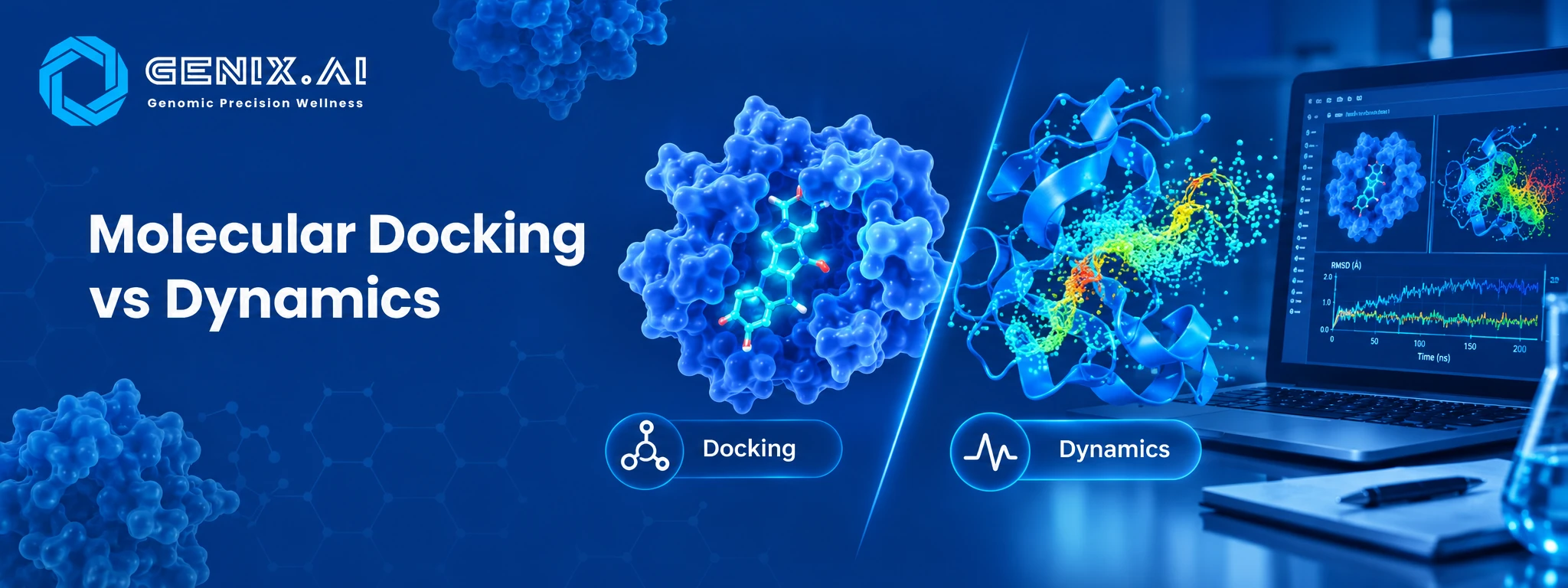
Once a target is chosen, its three dimensional shape decides what can bind to it. Prediction tools now estimate that shape from sequence alone. Molecular docking then tests how well candidate molecules fit, and molecular dynamics simulations check whether a fit stays stable over time. A bad candidate can be dropped before anyone orders a chemical.
6. Weeding Out Risky Molecules Early
Many drugs fail because the body absorbs them poorly or reacts badly to them. Predictive models for absorption and toxicity, often grouped under the label ADMET, flag these problems early. That does not remove laboratory testing. It means the lab receives a shorter and better list.
A Case Study From the HIV Era
1. Designing Drugs From a Protein Structure
HIV needs an enzyme called protease to mature, so blocking it became a target. Researchers solved the three dimensional structure of that enzyme in the late 1980s. Teams then used the structure to design molecules that fit its active site. The first protease inhibitor reached patients in 1995, and nelfinavir, which relied heavily on structure based design, was approved in 1997.
2. What the Case Shows
The tools were far simpler than today's. Yet the pattern was clear. When researchers understand a target's shape, they can design instead of guessing. Modern computational biology applies the same idea to far more targets and at a much larger scale.
The Limits Worth Knowing
1. Predictions Are Not Proof
A docking score is an estimate. A molecule that looks perfect on screen can still fail in a cell, an animal or a patient. Computational work narrows the field, and laboratory and clinical testing still make the final call. That is why strong teams treat each result as a hypothesis to test rather than an answer to accept.
2. Data Quality and Repeatability
A model fed messy data will give messy answers. Analyses also need to be repeatable, so another team can rerun them and get the same result. Versioned workflows and clear documentation make that possible, and teams often underestimate the effort involved.
Build It Yourself or Bring in Help
Weighing In House Against Outsourced Computing
Setting up servers and hiring specialists takes time. Smaller labs and early stage biotech teams often find that outsourcing the heavy analysis is the faster route, while larger groups may prefer to keep core work in house. Our piece on in house versus outsourced biocompute lays out the trade offs.
Conclusion
Computational biology will not replace the lab, but it can make every lab day count for more. Genix.ai offers this through BioCompute, a service that pairs NGS data analysis with protein modeling and docking. It also builds custom pipelines. The page lists turnaround times such as five to ten days for a docking campaign and seven to fourteen days for a molecular dynamics run. For pharma and biotech teams, the Pharma and Biotech solution adds biomarker discovery and patient stratification with explainable outputs. If you are planning a project, you can request a demo and talk it through.
FAQ's
1. What is computational biology in drug discovery?
It uses data analysis and computer models to find targets and test candidate molecules before lab work begins.
2. How is bioinformatics different from computational biology?
Bioinformatics mainly manages and analyses biological data, while computational biology builds models to predict biological behaviour.
3. Can AI and computational biology design a drug alone?
No, they narrow the options, but laboratory and clinical testing must still confirm any candidate.
4. Does computational drug development reduce cost?
It can cut wasted lab work by dropping weak candidates early, though clinical trials still carry major costs.
5. What data do these methods need?
They need quality inputs such as sequencing files and protein structures, because poor data leads to poor predictions.