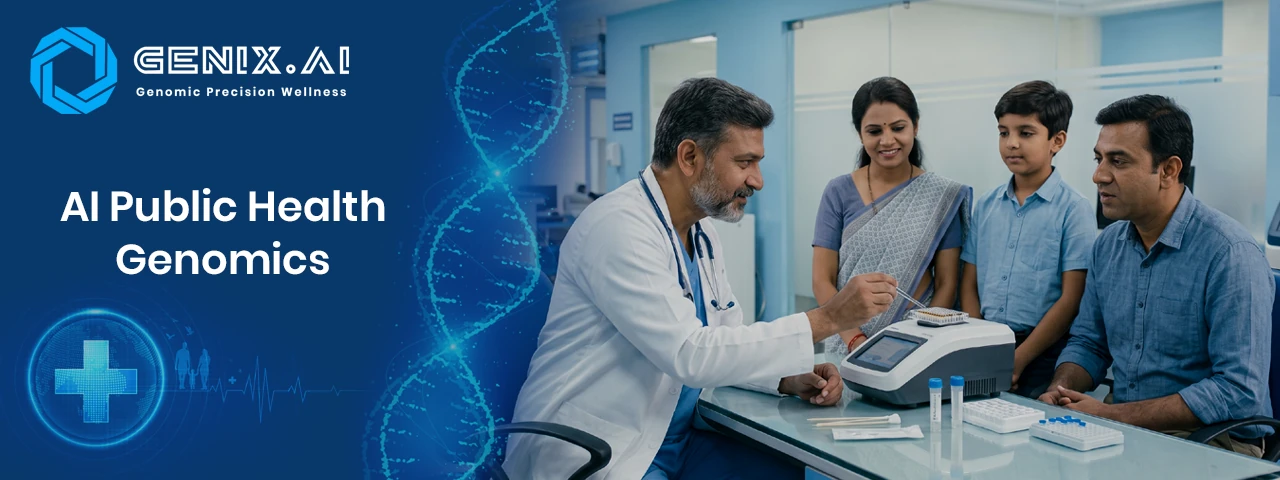
Public health in India is entering a more data aware phase. Disease surveillance is no longer limited to counting reported cases after people fall ill. Researchers, universities, and government health teams are now looking at how populationscale DNA analysis can support earlier signals, sharper risk mapping, and better planning.
This shift is not about replacing field workers, clinicians, or public health judgement. It is about giving them a deeper layer of biological information. When used responsibly, AI in public health can connect genomic patterns with epidemiology, geography, environment, and health records in a way that supports careful decision making.
Abstract
Public health is changing shape. Instead of only reacting once people fall sick, researchers and health teams are starting to look at DNA data across entire populations to catch risks earlier and plan more wisely. This isn't about replacing doctors or field workers. It's about giving them a new layer of biological insight, one that works alongside epidemiology, geography and health records rather than in place of them. Done carefully, with strong governance and human review at every step, AI powered genomics can help India build a public health system that is more prepared, more transparent and more attuned to its own diversity.
Why Population Scale DNA Analysis Matters
DNA data can reveal patterns that ordinary surveillance may not show clearly. At the population level, genomic analysis can support research into inherited risk, pathogen movement, variant patterns, and disease susceptibility across diverse groups. For India, this matters because the population is highly varied across regions, communities, lifestyles, and access to care.
Still, DNA data on its own is not enough. It needs clinical, demographic, environmental, and behavioural information to become meaningful for public health use. This is where AI and public health begin to intersect. AI can support pattern recognition, but people must decide what those patterns mean.
The Changing Role of Disease Surveillance
Traditional surveillance often reacts to visible illness. Populationscale genomics adds another view. It can support researchers in studying how disease risk, transmission, or biological variation may appear across groups over time. This does not mean every signal becomes an alert. It means surveillance can become more layered and better documented.
For public agencies and universities, this is important because disease surveillance is not only about response. It is also about preparedness, resource planning, ethical communication, and longterm research. AI in disease detection can support this work by organising complex data, but the final interpretation needs human review.
How AI Supports Genomic Interpretation
Large DNA datasets can be difficult to review manually. AI can assist by grouping patterns, flagging unusual signals, supporting annotation, and making complex datasets easier to explore. In public health genomics, this can reduce confusion across teams when multiple institutions are working on the same study.
A useful workflow may support:
- Secure data ingestion
- Structured analytical pipelines
- Pattern discovery
- Populationaware review
- Explainable outputs
- Human validation
- Audit trails
This type of workflow is especially important when AI in population health is used for policyfacing research. Public health decisions need traceability. Teams should be able to see what data was used, which methods were applied, and how findings were reviewed.
Early Signals Need Careful Handling
The phrase early disease detection can sound exciting, but it needs caution. AI in early disease detection should not be presented as a shortcut to certainty. Genomic signals may suggest risk, movement, or association, but they require validation and review. Public health teams must separate a useful signal from noise, bias, or incomplete data.
This is where governance becomes central. Any use of AI in disease management should include clear rules on consent, data access, data minimisation, review authority, and communication. Public trust depends on how responsibly information is handled, especially when DNA data belongs to communities rather than isolated individuals.
India Needs PopulationAware Genomic Systems
Imported assumptions may not fit Indian population realities. India’s diversity means public health genomics must be sensitive to local variation. A model trained or interpreted without population awareness may miss important differences or overstate signals. Researchers need systems that allow careful review across regional and demographic layers without turning communities into labels.
This is not only a technical issue. It is also an ethical one. Population level research must avoid stigma, protect privacy, and communicate findings with care. Universities, research bodies, and public agencies should involve ethics committees, domain experts, and communitysensitive reviewers throughout the workflow.
What Institutions Should Prepare before Adoption
Technology adoption should begin with readiness, not urgency. Before scaling DNA analysis, institutions should define the public health question, data sources, consent model, governance structure, analytical pathway, and review process. They should also decide who can access data and how findings will move from research teams to decisionmakers.
Key areas to prepare include:
- Ethical approval and oversight
- Data quality checks
- Secure storage
- Rolebased access
- Reproducible pipelines
- Documentation standards
- Review and validation steps
- Clear communication plans
For research leaders, the adoption question should remain grounded. Is the team asking a clear public health question? Is the data fit for analysis? Are reviewers trained to challenge the output? Are communication teams ready to explain findings without creating fear? These questions are basic, but they often decide whether a genomics programme earns confidence.
They also keep the work close to public need, which matters in a country where trust, access, language, and local realities shape health decisions locally each day.
The goal is not to make AI the centre of public health. The goal is to make public health genomics more reliable, transparent, and usable for people who must act on the findings.
Building Trust Through Explainability
Trust is essential when genomic data is linked with public health decisions. Public institutions need systems that show how conclusions were reached. Blackbox outputs are risky in this area because they may influence research priorities, surveillance planning, or public communication.
A platform built for research and public health can support this direc tion when it offers secure data handling, reproducible workflows, explainable analysis, and reviewled reporting. The main value is not automation alone. It is the ability to bring structure and accountability into complex genomic research.
Conclusion
Populationscale DNA analysis is changing how disease surveillance is imagined in India. It can add depth to public health research, support preparedness, and give institutions a clearer way to study patterns across diverse groups.
Yet the future of AI in public health must be carefully considered, not rushed. Strong governance, population aware analysis, ethical review, secure infrastructure, and human judgement are essential. When these foundations are in place, AIpowered genomics can support disease surveillance in a responsible, transparent, and peoplecentred way.