Abstract
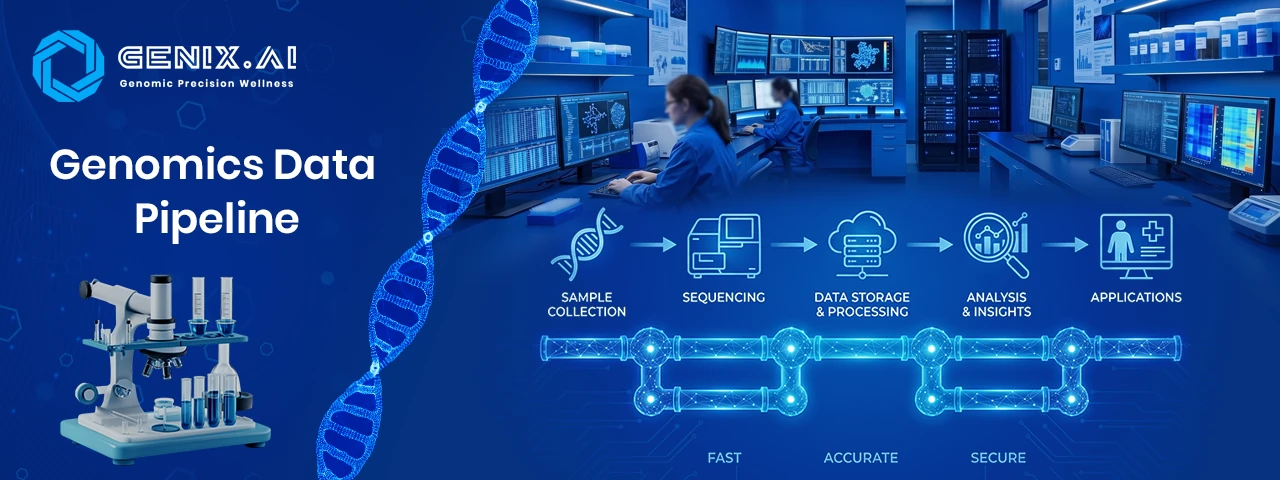
Genomics research generates data at a pace most labs were never built to handle. A single sequencing run can produce terabytes of raw output, and that volume only grows as sample sizes expand and sequencing depth increases. A genomics data pipeline that works for ten samples often breaks down completely at a thousand. This blog looks at what it actually takes to design a genomics data pipeline that scales with your research, covering the core stages of a bioinformatics workflow, the infrastructure decisions that matter most, and the common mistakes that quietly limit growth. Whether you are running a small academic study or managing genomic data analysis across multiple ongoing projects, the goal is the same, a pipeline that stays reliable as demand increases rather than one that needs to be rebuilt every time the data grows.
Why Genomics Pipelines Break Down at Scale
Most research teams start with a workflow that fits their current project size. Scripts are written for a specific dataset, storage is provisioned for a known number of samples, and processing steps run in a fairly linear order. This works fine early on, but it rarely survives contact with real growth.
The Hidden Cost of Manual Steps
Manual quality checks, one off scripts, and hardcoded file paths are easy to overlook when a pipeline only processes a handful of samples. Once NGS data processing scales into the hundreds or thousands of samples, those manual steps become the actual bottleneck, not the sequencing itself or the compute power available.
Storage and Compute Assumptions That Don't Hold
A pipeline designed around local storage and a single workstation will eventually run out of room, both literally and in terms of processing time. Research data pipelines need to be built with the assumption that data volume will keep growing, not treated as a fixed quantity from day one.
Core Building Blocks of a Scalable Genomics Pipeline
A genomics data pipeline that scales well is not one giant tool, it is a set of well defined stages that can each grow independently without forcing a redesign of the whole system.
Data Ingestion and Standardization
Raw sequencing output needs to be captured, validated, and standardized before anything else happens. This stage should handle inconsistent file formats and metadata gracefully, since research data rarely arrives in a perfectly uniform state, especially when it comes from multiple sequencing platforms or collaborating labs.
Automated Quality Control
Every scalable bioinformatics workflow needs automated quality control built in early, not added later as an afterthought. Catching low quality reads or contaminated samples before they move further down the pipeline saves significant compute time and prevents bad data from quietly affecting downstream results.
Modular Processing Steps
Alignment, variant calling, annotation, and downstream analysis should be built as separate, modular stages rather than one long script. This makes it far easier to update a single step, swap out a tool, or scale one part of the pipeline without touching the rest.
Workflow Orchestration and Reproducibility
Tools like Nextflow and Snakemake exist for a reason, they let research teams define a pipeline once and run it reliably across different environments, whether that is a local cluster or a cloud based system. Reproducibility matters just as much as speed, since results that cannot be consistently regenerated are not particularly useful for genomic data analysis in the long run.
Planning for Growth From the Start
Scalability is not something you bolt onto a pipeline later, it needs to be part of the original design decisions.
Cloud and Hybrid Infrastructure
Cloud based compute allows a genomics data pipeline to expand and contract based on actual demand, rather than being limited by whatever hardware happens to be sitting in a lab. A hybrid approach, keeping sensitive data on premises while scaling compute in the cloud, works well for many research teams balancing cost, speed, and data governance requirements.
Version Control for Data and Code
Tracking changes to both the pipeline code and the reference datasets it depends on prevents the kind of quiet drift that makes results hard to reproduce months later. This becomes especially important as more researchers contribute to the same research data pipeline over time.
Common Mistakes That Limit Scalability
Even well intentioned pipelines run into trouble when a few recurring mistakes are overlooked.
Treating the Pipeline as a One Time Build
A pipeline built for a specific project often gets reused without revisiting its assumptions, which causes problems the moment sample sizes or data types change.
Ignoring Metadata Management
Poor metadata tracking makes it difficult to trace samples back to their source, which becomes a serious issue once a scalable genomics pipeline is handling data from multiple studies or collaborators at once.
Conclusion
Designing a genomics data pipeline that scales is less about picking the fastest tool and more about building a system that can grow without falling apart. Automated quality control, modular processing, reproducible workflows, and flexible infrastructure all play a part in making sure a bioinformatics workflow holds up as research demands increase. Genix.ai supports research teams working through exactly these challenges, helping labs build genomic data analysis and NGS data processing pipelines that are designed to scale alongside their research rather than needing to be rebuilt at every stage of growth.
FAQs
1. What is a genomics data pipeline?
It is a structured workflow that processes raw sequencing data through quality control, alignment, and analysis to produce usable research results.
2. Why do genomics pipelines fail to scale?
They usually rely on manual steps, fixed storage assumptions, or non modular code that cannot handle growing data volumes.
3. What tools help with pipeline orchestration?
Tools like Nextflow and Snakemake allow pipelines to run reliably and reproducibly across different computing environments.
4. Is cloud infrastructure necessary for genomic data analysis?
It is not strictly necessary, but it makes scaling compute and storage significantly easier as data volume grows.
5. How does metadata management affect scalability?
Poor metadata tracking makes it hard to trace and manage samples once a pipeline handles data from multiple sources.