For decades, the hard part of genomics was never getting the DNA sequence. It was figuring out what that sequence actually meant for a person's health. A genome contains billions of letters, and somewhere in there are the variants that matter. Finding them by hand, or even with older statistical tools, took weeks and still left a lot of guesswork. That gap between raw data and useful insight is exactly where AI has made the biggest difference this year.
Abstract
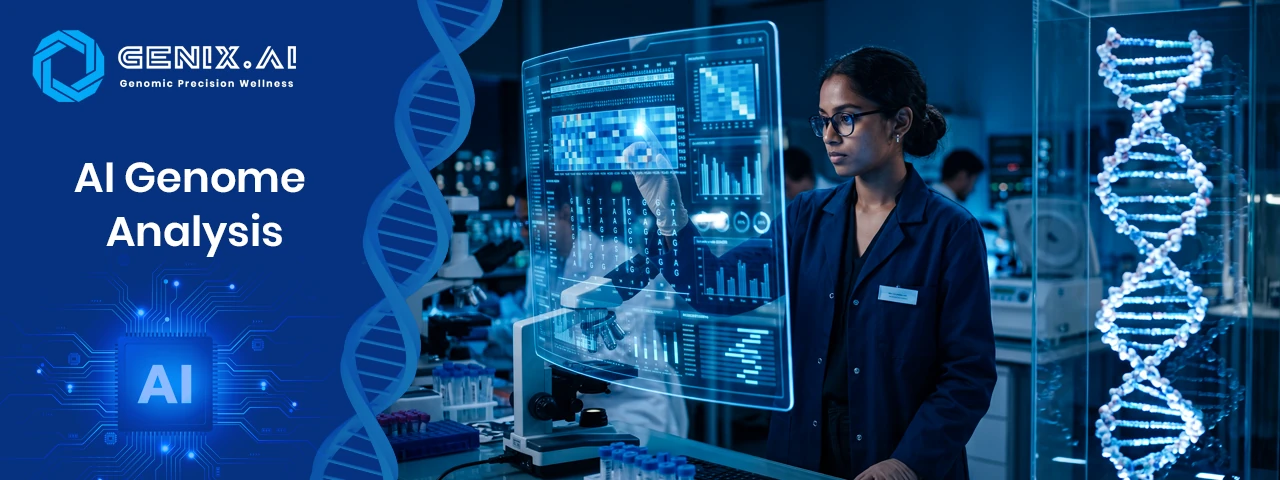
Genome analysis used to be something only research labs and hospitals with deep pockets could take seriously. Sequencing a genome is one thing, but making sense of the millions of data points inside it is another job entirely. In 2026, artificial intelligence has become the layer that turns raw genetic data into something doctors, researchers and even individuals can actually use. This blog looks at how AI is reshaping genome analysis this year, what has changed technically, and why it matters for anyone curious about their own biology or working in the field.
Why Genome Analysis Needed AI in the First Place
Sequencing machines got faster and cheaper long before interpretation caught up. Labs were generating more genomic data than their teams could review manually, and every new sample added to a growing backlog of unread information.
1. The Data Bottleneck
A single whole genome sequence can produce millions of variants once it is compared against a reference. Most of these are harmless, but a small fraction are not. Sorting through that volume without automated help simply is not realistic anymore, especially when results are needed for clinical decisions rather than pure research.
2. The Consistency Problem
Human reviewers get tired, miss things, or interpret ambiguous variants differently depending on their training. This inconsistency was one of the quieter problems in genomics for years, and it is one of the reasons AI models trained on large, curated datasets have found such a natural role here. They apply the same evidence criteria every time, which reviewers then check and refine.
What Changed Specifically in 2026
The past year brought a shift from AI that simply flags variants to AI that helps build a full clinical picture around them.
1. Better Variant Prioritisation
Modern models now weigh a variant against population frequency data, known disease associations and computational predictions of how it might affect protein function. Instead of handing a reviewer a flat list of thousands of variants, the system narrows attention to the handful that are actually worth a closer look.
2. Linking Genotype With Phenotype
One of the more meaningful advances this year has been connecting genetic findings with symptoms and clinical history rather than treating the genome as an isolated dataset. When a model can factor in a patient's reported symptoms alongside their variants, the resulting shortlist becomes far more relevant to the person sitting in front of a doctor.
3. Faster Turnaround on Complex Cases
Whole genome and whole exome analysis that once took a lab several weeks can now move through initial AI assisted review much faster, freeing up human experts to focus their time on the cases that genuinely need deeper judgment rather than routine filtering.
Where This Shows Up in Everyday Health
Genome analysis is not just a hospital story anymore. Consumer DNA testing has grown alongside these clinical advances, and people are using it for reasons well beyond curiosity about ancestry.
1. Preventive and Personalised Health
People increasingly want to know what their genetics suggest about metabolism, nutrition response, fitness recovery or inherited risk long before any symptom shows up. AI interpretation is what makes it possible to turn a raw genetic profile into something readable, structured and specific to that one person rather than a generic pamphlet of possibilities.
2. Family Planning and Hereditary Awareness
Carrier screening and hereditary risk reports rely heavily on AI supported interpretation to flag patterns that matter for future children. This kind of analysis has become far more accessible to couples planning a family, not just to those already facing a known genetic condition in the family line.
The Limits Worth Keeping in Mind
None of this means AI has replaced expert judgment, and it should not be mistaken for one. Genomic AI models are only as good as the data they were trained on, and rare or understudied populations can still be interpreted with less confidence. A predisposition flagged in a report is a signal to investigate further, not a diagnosis on its own. Responsible platforms keep a human reviewer in the loop precisely because context, family history and clinical judgment still matter enormously.
What This Means Going Forward
The direction is fairly clear. Genome analysis is moving from a slow, specialist bottleneck toward something closer to a routine part of health decision making, at least for people who choose to pursue it. AI is not doing the science instead of humans, it is doing the sorting, the pattern recognition and the heavy lifting so that human expertise can be applied where it actually counts.
Conclusion
The genome has always held more information than any person could interpret alone, and AI is finally closing that gap in a way that feels practical rather than futuristic. Whether it is a hospital processing sequencing data at scale or an individual trying to understand their own DNA test results, the interpretation layer built on artificial intelligence is what makes genome analysis usable rather than overwhelming. Genix.ai works in exactly this space, combining AI led interpretation with genomic sequencing to turn complex genetic data into insights people can actually act on, whether that is through its consumer DNA testing reports or its genomic intelligence platform built for hospitals and labs.
FAQs
1. What is genome analysis?
It is the process of examining a person's full genetic sequence to identify variants and understand what they might mean for health.
2. How does AI help with genome analysis?
AI helps sort through millions of genetic variants quickly and highlights the small number that are actually relevant to a person's health or symptoms.
3. Is AI based genome analysis accurate?
It performs well on well studied variants and populations, though results are still reviewed by human experts before being finalised.
4. Can genome analysis predict future disease?
It can flag inherited risk and predisposition, but it does not diagnose disease on its own and should be paired with professional medical advice.
5. Who can benefit from genome analysis?
Hospitals, diagnostic labs, researchers and individuals interested in personal wellness, nutrition, fitness or family planning can all use it in different ways.