Abstract
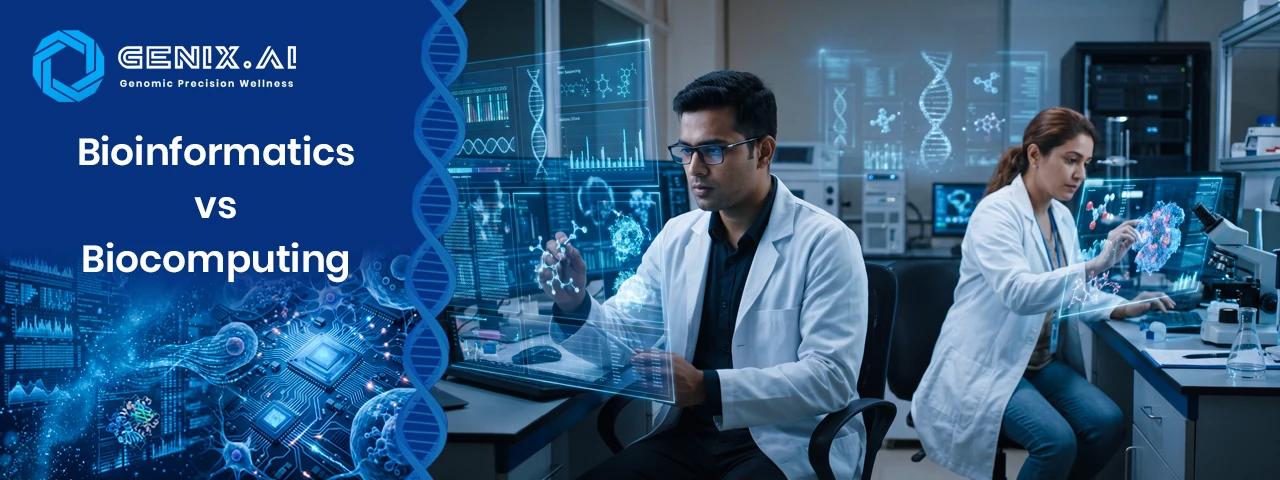
Ask a handful of scientists to define biocomputing and you may get a handful of different answers. Ask them about bioinformatics and the replies sound similar, yet the two words keep trading places in job ads, grant proposals and vendor brochures. That blur matters if you’re buying analysis, hiring a team or just trying to follow the news. This article sorts out what each term usually means and where they overlap. It also shows how they fit together in real projects, including how biocomputing services pick up where plain data analysis stops.
Two Words in One Crowded Space
1. Where the confusion comes from
Bioinformatics grew up alongside the Human Genome Project, which wrapped up in 2003. Back then the main job was storing and comparing sequences. Since then the field has stretched into structures, simulations and cloud scale computing, and the vocabulary stretched with it. Sequencing costs have dropped from around 100 million dollars per genome in the early 2000s to well under 1,000 dollars today. That flood of cheap data pulled more computing and more modeling into the same toolbox. Nobody issued an official ruling on what to call what.
2. A working definition for each
Here is a practical way to think about it. Bioinformatics is the craft of using software and statistics to organize and analyze biological data, especially sequences. Biocomputing is the wider umbrella. It includes that analysis but also reaches into modeling, simulation and the computing power needed to run them, often delivered as a service. Other writers draw the line a little differently, so treat this as a working map and not a law. Our own post on biocomputing and traditional bioinformatics takes a closer look at the split.
What Bioinformatics Does Best
1. Making sense of sequences
A sequencer produces millions of short fragments. Bioinformatics lines them up against a reference genome, spots where a sample differs and measures which genes are active. Tools such as GATK and DESeq2 are everyday names here. This is the heart of next generation sequencing analysis, and it answers a basic question. What is different in this sample?
2. Giving variants meaning
Finding a change in DNA is only half the job. Clinicians want to know whether it matters, so each variant gets checked against public resources such as ClinVar and gnomAD. That interpretation step is where analysis starts to touch patient care, and it’s why hospitals and labs lean on solid bioinformatics support.
What Biocomputing Adds
1. Modeling and simulation
Knowing a gene is switched on doesn’t tell you what its protein looks like or which molecule might block it. Biocomputing steps in here. Structure prediction tools such as AlphaFold, whose public database covers more than 200 million proteins, give researchers a model to work with. Molecular docking then tests how well candidate compounds fit, and simulation checks whether that fit holds up as atoms move.
2. Computing at scale, delivered on demand
The second addition is practical. Heavy analysis needs serious hardware, repeatable workflows and people who can keep both running. Biocomputing in this sense means all of that packaged as a service, so a small lab doesn’t have to build it first. Custom pipeline development is one clear example.
Bioinformatics vs. Biocomputing
1. Bioinformatics: Focuses on analyzing biological data to understand its meaning. It uses sequencing reads and variant files for alignment, variant calling, and gene expression analysis. Typical outputs include annotated variants, gene lists, and research figures. It is widely used by laboratories and clinical teams.
2. Biocomputing: Focuses on understanding biological behavior and testing potential outcomes computationally. It uses biological sequences, structures, and compound libraries for structure prediction, molecular docking, and simulations. Typical outputs include structural models, binding scores, simulation trajectories, and candidate shortlists. It is useful for drug developers and research teams.
Key Difference: Bioinformatics primarily analyzes biological data, while biocomputing extends computational methods to model and investigate biological systems. Both approaches often work together in modern research projects.
How the Two Work Together
1. One workflow, two stages
Think of bioinformatics as the first half of a relay and biocomputing as the second. The first runner finds what is interesting. The second takes it further.
Sequencing data → Bioinformatics analysis → Target or variant → Biocomputing models and simulation → Lab testing2. An illustrative scenario
This is a typical scenario and not a client story. A biotech team has RNA from treated and untreated cells. Differential expression analysis, listed at 3 to 5 days on the BioCompute service page, points to one gene that jumps. The team then predicts the protein’s structure, a step the same page lists at 3 to 5 days. A docking campaign comes next, listed at 5 to 10 days, ranking compounds worth ordering. No single stage did all the work, and the project needed both halves. Each stage also feeds back into the one before it, so a poor docking result can send the team back to look again at the original gene list.
Who Needs Which
1. Academic labs and clinical teams
If your main question is what your data shows, bioinformatics is probably the heart of the job. The BioCompute page describes publication ready figures, statistics and methods support for researchers.
2. Drug developers
If you also need to test ideas before spending on lab work, biocomputing earns its place. Pharma and biotech groups often lean on outsourced computational biology for exactly this reason.
3. Anyone buying a service
It’s easy to get lost in labels, so ask for specifics. What input formats do they accept, what deliverables come back and how long does it take? A provider who answers plainly usually knows the work.
Conclusion
Bioinformatics and biocomputing are not rivals. They are neighbors who share a fence and a lot of tools. Genix.ai covers both sides through its BioCompute service, which lists NGS data analysis and protein modeling with docking, plus custom pipelines, under the banner of bioinformatics analysis as a service. A PhD founder reviews every deliverable, and the service page states costs run 50 to 70 percent below traditional CROs. A free consultation of about half an hour is the easiest way in. If you’re exploring biocomputing services, begin on the BioCompute page.
FAQ's
1. What is the main difference between bioinformatics and biocomputing?
Bioinformatics focuses on analyzing biological data while biocomputing is a wider term that adds modeling, simulation and the computing behind them.
2. Are bioinformatics and biocomputing the same thing?
They overlap heavily and people often use them interchangeably, though there is no single official definition.
3. Which one do I need for sequencing data?
Sequencing analysis is core bioinformatics work, and biocomputing services often bundle it with later modeling steps.
4. Does biocomputing replace lab experiments?
No, it helps narrow the options so lab work goes to the most promising candidates.
5. Can I outsource both to one provider?
Yes, many providers cover analysis and modeling under one engagement.