Genomic reports can shape real clinical conversations. A hospital may use them to understand inherited risk, and a laboratory may use them to support specialist review. That is why an AI-generated genomic insight cannot be a black box.
For hospitals and labs in India, trust comes from two linked qualities: clear reasoning and disciplined validation. Validation explainability genomics brings these qualities together. It shows what the system found, why it matters, how strong the evidence is, and where clinical caution is needed.
Here is what explainability and validation mean for credible genomic reporting.
Abstract
A genomic report doesn't just sit in a folder it can shape how a doctor reads inherited risk, or how a lab decides what needs specialist review. That's a lot of weight to put on something that just spits out an answer with no reasoning behind it. This piece looks at why AI-generated genomic insights need to show their work the evidence, the strength of the finding, where the uncertainty is instead of just stating a conclusion. It also walks through how Genix builds that discipline in, layer by layer: checking data quality first, mapping evidence next, running it through clinical logic, and finally making sure the language actually makes sense to whoever's reading it, whether that's a physician or a patient. There's also a section on why this matters more, not less, in India, given how genetically diverse the population is and how much research still leans on non-Indian datasets.
What Explain ability Means in Genomic Reporting
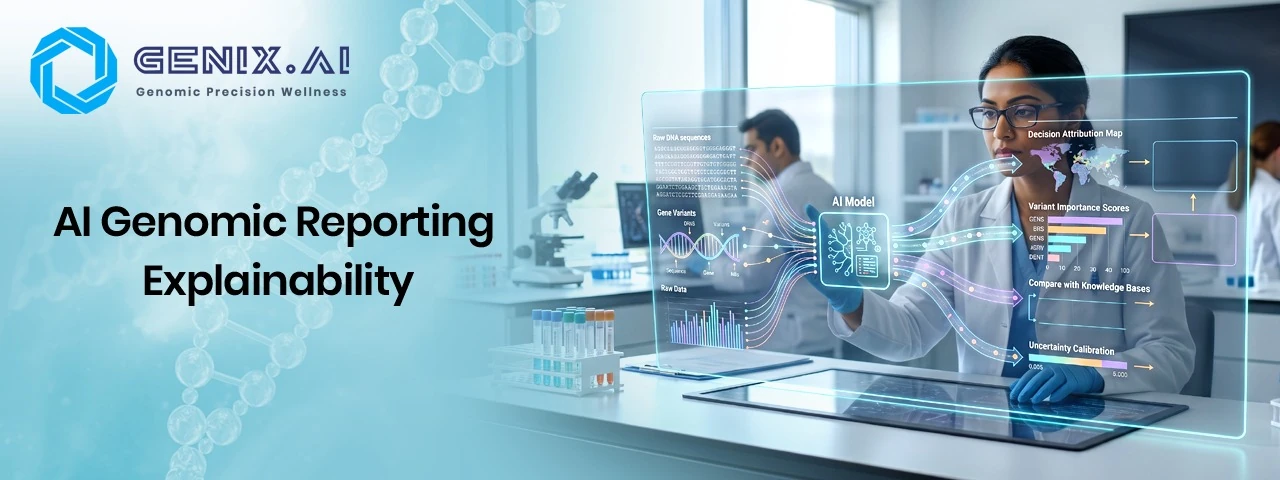
Explainability means that a genomic report should not only state an insight. It should show the reasoning behind it.
In genomic reporting, this includes:
- The gene or variant connected to the insight.
- The evidence category used to interpret it.
- The strength of the gene-disease or gene-trait association.
- The relevance of the finding for the person being tested.
- The limits of interpretation.
This matters because DNA remains largely stable throughout life, while scientific interpretation continues to improve. A variant that appears uncertain today may become clearer as research grows.
Explainability allows clinicians, genetic counsellors, and lab teams to separate strong findings from early signals.
Why AI Needs More Than Accuracy
AI can process large genomic datasets quickly. It can identify patterns across variants, publications, phenotype data, population frequencies, and clinical annotations. This is valuable when clinical genome sequencing produces millions of data points from one sample.
A credible AI genomic report must answer three questions:
Question | Why it matters |
What was found? | The report should identify the relevant gene, variant, or biological pathway. |
Why does it matter? | The interpretation should be linked to recognised evidence and clinical relevance. |
How reliable is it? | The report should show confidence, limitations, and review status. |
Without these answers, a finding may look impressive but remain difficult to trust. In healthcare, an unexplained prediction is not enough for responsible use.
The Clinical Risk of Unexplained Genomic Insights
A clinician may not know whether a variant is clinically actionable. A lab may struggle to defend the report during an audit. A patient may make health decisions based on an incomplete understanding.
The risk is higher when the report connects DNA to disease predisposition, drug response, nutrition, fitness, or inherited conditions. These areas require careful wording because genes rarely act alone. Environment, age, medical history, family background, and lifestyle also influence outcomes.
That is why evidence-based genomic reporting should avoid absolute statements. It should present genetic tendency, clinical relevance, and recommended next steps in clear language.
How Validation Builds Hospital and Lab Credibility
Genetic validation adds discipline to the process. It checks whether the insight is scientifically supported, technically reliable, and suitable for the stated use.
A strong validation framework usually examines:
- Analytical reliability, including sample quality, sequencing performance, and variant calling accuracy.
- Scientific evidence, including peer-reviewed research and curated clinical knowledge.
- Clinical relevance, including screening, prevention, counselling, or referral value.
- Population relevance, including whether evidence applies reasonably to Indian users.
- Reporting clarity, including whether the language is understandable and not overstated.
For B2B partners, this creates an audit-friendly record. It also gives clinicians a clearer basis for discussing results with patients.
How Genix Validates Every Clinical Insight
Genix treats validation as a layered process rather than a final editorial step. Each insight moves through scientific, computational, and clinical checks before it appears in a report.
- The process begins with a data quality review. Poor-quality reads, unclear variant calls, or weak coverage can affect interpretation. These signals must be flagged before any health insight is generated.
- The next layer is evidence mapping. Genix links each insight to relevant genes, variants, biological pathways, and published evidence. The goal is to determine whether the finding is well-supported or still emerging.
- Then comes interpretation review. This is where genomic data science becomes essential. Bioinformatics pipelines, statistical checks, population data, and clinical logic are assessed together. The output is not considered final until it passes the consistency checks.
Finally, report language is reviewed for clarity. Findings are written so patients can understand them, while clinicians can still see the evidence trail.
What Explainable Reports Should Show
An explainable genomic report should make the evidence visible without overwhelming the reader.
A useful report should show:
- What the insight means for health, wellness, risk, or response.
- Whether the finding is strong, moderate, limited, or uncertain.
- Why the insight appears in the report.
- Whether the result needs clinician review, counselling, or confirmatory testing.
- What the user should not assume from the result.
This structure is important because reports may be read by different people. A physician, nutritionist, genetic counsellor, laboratory director, and patient may all need different levels of detail.
Why Human Oversight Still Matters
AI can organise complex genomic information, but responsible genomic interpretation still needs expert oversight.
Human review is important because clinical meaning depends on more than data points. Reviewers must consider the phenotype, family history, test purpose, and the medical significance of the finding. They must also decide whether the evidence is strong enough for a patient-facing report.
A well-governed genomic research centre should combine automated analysis with expert review, documentation, and quality control. This balance reduces avoidable errors and keeps the report aligned with clinical responsibility.
Why This Matters for India
India has wide genetic diversity, mixed ancestry patterns, and varied access to specialist care.
A finding based mainly on non-Indian populations may not carry the same strength for an Indian user. Labs and hospitals need reporting systems that clearly acknowledge this. They also need workflows that respect consent, privacy, responsible data use, and clinical boundaries.
As genomics expands across preventive health, reproductive planning, oncology, rare disease evaluation, and pharmacogenomics, explainable reporting will become central to patient trust.
The Future of Trustworthy Genomic Reporting
The next phase of genomic reporting will not be defined only by faster sequencing or larger databases. It will be defined by transparent interpretation.
Hospitals and labs will increasingly look for reports that can withstand clinical review, patient questions, and quality audits. Patients will also expect reports that explain results without fear, confusion, or exaggerated claims.
Explainability turns genomic reporting into a guided interpretation rather than a raw data dump. Validation turns that interpretation into something clinicians can examine, discuss, and use responsibly.
For Genix, the value of AI in genomics lies in making complex science clearer, not louder. When every insight is validated, traceable, and explained, genomic reporting becomes more useful for hospitals, labs, clinicians, and the people whose DNA is being interpreted.