Abstract
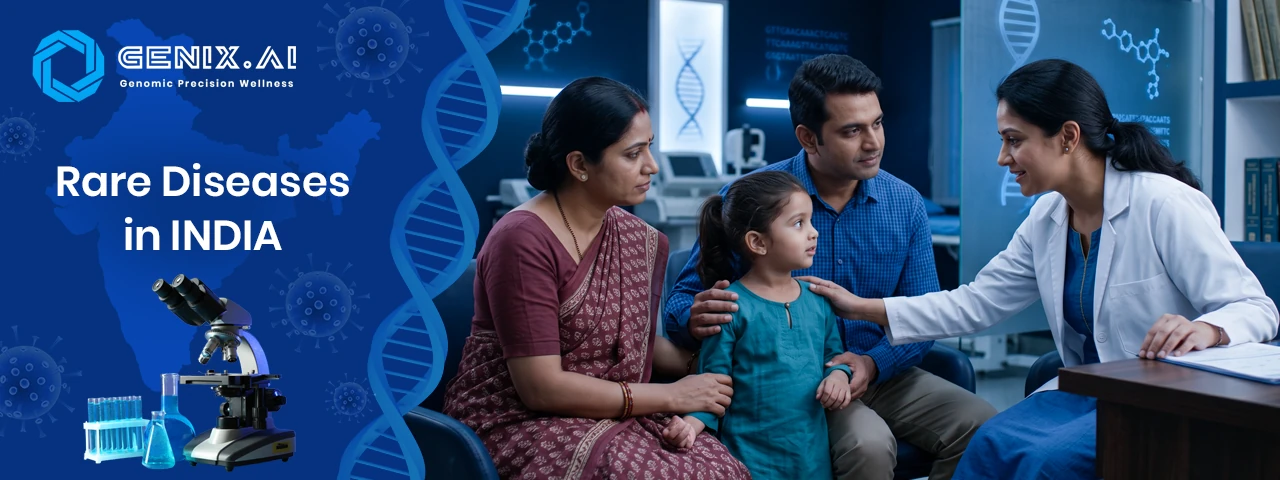
When people hear the word rare disease, they often picture something distant, almost theoretical. But rare does not mean uncommon in India. Some estimates suggest tens of millions of people across the country live with a condition that fits the rare disease definition, and most of them struggle for years before they even get a correct diagnosis. This blog looks at ten conditions that keep surfacing in India's rare disease conversation, why they deserve more government focus, and what genetic testing can do to close the diagnostic gap that leaves so many families waiting.
Understanding What Counts As A Rare Disease
Before naming the conditions, it helps to understand where the line is drawn. The World Health Organization generally defines a rare disease as one that affect one person or fewer per thousand in a population, though the exact threshold varies from country to country depending on health infrastructure and resources.
Top 10 rare diseases in India
1. Thalassemia
An inherited blood disorder where the body produces less haemoglobin than normal, often requiring regular blood transfusions throughout a person's life.
2. Sickle Cell Anaemia
A genetic condition that causes red blood cells to form a rigid shape, leading to pain episodes, anaemia and a higher risk of infection.
3. Haemophilia
A clotting disorder where blood does not clot properly due to a missing or deficient clotting factor, leading to prolonged bleeding after injury.
4. Gaucher Disease
A lysosomal storage disorder where the body lacks the enzyme needed to break down certain fatty substances, causing them to build up in the spleen, liver and bone marrow.
5. Pompe Disease
Another lysosomal storage disorder, this one affecting the muscles due to an enzyme deficiency that leads to a buildup of glycogen, gradually weakening the heart and skeletal muscles.
6. Spinal Muscular Atrophy
A genetic neuromuscular condition causing progressive muscle weakness and loss of movement, most often diagnosed in early childhood.
7. Duchenne Muscular Dystrophy
A genetic muscle wasting disorder that primarily affects boys, causing progressive muscle weakness that typically becomes noticeable in early childhood.
8. Cystic Fibrosis
An inherited condition that affects the lungs and digestive system, caused by a faulty gene that leads to thick, sticky mucus buildup in the body.
9. Primary Immunodeficiency Disorders
A group of genetic conditions where part of the immune system is missing or does not function properly, leaving children more vulnerable to repeated infections from an early age.
10. Hirschsprung's Disease
A condition present from birth where nerve cells are missing from parts of the large intestine, making it difficult for the bowel to function normally.
Why Definitions Matter For Policy
India's own definition matters because it decides who qualifies for government support. The country's National Policy for Rare Diseases, approved in 2021, set up a framework for diagnosis, treatment and financial assistance at designated centres of excellence, but caregivers and advocacy groups have repeatedly said the coverage still falls short of the real cost of lifelong treatment.
How Many Rare Diseases Exist In India
Roughly 450 rare diseases have been formally recorded in the country so far, a number that keeps growing as diagnostic tools improve. Many more likely go unidentified simply because doctors outside major cities have never encountered them before.
The Diseases That Keep Coming Up In India's Rare Disease Data
Based on national health data and the categories recognised under India's rare disease policy, a few conditions appear again and again when experts discuss the country's biggest rare disease burden.
Blood And Inherited Disorders
Thalassemia and Sickle Cell Anaemia are two of the most widely discussed inherited blood disorders in India, both requiring lifelong management and, in many cases, regular blood transfusions. Haemophilia follows close behind, a clotting disorder that shows up in two main forms depending on which clotting factor is missing.
Metabolic And Storage Disorders
Gaucher Disease and Pompe Disease both fall under a group known as Lysosomal Storage Disorders, where the body lacks the enzymes needed to break down certain substances, leading to their gradual buildup in cells. These are among the conditions where enzyme replacement therapy exists but remains expensive and hard to access outside specialised centres.
Neuromuscular Conditions
Spinal Muscular Atrophy and Duchenne Muscular Dystrophy are two neuromuscular disorders that cause progressive muscle weakness, often diagnosed in early childhood. Both require ongoing physical therapy and specialist care, and both are frequently cited in India's rare disease advocacy discussions because treatment options, where they exist, come at a very high cost.
Immune And Developmental Disorders
Primary Immunodeficiency disorders in children weaken the body's ability to fight infections from a young age, often leading to repeated hospital visits before anyone suspects a genetic cause. Cystic Fibrosis, which affects the lungs and digestive system, and Hirschsprung's Disease, a condition affecting the nerves in the intestine, round out the list of conditions that Indian clinicians and patient groups continue to flag as needing more attention and resources.
Why These Diseases Struggle To Get Government Attention
It is worth asking why conditions affecting so many families still do not get the visibility that more common diseases receive.
The Diagnosis Gap
Many rare diseases share symptoms with more common illnesses in their early stages, which means patients are often treated for the wrong condition for months or years before someone thinks to test further. In smaller towns, the specialists needed to even suspect a rare genetic disorder may not be available at all.
The Cost Barrier
Treatment for several of these conditions, particularly the lysosomal storage disorders, can run into costs that most Indian families simply cannot absorb on their own. Even with government schemes in place, the gap between what is covered and what treatment actually costs remains a serious problem that patient groups continue to raise.
The Data Problem
India still does not have a fully centralised national registry that tracks every diagnosed rare disease case. Without solid data on how many people actually have each condition and where they are located, it becomes harder for policymakers to plan resources, fund research or decide which centres of excellence need to be expanded.
What Needs To Change
None of this means progress has been absent. The 2021 policy was a real step forward, but the ten conditions above show where the gaps still sit.
Wider Newborn And Carrier Screening
Many of these conditions, including thalassemia and sickle cell disease, can be identified earlier through carrier screening and newborn screening programs, which could reduce the number of children born with severe, undiagnosed forms of these disorders.
Faster Access To Genetic Diagnosis
Genetic and genomic testing can cut down the diagnostic odyssey that so many rare disease families go through, sometimes turning a multi year search for answers into a matter of weeks.
Stronger Regional Infrastructure
Centres of excellence currently sit mostly in major metros, leaving families in smaller cities and rural areas with long travel times just to get a proper evaluation. Expanding this network, even gradually, would make a real difference.
Conclusion
Rare diseases in India are not actually rare when you add up the numbers, they are simply under discussed, underfunded and often undiagnosed for far too long. The ten conditions covered here are only part of a much longer list, but they represent where genetic testing and earlier screening could make the most immediate difference for families searching for answers. Genix.ai offers a rare disease genetic panel designed to screen for a wide range of hereditary conditions, giving individuals and families a starting point for understanding inherited risk long before symptoms become severe.
FAQs
1. What officially counts as a rare disease in India?
A condition affecting a very small proportion of the population, generally aligned with WHO's threshold of one or fewer people per thousand.
2. How many rare diseases are currently recorded in India?
Roughly 450 rare diseases have been documented so far, though the real number is likely higher.
3. Does the government provide financial help for rare disease treatment?
Yes, through the National Policy for Rare Diseases 2021, which offers support at designated centres of excellence.
4. Can genetic testing help detect these conditions early?
Yes, genetic testing can identify inherited risk factors long before symptoms appear, especially for conditions like thalassemia and sickle cell disease.
5. Why do rare diseases often take so long to diagnose?
Their symptoms frequently overlap with more common illnesses, and many doctors have limited exposure to rare genetic conditions.