Abstract
Regulators want mechanism-level evidence. Global markets want peer-reviewed proof. And funding bodies expect computational validation before clinical conversations even begin.
Molecular docking is the most practical, cost-effective answer to that demand. It answers the one question every AYUSH formulation must eventually face: does this compound actually bind to its claimed target and how strongly?
This explains what molecular docking is, why it is now non-negotiable for AYUSH validation in 2026, and how Genix.ai BioCompute delivers PhD-reviewed docking studies starting at $1,000 with results in 5–10 days.
Why AYUSH Drug Validation Can No Longer Skip Computational Science
1. Regulatory Pressure Is Real and Growing
The Ministry of AYUSH now expect mechanism-of-action documentation, target identification, and safety profiling as standard components of any credible new formulation dossier. These are no longer optional.
International markets are stricter still. European frameworks, US FDA botanical guidance, and WHO monograph standards all require reproducible molecular-level evidence before broader clinical claims can be supported. Molecular docking provides an exactly rigorous, reproducible method for demonstrating that a bioactive compound interacts with a specific biological target, with quantifiable binding affinity data to back it up.
2. The Publication Gap Hurting AYUSH Credibility
Thousands of traditional AYUSH formulations remain clinically plausible, but computationally invalidated. That means they cannot anchor regulatory submissions, cannot attract serious research funding, and cannot enter global licensing conversations.
Molecular docking closes that gap faster than any other method. A well-executed study covering compound preparation, target docking, profiling, and network pharmacology produces a complete, publication-ready dataset that can support a journal submission, a patent filing, or the computational chapter of a regulatory dossier.
In 2026, this is not a future consideration for AYUSH companies. It is a present competitive necessity.
What Molecular Docking Actually Does for AYUSH Compounds
1. From Plant to Protein The Core Mechanism
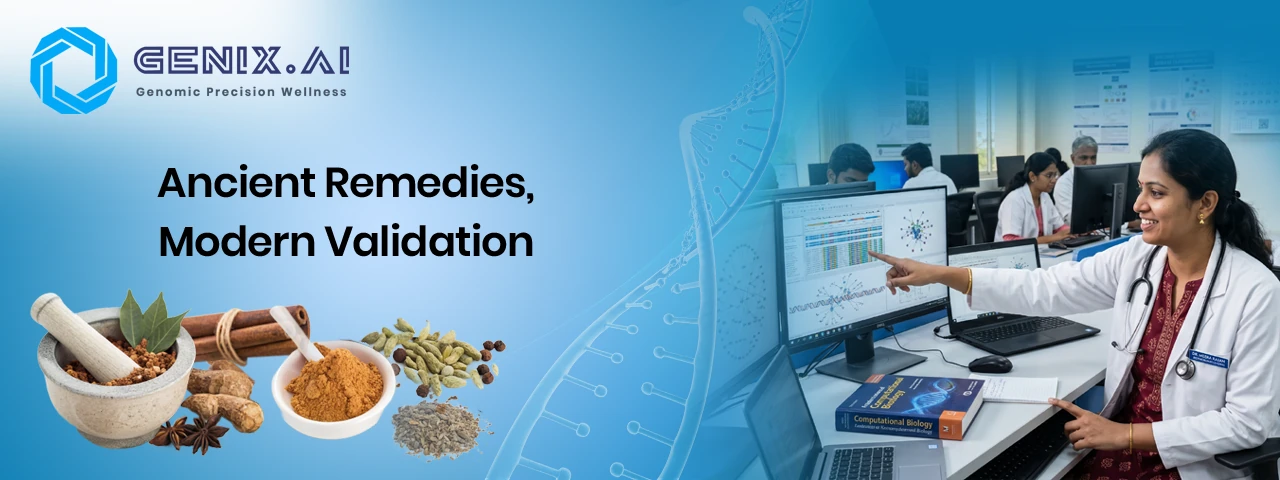
Every AYUSH formulation contains bioactive phytochemicals flavonoids, alkaloids, terpenoids, glycosides each with a distinct three-dimensional molecular structure. Molecular docking computationally simulates what happens when one of those phytochemicals encounters a disease-relevant target protein.
Using the 3D structures of both the compound and the protein, docking software calculates the most energetically favorable binding configuration and assigns a binding affinity score. A strong score confirms meaningful interaction. A weak score saves months of wet lab time chasing a dead end.
Whether it is Ashwagandha targeting cortisol receptors, curcumin analogues against COX-2, or a Siddha compound evaluated against a dengue protease the workflow is identical, and the output is directly usable in publications and regulatory filings.
2. Network Pharmacology Built for Multi-Target Formulations
Unlike synthetic drugs engineered for a single protein, AYUSH formulations typically contain dozens of bioactive compounds acting simultaneously across multiple disease pathways. Single-target drug models cannot fairly evaluate them.
Network pharmacology maps these multi-target interactions computationally identifying which compounds hit which proteins, how those proteins connect within a disease network, and which nodes are most pharmacologically significant. It makes the scientific case for a formulation's mechanism on its own terms.
Genix.ai BioCompute delivers network pharmacology analysis as part of its AYUSH docking service producing target interaction networks, pathway enrichment maps, and hub target identification that hold up under both peer review and regulatory scrutiny.
3. ADMET Profiling Predicting Safety Without Animal Studies
ADMET Absorption, Distribution, Metabolism, Excretion, and Toxicity is required by regulators, expected by journal reviewers, and essential before any serious development conversation. Computational ADMET using SwissADME and RDKit predicts these properties directly from molecular structure.
For AYUSH compounds with centuries of empirical safety history but limited formal pharmacokinetic documentation, computational ADMET provides the scientific bridge between traditional use evidence and modern regulatory language. Genix.ai BioCompute includes it in every docking engagement the deliverable is never just a binding score.
The Genix.ai BioCompute Docking Workflow End to End
1. Compound Library Preparation
The project begins with identifying and preparing the bioactive compounds in the formulation. Three-dimensional molecular structures are sourced from PubChem, ChemSpider, and ZINC, then energy-minimized and geometry-optimized for docking accuracy. For complex multi-herb formulations, this can involve libraries of 50 to 500+ compounds handled entirely by the Genix BioCompute team within the project scope.
2. Target Protein Selection and Preparation
The disease-relevant target protein is selected based on the formulation's claimed therapeutic indication, sourced from the Protein Data Bank, cleaned, protonated at physiological pH, and validated for docking readiness. Where the target is less clearly defined common in conditions like metabolic syndrome or immune modulation Genix BioCompute applies reverse docking and disease-target databases to identify the most pharmacologically relevant proteins.
3. Docking Simulation, Scoring, and Benchmarking
Docking is performed using AutoDock Vina against prepared targets. Output includes binding affinity scores, binding poses visualized in PyMOL, key interacting residues, hydrogen bond maps, and hydrophobic contact analysis. Top-scoring compounds are benchmarked against known reference ligands or approved drugs at the same target providing the comparative context that reviewers require.
4. MD Simulation for Binding Stability
For lead compounds, Genix.ai BioCompute offers GROMACS molecular dynamics simulation to confirm binding stability over time. Docking gives a snapshot. MD simulation runs that snapshot forward typically 50 to 100 nanoseconds confirming whether the complex holds under physiological conditions. RMSD, RMSF, and binding free energy outputs elevate a docking study from preliminary to conclusive.
5. Publication-Ready Deliverable Package
Every engagement closes with binding affinity tables, docking pose figures, ADMET summary, network pharmacology maps where applicable, a methods section written to journal submission standards, and all raw output files for reproducibility. The package is designed to go directly into submission no additional formatting or interpretation is required.
Transparent Pricing Directly from Genix BioCompute
All prices in USD. Volume discounts available for 20+ samples.
Service | Starting Price | Turnaround | Key Deliverables |
Molecular Docking Campaign | $1,000 | 5–10 days | Binding scores, poses, ADMET, interaction maps |
Protein Structure Prediction | $500/target | 3–5 days | PDB file, validation report, visualization |
MD Simulation | $2,000/run | 7–14 days | Trajectory, RMSD/RMSF, binding free energy |
RNA-Seq Analysis | $150/sample | 3–5 days | QC, alignment, DE, pathway analysis, figures |
WGS / WES Analysis | $200/sample | 5–7 days | Variant calling, annotation, VCF + report |
Custom Pipeline Development | $5,000 | 2–4 weeks | Nextflow/Snakemake pipeline, Docker, docs |
For multi-compound libraries, full AYUSH validation packages, or institutional engagements, contact biocompute@genix.ai for a custom scope and quote.
Who This Service Is Built For
AYUSH pharmaceutical companies preparing CDSCO dossiers or international regulatory submissions need docking data that directly supports mechanism-of-action claims Genix BioCompute delivers it submission-ready.
Nutraceutical and functional food brands seeking science-backed differentiation use docking results to publish peer-reviewed validation of key bioactives and support credible marketing claims.
Academic researchers and PhD students working on herbal pharmacology or computational drug discovery use Genix BioCompute to produce the computational chapter of a thesis or the supplementary data for a journal manuscript.
Biotech startups repurposing traditional medicine compounds for modern pipelines use network pharmacology and docking data as the preclinical computational evidence needed to attract seed funding or enter accelerator programs.
Conclusion
Molecular docking is no longer specialist infrastructure for large pharma teams. In 2026, it is the minimum credible evidence layer for any AYUSH formulation pursuing regulatory approval, international market entry, or serious research investment.
Your formulation has centuries of traditional evidence behind it. What it needs now is the computational proof that regulators, reviewers, and investors understand.
Genix.ai BioCompute delivers PhD-reviewed, publication-grade molecular docking starting at $1,000 — with a 5–10 day turnaround, full NDA protection, and a deliverable built for direct submission.
👉 Request your free consultation at genix.ai/molecular-docking
Frequently Asked Questions
Q: What is molecular docking and why does it matter for AYUSH validation?
It computationally proves how a herbal compound binds to a disease target the mechanism evidence regulators and journals now require.
Q: Which AYUSH systems can be validated using molecular docking?
All of them Ayurveda, Siddha, Unani, Homeopathy, and nutraceutical formulations are supported.
Q: How much does a molecular docking campaign cost at Genix BioCompute?
A full molecular docking campaign starts at $1,000, with results delivered within 5–10 days.
Q: What is network pharmacology, and do I need it for a multi-herb formulation?
It maps multi-target interactions across disease networks essential for any formulation acting through more than one biological pathway.
Q: Is ADMET profiling included in every docking engagement?
Yes , full ADMET profiling covering absorption, distribution, metabolism, excretion, and toxicity is included as standard.
Q: Will the deliverable be ready for direct journal or regulatory submission?
Yes , binding data, figures, a written methods section, and raw files are all formatted for direct submission.
Q: How many compounds can be included in a single docking campaign?
From a single compound to libraries of 500+ phytochemicals scope is defined during the free consultation.
Q: Is my formulation data protected under NDA?
Yes ,all projects are NDA-protected, and you retain full ownership of all results, code, and analysis.
Q: Can this analysis support a CDSCO regulatory dossier?
Yes, the computational validation, ADMET profiles, and mechanism documentation are structured specifically for regulatory inclusion.
Q: How do I get started?
Visit genix.ai/molecular-docking, submit your project details, and receive a free scoping response within 24 hours.