Abstract
In October 2024, the Nobel Prize in Chemistry was awarded to the architects of AlphaFold, the first Nobel Prize for a breakthrough enabled entirely by artificial intelligence. That prize recognized AlphaFold2. AlphaFold3, released the same year, has already moved further: it predicts entire molecular complexes proteins interacting with DNA, RNA, and drug candidates with 76% accuracy on ligand binding poses, double that of any prior computational method. For AI-native genomics platforms like Genix.ai, this is not an incremental upgrade. It is a structural intelligence layer that elevates clinical variant interpretation, powers drug discovery workflows, and accelerates rare disease research in ways that were computationally inaccessible two years ago.
AlphaFold3: Artificial Intelligence-Powered Protein Structure Prediction Model, Version 3, developed by Google DeepMind and Isomorphic Labs.
AlphaFold3 The Nobel Prize-Winning AI Redefining Molecular Biology in 2026
AlphaFold3 (Artificial Intelligence-Powered Protein Structure Prediction Model, Version 3) is a deep learning system jointly developed by Google DeepMind and Isomorphic Labs that predicts the 3D structure of proteins, DNA, RNA, and small-molecule ligands from sequence data alone.
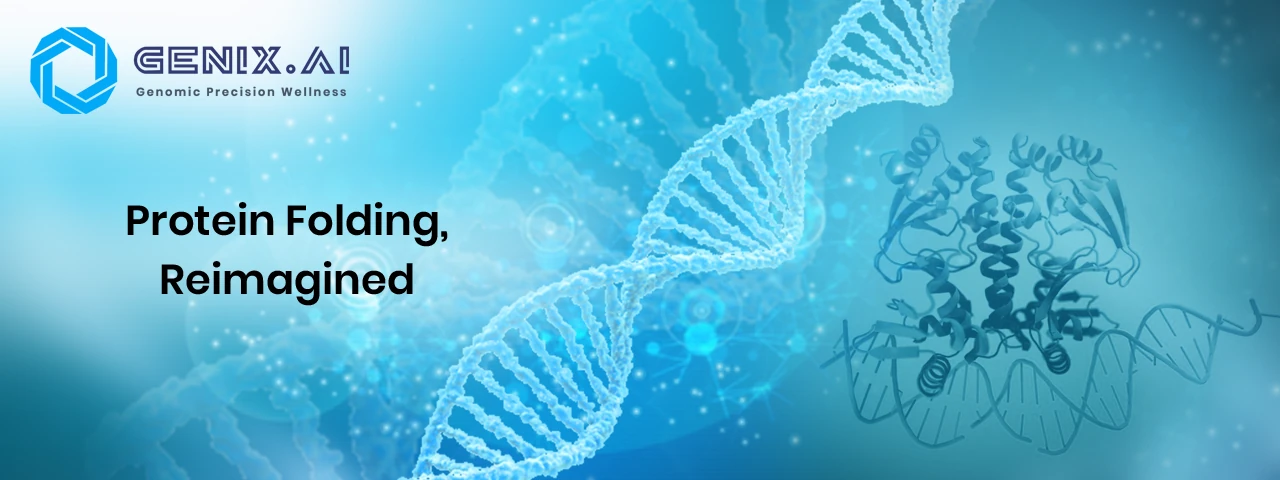
The lineage matters. AlphaFold2 solved the protein folding problem, a challenge that had resisted structural biology for fifty years. Its developers, Demis Hassabis and John Jumper, received the 2024 Nobel Prize in Chemistry for that work. AlphaFold3 shifts the paradigm further: from predicting how a single protein folds, to predicting how entire molecular systems interact. Its diffusion-based architecture simultaneously models full molecular complexes at atomic resolution drug candidates binding to target proteins, RNA folding alongside regulatory proteins, antibody-antigen interactions in a single unified pass. Where AlphaFold2 handled one chain at a time, AlphaFold3 handled the entire biological scene.
Following the open-source release of its code for non-commercial academic use, adoption has accelerated globally. As of March 2026, the AlphaFold Database maintained by EMBL-EBI houses over 200 million predicted structures and has added millions of protein complex predictions, the largest publicly available structural dataset in history.
For Genix.ai, built at the convergence of NGS, AI-driven annotation, and clinical bioinformatics, AlphaFold3 is the structural engine behind its BioCompute service line and clinical annotation capabilities available today, delivered in days.
76% Ligand Binding Accuracy Why This Number Matters for Drug Discovery
AlphaFold3 achieves 76% accuracy on protein-ligand binding pose prediction, a 1.8-fold improvement over any competing method. For drug discovery teams, this is the figure that changes timelines.
Traditional structure determination through X-ray crystallography or cryo-EM is powerful but slow and structurally limiting. Virtual drug screening that previously required six months of crystallography now runs in 48 hours using AlphaFold3-predicted structures as docking inputs. Genix.ai's BioCompute molecular docking service at $1,000 per study uses AlphaFold3 structures as docking targets and delivers binding scores, docking poses, ADMET predictions, and interaction maps. For AYUSH drug validation, this provides computational evidence for phytochemical efficacy against predicted target structures that often have no experimental crystal structure available.
Downstream, molecular dynamics simulation at $2,000 per run models how drug-protein complexes behave over time not just whether they bind, but whether binding is stable under physiological conditions. AlphaFold3's high-confidence input structures sharpen MD accuracy significantly. The complete Genix.ai in silico pipeline protein structure prediction at $500 per target, molecular docking at $1,000, MD simulation at $2,000 is PhD-reviewed and delivered in days through Genix.ai BioCompute.
From Sequence to Structure to Function AlphaFold3 in Clinical Variant Interpretation
NGS generates enormous variant data volumes. The bottleneck has never been sequencing it has been classifying what variants actually do. For the thousands of variants of uncertain significance (VUS) identified in clinical WGS and WES panels, structural annotation is the missing interpretive layer.
AlphaFold3 enables structural impact modeling at the variant level. A missense mutation in a disease-relevant gene can now be modeled in full molecular context: does it disrupt a binding domain, destabilize protein folding, prevent protein-protein interaction, or abolish cofactor binding? This moves interpretation beyond sequence-level ACMG classification into functional territory.
Genix.ai's AI Clinical and Annotation Engine integrates structural predictions alongside sequence annotations from ClinVar, gnomAD, and CADD to deliver variant reports with mechanistic depth. For clinical teams using Genix Shield™ for preventive risk screening, Genix Rx™ for pharmacogenomics, or Genix Rare™ covering 750+ genetic disorder markers this structural layer converts reports from descriptive to actionable. WGS and WES analysis through Genix.ai BioCompute starts at $200 per sample and incorporates this interpretation pipeline as standard.
Open Access, AlphaFast, and What the 2026 Research Ecosystem Looks Like
AlphaFold3's open-source release for academic non-commercial use was a defining moment making the most accurate structural prediction tool in history freely accessible to research institutions worldwide. In parallel, new frameworks like AlphaFast, which integrates GPU-accelerated MSA generation via MMseqs2, are eliminating the primary throughput bottleneck in AlphaFold3 pipelines. Large-scale structural campaigns across entire target panels are now feasible for mid-scale labs.
For teams who want AlphaFold3 without building the infrastructure, Genix.ai abstracts that burden entirely. Whether the need is a single protein structure prediction, a docking campaign, or a custom Nextflow/Snakemake pipeline with AlphaFold3 as a structural input module, Genix.ai delivers it under NDA with full IP ownership retained by the client. Custom pipeline development starts at $5,000 and includes Docker containerization, cloud deployment, and documentation.
Population Intelligence The South Asian Calibration Gap AlphaFold3 Cannot Fill Alone
AlphaFold3's training draws from the Protein Data Bank, a repository overwhelmingly biased toward proteins studied in European and North American research contexts. The clinical consequence is direct: variants common in South Asian populations may be structurally annotated against reference backgrounds that do not reflect Indian genomic diversity, increasing the risk of misclassification as benign.
India carries one of the highest rare disease burdens globally, with a high prevalence of population-specific founder variants in genes linked to metabolic disorders, neurodevelopmental conditions, and hereditary cancers. Running these through Eurocentric structural annotation pipelines without correction is a clinical quality problem.
Genix.ai's Bias and Population Intelligence layer addresses this directly calibrating variant interpretation against South Asian and Indian genomic datasets. Combined with AlphaFold3-informed structural annotation, the AI Clinical and Annotation Engine, and a 99.9% accuracy benchmark, this is what makes Genix.ai a genuine clinical genomics platform rather than a generic bioinformatics tool deployed in an Indian market context. It is also why Genix.ai is positioned at the intersection of India's ABDM digital health infrastructure, DPDP Act 2023 compliance, and the national push toward population-scale precision medicine.
March 2026 Protein Complexes, cryo-EM Convergence, and the Expanding Target Universe
The structural biology landscape in 2026 is defined by the convergence of AI prediction and experimental validation. Approximately 40% of new structures deposited into the Protein Data Bank from 2024 to 2025 used cryo-EM and a growing share use AlphaFold3 predictions as structural priors, reducing experimental refinement time dramatically.
The March 2026 collaboration between EMBL-EBI, Google DeepMind, NVIDIA, and Seoul National University added millions of protein complex predictions to the AlphaFold Database, prioritizing proteins relevant to human health and WHO priority pathogens. This is the largest collection of predicted complex structures publicly available. For Genix.ai's pharma and biotech clients, this directly expands the dockable target universe proteins that previously had no usable structure due to crystallization failure or insufficient cryo-EM resolution now have high-confidence predicted complex models available for screening campaigns.
Conclusion: AlphaFold3 Is the Engine Genix.ai Is the Platform That Puts It to Work
AlphaFold3 is not a research milestone to be admired from a distance. It is production infrastructure, the Nobel Prize-winning structural foundation on which next-generation drug discovery pipelines, clinical annotation systems, and precision medicine platforms are being built right now.
Genix.ai delivers that integration. BioCompute services bring AlphaFold3-powered protein structure prediction, molecular docking, MD simulation, and NGS analysis to researchers and pharma teams at India pricing with global quality standards. The AI Clinical and Annotation Engine, Bias and Population Intelligence layer, and consumer genomic products Genix Rare™, Genix Rx™, Genix Shield™ translate structural predictions into population-calibrated clinical reports with the depth that precision medicine demands.
The protein folding problem is solved. The work now is building platforms that put that solution to clinical use. Genix.ai is built to be exactly that platform for India and for the global research community.
Explore BioCompute services at genix.ai/biocompute or request a platform demo at genix.ai/request-demo.
FAQ's
1. What is AlphaFold3 and why did it win the Nobel Prize?
AlphaFold3 is Google DeepMind and Isomorphic Labs' AI model for molecular structure prediction; the 2024 Nobel Prize in Chemistry was awarded to its AlphaFold2 predecessors for solving the protein folding problem.
2. How is AlphaFold3 different from AlphaFold2?
AlphaFold3 uses a diffusion-based architecture to model full molecular complexes proteins, DNA, RNA, and ligands simultaneously while AlphaFold2 handles only single-chain protein folding.
3. Is AlphaFold3 open source?
AlphaFold3's code is available for non-commercial academic use; commercial applications require enterprise access through Isomorphic Labs.
4. How does Genix.ai use AlphaFold3 in its BioCompute services?
Genix.ai uses AlphaFold3-powered structure prediction for protein modeling, molecular docking, MD simulation, and structural variant annotation within its BioCompute and clinical annotation pipelines.
5. Why does population calibration matter for AlphaFold3-based genomics in India?
AlphaFold3 training data is Eurocentric; Genix.ai's Bias and Population Intelligence layer recalibrates structural annotation against South Asian genomic datasets to reduce variant misclassification risk.