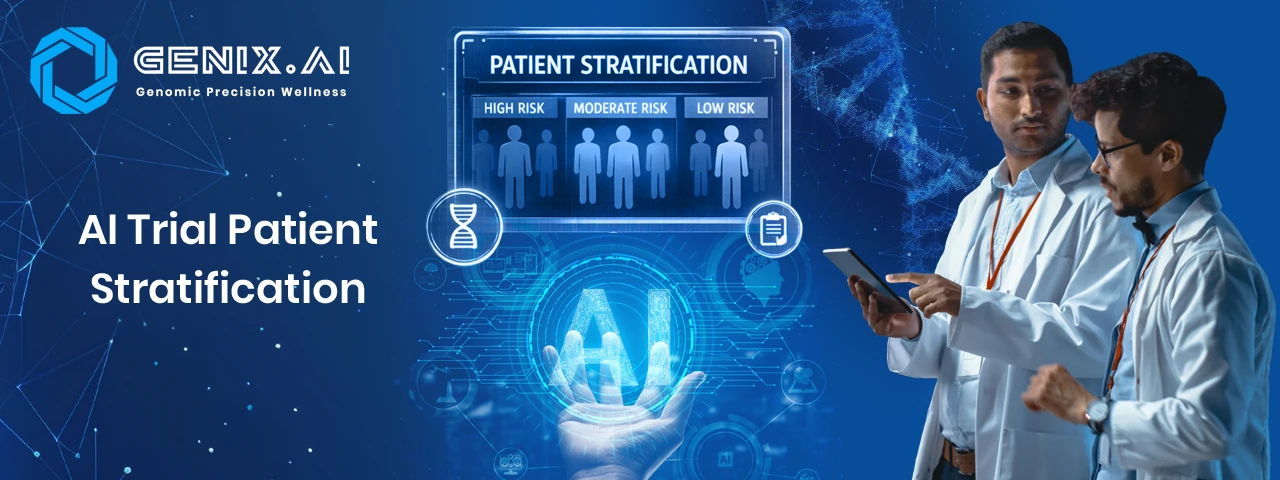
Clinical research is moving from broad patient groups to sharper, biology-led decisions. Two people may share the same diagnosis yet respond differently to one treatment. Their genes, disease pathway, metabolism, co-existing conditions, and inherited risk can all influence outcomes.
That is why AI in clinical research is gaining attention across pharma, biotech, and CRO teams. When paired with genomic platforms, it can more accurately identify patient subgroups, reduce avoidable screening failures, and improve study design.
Abstract
Every patient is different and clinical trials are finally catching up to that reality. Two people can share the same diagnosis yet respond to the same treatment in completely different ways. The reason often lies in their biology: their genes, their metabolism, their inherited risks.
That is the gap genomic platforms and AI are now closing in clinical research. Instead of grouping trial participants by diagnosis alone, researchers can now look deeper at the molecular signals that actually drive disease and response. This blog walks through how that works in practice: how AI helps make sense of thousands of genetic variants, how genomic data strengthens patient selection, and how smarter stratification reduces screening failures and improves study outcomes.
It also addresses something that matters specifically for India. With one of the most genetically diverse populations in the world, India cannot rely on Western reference datasets alone. The GenomeIndia initiative is changing that and this blog explains why population-aware genomic research is essential for trials that are fair, representative, and scientifically sound.
Throughout, the focus stays grounded: AI supports the process, but clinical experts, ethics committees, and human judgment must lead every decision. For CROs, sponsors, and research teams exploring what precision trial design looks like in practice, this blog is a clear starting point.
Why Patient Stratification Matters in Clinical Trials
Patient stratification is the grouping of participants based on biological or clinical traits. In a conventional study, eligibility may depend on diagnosis, disease stage, age, treatment history, and laboratory results.
Those factors are essential, but they may not explain the molecular reason behind a disease or why a patient responds well, poorly, or with more side effects.
Genomic stratification can look at:
- Inherited variants that raise disease risk
- Tumour mutations that may guide therapy selection
- Pharmacogenomic markers linked to drug response
- Biomarkers that signal disease progression
For CROs, better stratification can focus screening on participants who more closely align with the scientific question.
Where Genomic Platforms Fit In
A genomic platform brings together testing, sequencing, interpretation, and reporting under one roof so researchers are never looking at a single marker in isolation, but at the full biological picture.
Across the trial lifecycle, this makes a real difference. When designing a protocol, genomic data helps define which patients truly belong in the study based on their biology, not just their diagnosis. During recruitment, it can surface eligible participants earlier before time and resources are spent on the wrong candidates. At the randomisation stage, it ensures genetic subgroups are balanced across study arms, so results are not skewed by underlying biological differences. When safety reviews come around, genomic data can flag variants that affect how a patient metabolises a drug or raises their risk of an adverse response. And when the trial concludes, it helps explain something conventional analysis often cannot why certain subgroups responded the way they did.
In short, genomic platforms do not just add data. They add context at every stage where clinical decisions are made.
This is useful in oncology, rare diseases, cardiometabolic disorders, neurological diseases, immune conditions, and research on inherited diseases.
The Role of AI in Clinical Trials
Genomic data is powerful, but it is also large and complex. A sequencing report may contain thousands of variants. Researchers need to know which signals are relevant, uncertain, or clinically meaningful.
That is where AI in clinical trials can add value. AI can review large datasets, find patterns across participants, and highlight relationships that may be difficult to detect manually.
In trial stratification, AI may support:
- Matching patients to biomarker-defined cohorts
- Reviewing eligibility against protocol criteria
- Finding similar molecular profiles across sites
- Predicting progression in defined subgroups
AI should not make final eligibility decisions on its own. The output needs review by clinicians, genetic experts, statisticians, ethics committees, and trial investigators.
Why India Needs Population-Aware Genomic Research
India has wide genetic, linguistic, regional, dietary, and community-level diversity. A variant common in one group may be rare in another. A risk pattern identified in Western datasets may not apply neatly to Indian participants.
India’s Genome India programme has completed whole-genome sequencing for over 10,000 individuals representing various population groups. This matters because Indian reference data can improve local variant interpretation.
For clinical trials, better population data can support fairer recruitment and clearer subgroup analysis.
Linking Stratification with AI in Disease Detection
Patient stratification begins before trial enrolment. Many eligible participants remain unidentified because diagnoses are delayed, records are fragmented, or genetic testing is not routinely used.
AI in disease detection can support this stage. It can identify signals across laboratory reports, imaging notes, health records, family history, pathology reports, and genomic results.
In research, this may make it easier to find patients with rare mutations, inherited risks, early-stage disease, or specific treatment histories. For Indian healthcare systems, this matters because advanced diagnostics are not equally available across the country.
The aim is not to label people prematurely. It is to improve clinical awareness and connect the right patient to the right research pathway when ethics requirements are met.
The Promise of AI in Early Disease Detection
Some diseases develop silently for years. By the time symptoms appear, the disease may already be advanced. AI in early disease detection can support trial teams by identifying people at increased risk.
This is relevant for prevention studies, screening-linked trials, and early-intervention research. Genomic risk scores, family history, lifestyle data, and clinical markers can be combined to identify groups that need closer monitoring.
This approach must be handled carefully. Genetic risk is not a diagnosis. It only indicates probability. People should receive clear counselling so they understand what the result means and what it does not mean.
How AI in Public Health Research Supports Trial Planning
Clinical trials are shaped by disease burden, diagnostic access, referral patterns, and regional healthcare capacity.
AI in public health research can study large-scale trends and reveal where certain diseases, risk patterns, or diagnostic gaps are more visible. Combined with genomics, it can support smarter feasibility planning for multicentre studies.
This can guide site selection, underrepresented community mapping, and screening plans before recruitment starts.
AI in Population Health Management and Trial Readiness
AI in population health management can turn scattered health signals into organised insight. Hospitals, diagnostic networks, and research organisations can use approved data pathways to identify at-risk populations and improve referral planning.
For CROs, this can strengthen trial readiness. Teams can estimate whether enough eligible participants exist, whether genetic testing is available, and whether follow-up is realistic.
Ethical Guardrails Must Stay Central
Genomic information is sensitive because it can affect individuals and families. Trial teams need strong safeguards.
Important safeguards include:
- Clear informed consent
- Data privacy and secure storage
- Genetic counselling where family-linked results may appear
- Human review of AI-supported recommendations
- Bias checks across Indian population groups
The WHO has highlighted ethics, transparency, accountability, inclusiveness, and human oversight as important principles for AI in health. Indian biomedical research also needs ethics committee review and national research guidance.
What This Means for CROs and Sponsors
For CROs and sponsors, genomic stratification can make trials more focused. It can improve feasibility, strengthen cohort selection, support safety analysis, and make results more meaningful.
The strongest use cases include biomarker-led recruitment, rare disease participant identification, pharmacogenomic subgroup analysis, early disease risk screening, multi-site feasibility planning, and post-trial responder analysis.
The benefit comes from combining genomic science with clinical expertise. AI can organise and detect patterns, but interpretation must remain medically grounded.
Conclusion
Genomic platforms are changing how trial teams think about patient stratification. They help researchers move beyond diagnosis alone and understand the biological differences that shape response, risk, and disease progression.
For India, this shift is important because population diversity needs stronger representation in research. Used responsibly, AI and genomics can support better trial design, earlier identification of eligible participants, and more meaningful evidence for future treatments.
The future depends on ethical, human use of datasets.