Abstract
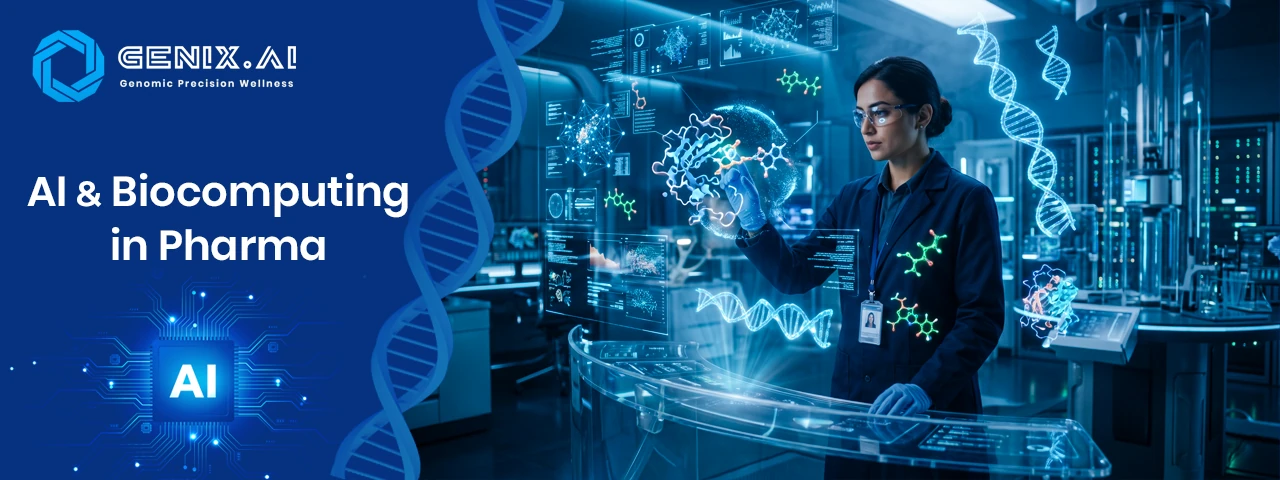
Drug research has always been slow because biology is messy and most ideas fail. Lately two things have started to change that. AI learns patterns from huge piles of data, and biocomputing gives scientists the computing tools to test ideas before the lab does. Used together they can cut a lot of guesswork. This guide explains how that partnership works in pharmaceutical research and where human judgment still has to lead.
Why pharmaceutical research is ready for a shake up
1. Time, cost and failure
A new medicine often takes a decade or more to reach patients, and the bill commonly runs past a billion dollars once the failures are counted. Roughly nine in ten candidates that enter human trials never get approved, a figure widely cited in reviews of the field. When that many ideas fall short, even a small improvement in early choices matters a great deal, which is why AI in pharmaceutical research has drawn so much attention.
2. Two ideas that often get mixed up
AI in drug discovery usually means models that learn from data to make predictions, such as which molecule might bind a target. Biocomputing in pharma is the wider toolkit, covering everything from sequencing analysis to docking and simulation. AI is one part of that toolkit. Neither works well alone, and AI does best when the other parts check its homework.
How the two work together
AI proposes and computation checks
Think of a loop.
Data → AI proposes candidates → Computation checks them → Lab tests the survivors → Results feed back into the modelEach lap gives the model better examples to learn from. Skip the checking step and a confident looking prediction can send a team in the wrong direction.
Where they speed things up
1. Finding targets and biomarkers
Early research starts with choosing what to attack. Pick a poor target and everything built on it inherits the flaw. Sequencing data and AI assisted analysis can highlight genes and proteins linked to disease, and biomarkers that separate patients who respond from those who don't. Researchers increasingly combine several data types at once, such as DNA and protein measurements, because disease rarely hides in one layer. Teams working in pharma and biotech lean on this stage because a better target saves everything that follows. The raw material is often next generation sequencing data.
2. Designing and screening molecules
Once a target is chosen, AI can suggest molecules and docking can test how well each fits. A single molecular docking campaign can score a large library, so the lab only sees the best few. Docking scores are estimates, though, and they still need confirming. AI designed molecules have already entered human trials, which shows the idea has moved beyond theory, though trial results will decide how far it goes.
3. Making trials smarter
Here's a made up example. A mid sized company runs a trial where a drug helps some patients and does little for others. Genomic analysis of the trial samples finds a variant pattern that's more common in the people who responded. The next trial enrolls with that pattern in mind. Nothing about the drug changed. The company simply stopped treating a mixed group as one.
Keeping humans in charge
1. Explainability builds trust
A suggestion nobody can explain is hard to defend in a lab meeting, let alone to a regulator. Good platforms keep AI suggestions clearly separate from expert conclusions and show the evidence behind each result. The validation and explainability page shows how one approach looks in practice.
2. Blind spots to watch
Models learn from the data they're given, so gaps in the data become gaps in the answer. Rare conditions and under studied populations are the usual weak points. A model trained mostly on one group of people can mislead when applied to another, which is why diverse reference data matters. You can read about this under bias and population intelligence.
3. Rules and records
Regulators are paying attention too. The US FDA, for one, has published guidance on using AI to support decisions about drugs, which puts a premium on documented, repeatable methods. That's a good reason to prefer workflows that keep a clear trail from raw data to final result.
Getting started without a big team
Build in house or bring in help
Not every company can hire a full computational team. Some buy analysis as a service for the stages they need, and some build a reusable bioinformatics pipeline first. Either way, cost deserves attention early, as this piece on why bioinformatics costs spiral points out. Whichever route you take, agree a clear scope and delivery timeline up front.
Conclusion
AI and biocomputing work best as a team, with scientists steering. Genix.ai supports that through Biocompute, a bioinformatics analysis service that spans everything from NGS data analysis to custom pipeline development, with biomarker and target discovery offered for pharma and funded biotech teams. Published pricing lists protein structure prediction from $500 per target and a docking campaign from $1,000, and docking turnaround is listed at 5 to 10 days. The company's pharma and biotech page also describes explainable, audit ready AI. A free 30 minute consultation is on offer, and projects sit under NDA with clients keeping ownership of results. Explore Biocompute to see whether it fits your research.
FAQs
1. How is AI used in pharmaceutical research?
To find patterns in biological data and suggest targets and molecules worth testing.
2. What does AI in drug discovery actually do?
It ranks possibilities so scientists test the most promising ones first.
3. What is biocomputing in pharma?
The use of computing tools such as docking and simulation to study biology and guide drug research.
4. Can AI replace lab experiments in drug development?
No, lab testing remains the proof that a candidate really works.
5. Is AI in pharmaceutical research reliable?
It can be when its results are explained and then confirmed in the lab.