Abstract
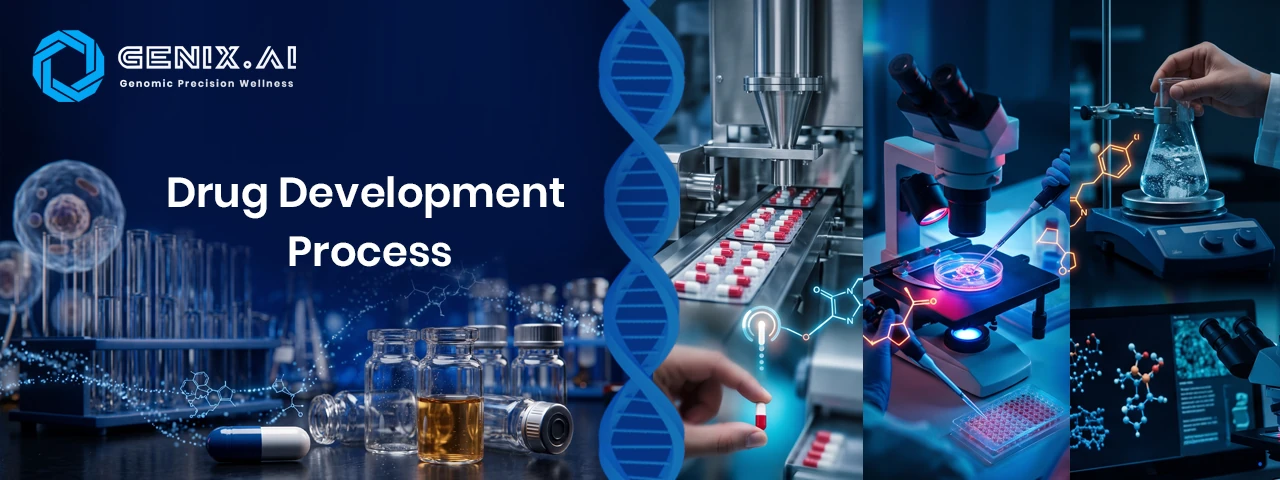
Most drug candidates never reach a pharmacy shelf, and each failure can cost years. So scientists have started asking a smarter question much earlier. Can biocomputing tell us which ideas deserve a lab bench before anyone spends the money? This guide follows biological data from raw sequence to a short list of promising molecules, and it's honest about where the computer's confidence runs out.
Why drug development needs a better filter
1. A long road with many dead ends
Bringing one medicine to patients often takes a decade or more. Along the way, the large majority of candidates that reach human trials never get approved, a commonly cited figure being around 90 percent. Every dead end that surfaces late is expensive, because the money and time are already spent. The goal of modern drug development is to find the weak ideas sooner and cheaply.
2. What biocomputing adds
Biocomputing here means using computers to study biology, the same idea as computational biology. In drug work it turns large piles of biological data into a ranked list of choices. It doesn't replace the lab. It decides what the lab should test first. It also leaves a record of why each choice was made, which helps when someone asks later. Think of it as a very fast, very patient filter.
From raw data to a shortlist
1. The path in one picture
Here's the usual route a project takes.
Biological data → Target selection → Structure prediction → Docking and screening → Safety filtering → Lab testing
Each stage narrows the field, so by the end you're holding a handful of candidates instead of thousands.
2. Choosing a target from biological data
Everything starts with a target, usually a protein tied to a disease. Sequencing data helps here, because variants and gene activity patterns point toward proteins worth studying. This is the territory of next generation sequencing analysis, where raw reads become a clean list of findings. Pick the wrong target and the cleverest downstream work is wasted.
3. Predicting the target's shape
Many drugs work by fitting into a protein like a key in a lock, so you need to know the lock's shape. When no experimental structure exists, AI tools such as AlphaFold can predict one from the amino acid sequence. Teams then check the model's quality before trusting it, because a poor model gives poor answers all the way down.
Screening and scoring candidates
1. Docking in plain terms
Molecular docking asks a simple question. If this molecule meets that protein, how well might they fit? The software tries many positions and scores each one. Higher scores usually mean a tighter predicted fit, though each program has its own scale. It's a core step in molecular docking services, and it's what turns a shape into a ranked list.
2. Virtual screening versus lab screening
Virtual screening runs docking across a whole library. Public libraries now list billions of molecules, and one, ZINC22, holds about 4.1 billion in ready to dock form. No lab could test that many by hand. The table compares the two approaches in general terms. In practice teams use both.Checking safety early with ADMET
A molecule that binds beautifully can still be a poor medicine if it's toxic or never reaches the right tissue. ADMET profiling predicts how a compound is likely to behave in the body and whether it could cause harm. Running it early lets teams drop risky candidates before they cost real money.
What a real project looks like
1. A small biotech and a big library
Here's a made up example with round numbers. A small biotech has a promising protein target and a library of thousands of compounds it can't afford to test physically. It docks the whole library virtually and filters the top scorers for safety. Only a few dozen go to the lab. Most still fail at the bench. That's normal. The point is that the lab spent its budget on dozens of tries instead of thousands.
2. Build it in house or hand it off
Some companies grow their own computational team. Others hire specialists for the stages they need. Costs can climb faster than expected either way, as this look at why bioinformatics costs spiral explains. A repeatable bioinformatics pipeline helps because the same analysis then runs the same way each time, and teams in pharma and biotech can start there.
Honest limits
1. Scores are not proof
A docking score is a prediction, and different programs can rank the same molecule differently. Rerunning with a second method is a common sanity check. Treat the output as a reason to test something, never as evidence that it works. The wet lab has the final word.
2. Good inputs matter most
Poor structures or biased reference data produce shaky shortlists, however fast the computer is. Ask where the data came from and who reviewed the output.
Conclusion
Biological data only becomes useful when someone turns it into decisions. Genix.ai offers help with that through Biocompute, where protein modeling and docking forms a full computer aided drug design workflow, running from structure prediction through ADMET prediction. Published pricing lists structure prediction from $500 per target and a docking campaign from $1,000, with docking turnaround of 5 to 10 days. It also covers computational validation for traditional medicines, such as docking of plant compounds. A free 30 minute consultation is on offer and projects sit under NDA, with clients keeping ownership of their results. ExploreBiocompute to see whether it fits your project.
FAQs
1. What is biocomputing in drug discovery?
Using computers to analyze biological data and rank targets and molecules before lab testing begins.
2. How does drug development use docking?
It predicts how well a molecule fits a target protein so the best candidates get tested first.
3. Can biocomputing replace lab testing?
No, it narrows the list but lab experiments must confirm the results.
4. How long does drug development take?
Often a decade or more from early research to approval.
5. Is virtual screening accurate?
It's useful for ranking candidates, but its predictions are estimates that need experimental confirmation.