Enquire Now

User icon

Phone icon

Email icon

WhatsApp Us
+91 886 141 4344
Chat with Us
cart Shop order Order now
Genomic Intelligence

Transform Sequencing Data Analysis into Clinical Confidence

Genix.ai delivers enterprise-grade genomic intelligence for institutions working across genome sequencing, metagenomic sequencing, and DNA sequence analysis, among others. The platform transforms complex genomic and phenotypic data into structured, explainable, and decision-ready outputs with precision, traceability, and scale.

Clinical genomics platform visualization

The Real Challenge Is Not Sequencing. It Is Sequencing Data Analysis

As genome sequencing and metagenomic sequencing become more accessible, the competitive advantage no longer lies in generating data. It lies in delivering accurate, scalable, and clinically meaningful sequencing data analysis.


Genomics workflows
Bioinformatics expertise
Interpretation times
Genomics workflows
Bioinformatics expertise

Disconnected tools across QC, annotation, interpretation, and DNA sequence analysis

Variation in interpretation across cohorts, populations, and clinical settings

Manual review workflows that slow down NGS sequencing data analysis

High variant volumes with limited clinical relevance

Limited ability to convert genome sequencing and metagenomic sequencing outputs into confident, actionable decisions

Genix.ai’s Philosophy

What Genomic Intelligence Means in a Modern Service Workflow

At Genix.ai, genomic intelligence goes beyond variant calling and raw output generation. It is built to support decision-ready interpretation across the full lifecycle of genomic analysis.

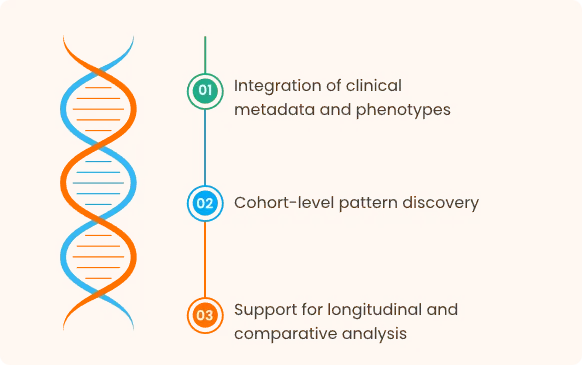
Connect genomic findings with phenotype, cohort, and population signals

Prioritise findings using clinically relevant evidence layers

Maintain traceability across processing, review, and final interpretation

Support decision-making with explainable outputs and scientific transparency

Core Capabilities That Strengthen Genomic Analysis at Scale
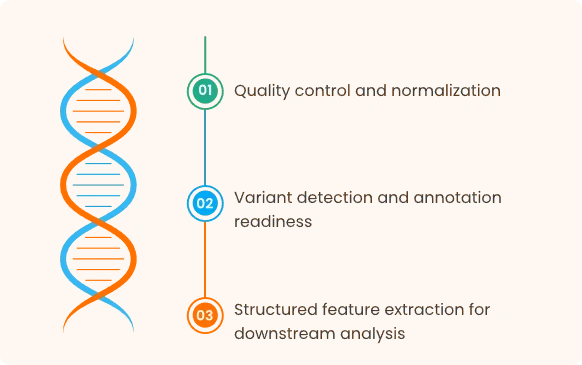
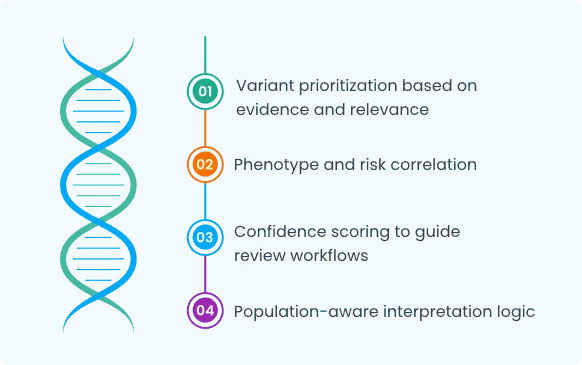
Structured Genomic Data Processing

AI-Powered Variant Intelligence

Phenotype and Population Signal Fusion

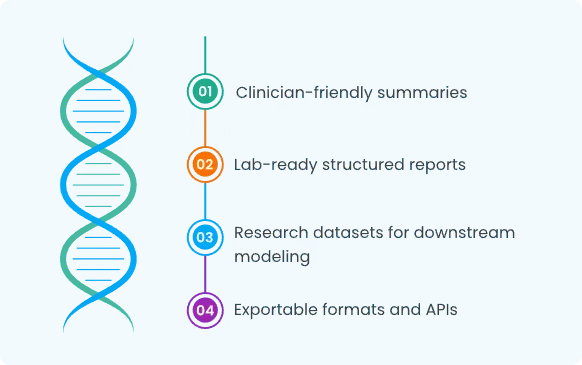
Report-Ready Clinical Outputs

How Clinical Annotation Moves
from Raw Data to Usable Insight

Built for Diverse Genomics Use Environments

The platform supports multiple operating models across healthcare and life sciences.

Clinical diagnostics and preventive genomics services

Diagnostic laboratories managing high-throughput interpretation

Pharma and biotech teams working with genomic evidence

Research and population studies requiring scalable analysis frameworks

Built for Scale, Governance, and Long-Term Deployment

The architecture is designed to support operational growth without losing scientific oversight.

Scales from focused pilots to population-level programmes

Supports multi-tenant and isolated deployment models

Strengthens auditability, governance, and controlled access

Works across SaaS, private cloud, and institution-aligned environments

What Sets This Platform Apart in Genomic Intelligence

The platform is built for serious healthcare deployment, not isolated experimentation.

Intelligence layer built into the workflow, not added later

Explainability is embedded by default across the interpretation path

Population-aware logic designed for broader cohort relevance

Strong collaboration model between AI systems and domain experts

Fit for regulated, review-heavy, and institution-led environments

Why hospitals choose genix.ai

Start a Conversation

Share a few details and our team will connect with you
User icon
Organization icon

Frequently Ask Questions

1. What is included in the Genix genomic report?
The report brings together key genetic insights in one structured format. Based on the selected scope, it may cover areas such as wellness, nutrition, fitness response, skin, allergy tendencies, hereditary patterns, and family-planning relevance. The aim is to present findings in a way that is easier to review and apply.
2. How is the sample collected?
The sample is collected using a saliva collection kit. The process is simple and non-invasive, with clear instructions included in the kit for proper sample submission. Once collected, the sample is sealed and sent for laboratory processing.
3. Is the sample collection process easy to complete?
Yes, the collection process is designed to be safe, hygienic, and convenient for home use. Since it uses saliva instead of invasive collection methods, it is generally easier for users to complete correctly with basic guidance.
4. How long does it take to receive the report?
The report is typically made available within 10 to 14 business days after the sample reaches the laboratory. This timeline includes sequencing, analysis, interpretation, and report generation. The exact turnaround may vary slightly depending on processing volume.
5. How reliable is the analysis?
The analysis is supported by sequencing workflows, bioinformatics processing, and structured interpretation methods. This helps improve consistency, reduce manual gaps, and maintain a high standard of reporting quality. The focus is on delivering dependable and scientifically grounded insights.
6. Is genetic data kept secure?
Yes, data security is treated as an important part of the service workflow. Genetic data is typically protected through encryption, controlled access, and secure cloud infrastructure, with user-led data management options where applicable.
7. Is the report easy to understand?
Yes, the report is designed to make genomic information easier to follow through clear sections, simplified explanations, and readable formatting. This helps users understand the main findings without losing the scientific value of the report.
8. Does the report include nutrition or fitness-related insights?
Yes, depending on the selected report scope. It may include insights linked to metabolism, nutrient response, physical performance tendencies, and recovery patterns. These sections are meant to make the findings more relevant to everyday health and lifestyle decisions.
9. Can the report identify disease risk or predisposition?
The report may highlight genetic predisposition and risk indicators based on known markers and available evidence. It is intended to support awareness and informed follow-up, rather than act as a standalone medical diagnosis. Any high-risk findings may still need clinical interpretation
10. Is the service suitable for children?
Yes, the service may be suitable for children aged 2 years and above with proper supervision during sample collection. In such cases, the report may help provide early visibility into inherited traits, nutritional tendencies, or broader health-related markers.
11. What happens after the report is ready?
Once the report is generated, the findings are presented in a structured format for review. The output is intended to support a better understanding of genetic traits and may also guide further consultation, lifestyle planning, or health-related follow-up where relevant.
12. What makes this service different from a basic genetic report?
The difference lies in the combination of sequencing, bioinformatics analysis, structured interpretation, and report-ready delivery. Instead of only presenting raw genetic findings, the service is designed to convert them into clearer and more usable genomic insights.
Genix.ai - Genomic Precision Wellness
Genix.ai Logo

Genix.ai is an AI-powered clinical platform using NGS and imaging to detect biomarkers early, enabling clinicians to deliver cost-effective, personalized treatments for rare pediatric conditions, cancer care, and infectious diseases.

©2026 Radiome Health Private Limited.

Developed in Association with Chadura.