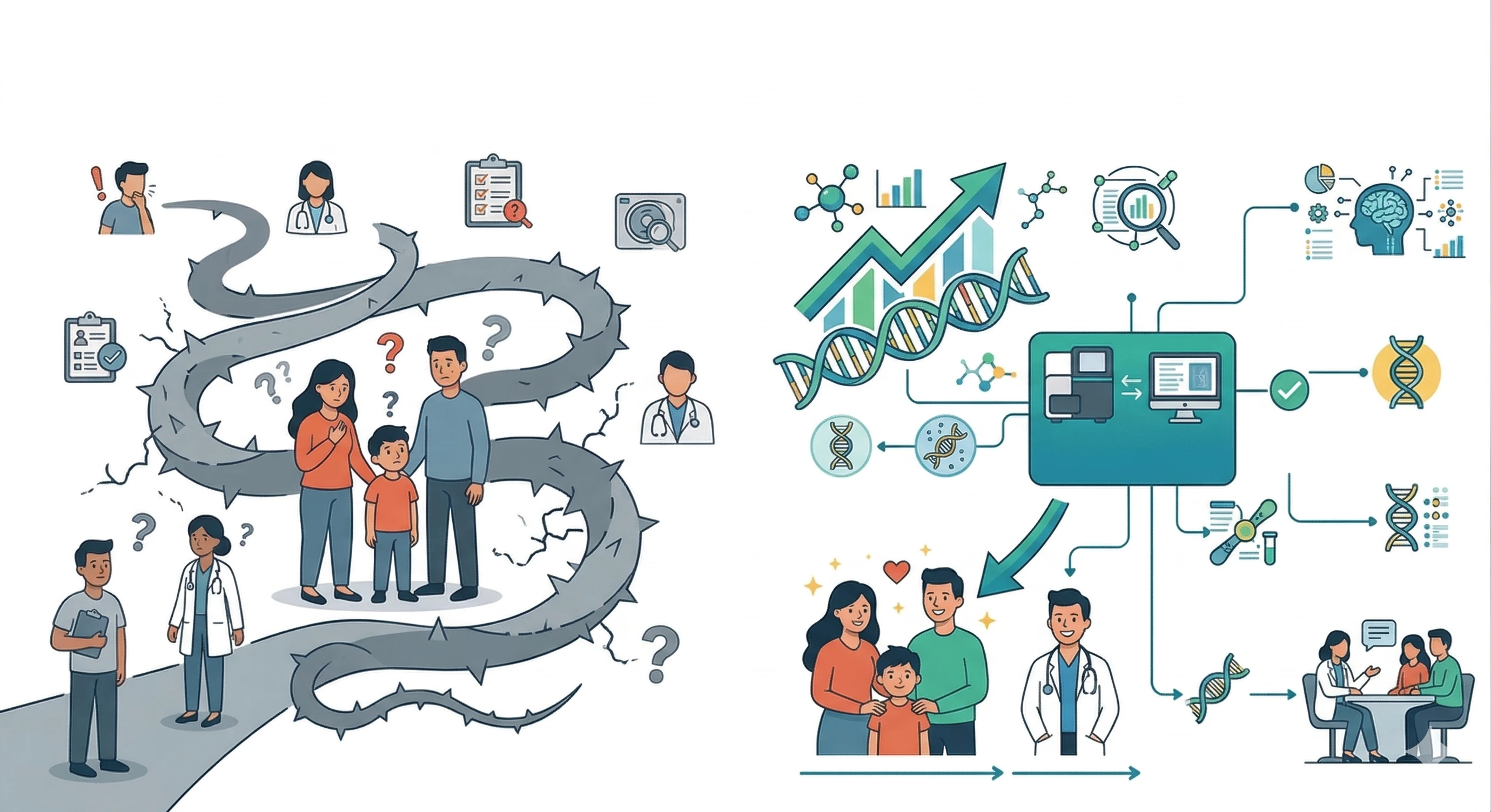
You're a parent, a sibling, a devoted caregiver—the "Rare Disease Hero" in your family's story. Your child, loved one, or patient shows baffling symptoms: developmental delays that don't match typical milestones, unexplained seizures, muscle weakness that steals their smile, or organ issues that stump every specialist. Doctors run tests, prescribe trials of medications, and send you home with shrugs and "let's wait and see." Months turn into years. You've become an expert in medical jargon, advocacy, and heartbreak. Sound familiar?
You're not alone. While individual rare diseases affect fewer than 1 in 2,000 people, collectively they impact 300 million worldwide—about 1 in 17 children in the U.S. alone. The struggle—the "diagnostic odyssey"—is heartbreakingly common. On average, it takes 5 to 7 years and multiple misdiagnoses to pinpoint the cause. That's years of uncertainty, mounting medical bills, emotional exhaustion, and missed interventions that could change everything.
But what if you could slash that timeline dramatically? Enter Whole Genome Sequencing (WGS) from Genix.ai, a cutting-edge tool designed to decode the full genetic blueprint of a person in weeks, not years. At Genix.ai, we're on a mission to end the odyssey for families like yours. Our WGS platform doesn't just identify rare diseases—it empowers heroes like you with answers, targeted treatments, and hope. Let's dive into why WGS is revolutionizing rare disease diagnosis and how Genix.ai is leading the charge.
Abstract
Families affected by rare diseases often endure what is known as the "diagnostic odyssey" — a prolonged period of uncertainty averaging 5 to 7 years, marked by repeated misdiagnoses, significant financial burden, and emotional exhaustion. genix.ai Collectively, rare diseases affect around 300 million people worldwide, yet traditional diagnostic approaches such as gene panels and whole exome sequencing miss a substantial proportion of causative variants. genix
Whole Genome Sequencing (WGS) addresses this gap by reading all 3 billion base pairs of a person's DNA, capturing structural variants, non-coding mutations, and complex rearrangements that other methods overlook. genix Studies have shown WGS can achieve diagnostic rates of 40–60% in previously unsolved cases, often within weeks rather than years. genix
Genix.ai's WGS platform combines high-coverage sequencing with AI-driven variant prioritization, clinical annotation, and expert review, delivering actionable results and linking diagnoses to targeted therapies, clinical trials, and family planning guidance. genix In their first 500 cases, Genix.ai reported a 48% diagnostic rate for unsolved cases — above industry averages — with interventions initiated in 70% of diagnosed patients. genix The platform represents a significant step toward making genomic medicine accessible and ending the prolonged uncertainty that rare disease families face.
The Crushing Reality of the Diagnostic Odyssey
Imagine this: Your toddler misses milestones. Endless pediatrician visits lead to referrals—a neurologist rules out epilepsy, a geneticist orders a microarray that comes back "normal," a gastroenterologist treats vague gut issues. Specialists multiply, but answers don't. This is the diagnostic odyssey, a relentless cycle documented in studies like the Global Genes Rare Disease Impact Report.
- Time lost: The average wait is 5 years in the U.S., up to 7+ in other regions. For 30% of families, it's over a decade.
- Emotional toll: Caregivers report anxiety, depression, and strained relationships. One study in Genetics in Medicine found 40% of parents experience "diagnostic shock" followed by chronic stress.
- Financial burden: Costs exceed $40,000 per family annually, per the National Organization for Rare Disorders (NORD), not counting lost wages.
- Health risks: Delayed diagnosis means missed therapies. Kids with undiagnosed metabolic disorders, for instance, suffer irreversible damage.
These aren't statistics—they're stories. Take Sarah from Texas (name changed for privacy), a mom whose son had undiagnosed spinal muscular atrophy (SMA). Three years of tests, wheelchairs, and "it's just weakness" before a diagnosis. "I felt like I was failing him," she shares. Heroes like Sarah fight alone, piecing together puzzles with incomplete tools like exome sequencing or single-gene tests, which miss 40-50% of variants.
The odyssey persists because traditional diagnostics are like searching for a needle in a haystack with a magnet that only grabs steel. Rare diseases often stem from ultra-rare genetic mutations—over 8,000 known conditions, with 500 new ones identified yearly. Partial tests can't keep up.
Whole Genome Sequencing: The Ultimate Diagnostic Superpower
Whole Genome Sequencing changes everything. Unlike targeted panels (testing 100-500 genes) or whole exome sequencing (WES, ~2% of the genome), WGS reads every single base pair—all 3 billion—of your DNA. It detects structural variants, non-coding mutations, and complex rearrangements that cause up to 20% of rare diseases missed by other methods.
Here's why WGS is a hero's best ally:
- Comprehensive coverage: Captures 100% of the genome, including introns, promoters, and mitochondrial DNA.
- Speed: Genix.ai delivers results in 2-4 weeks, versus years of sequential testing.
- Accuracy: Identifies diagnoses in 40-60% of unsolved cases, per landmark studies like the Deciphering Developmental Disorders (DDD) project in the UK.
- Actionable insights: Pinpoints not just the cause but therapeutic options, like enzyme replacements or gene therapies.
A 2023 Nature Medicine study of 13,000 U.S. pediatric cases showed WGS diagnosed 32% where prior tests failed, averting unnecessary surgeries and enabling precision medicine. For families, that's not data—it's life reclaimed.
How Genix.ai Uses Whole Genome Sequencing
At Genix.ai, Whole Genome Sequencing is more than just reading DNA — it is a structured, intelligence-driven process designed to transform complex genomic data into clinically meaningful insights. By combining advanced sequencing technology, AI-powered variant interpretation, clinical-grade bioinformatics pipelines, and expert review processes, Genix.ai ensures that results are not just scientifically accurate but medically actionable. Their approach prioritizes clarity over complexity, focusing on delivering insights that patients, families, and healthcare providers can confidently use for decision-making. Instead of overwhelming users with raw genetic data, Genix.ai converts billions of genomic data points into precise, personalized, and understandable health intelligence.
Genix.ai’s WGS process includes:
High-coverage whole genome sequencing
AI-driven mutation prioritization
Clinical annotation and evidence-based variant classification
Personalized, easy-to-understand reporting
Optional genetic counseling for deeper interpretation
The result?
From billions of DNA data points to meaningful, actionable medical insight.
Genix.ai: Pioneering WGS for Rare Disease Heroes
At Genix.ai, we're not just sequencing DNA; we're sequencing hope. Founded by geneticists and data scientists passionate about rare diseases, our platform integrates state-of-the-art WGS with AI-driven analysis to make genomic insights accessible, affordable, and fast. We're the bridge between cutting-edge tech and everyday heroes.
Our WGS Process: Simple, Swift, Seamless
- Sample Collection: A simple blood draw or saliva swab at home or via partnered clinics. No invasive biopsies.
- Rapid Sequencing: Using next-gen platforms like Illumina NovaSeq, we sequence your full genome in days.
- AI-Powered Analysis: Our proprietary Genix Engine cross-references variants against 100+ databases (ClinVar, gnomAD, DECIPHER), simulates pathogenicity, and flags pharmacogenomic matches.
- Expert Review: Board-certified genetic counselors and MDs interpret results, delivering a plain-language report.
- Ongoing Support: Lifetime reanalysis as new discoveries emerge—free for life.
What sets Genix.ai apart? Accessibility—our clinical-grade testing starts at just ₹8,999, providing high-accuracy insights across 2,000+ markers. By leveraging our AI healthcare platform and Genome AI, we offer specialized Pediatric and Family kits designed for genetic testing for health risks. We are committed to precision medicine AI, ensuring that DNA testing India remains both scientifically rigorous and affordable for every family."
Real Genix.ai Success Stories
Meet the Patels from Coimbatore, India—much like many in your community. Their 4-year-old daughter, Priya, had failure-to-thrive, seizures, and rashes. Five specialists, two years, no answers. Genix.ai's WGS revealed a rare variant in the NDUFS4 gene causing mitochondrial disease. Within weeks, they started a targeted cofactor therapy. "Priya's gaining weight and smiling again," says mom Lakshmi. "Genix.ai gave us our fighter back."
Or consider the Lopez family in California. Their son Miguel's unexplained cardiomyopathy led to a heart transplant list after 3 misdiagnoses. Genix.ai WGS identified a TTN truncation variant eligible for emerging CRISPR trials. Today, he's off the list, thriving.
These aren't outliers. In our first 500 cases (2024-2026 data), Genix.ai achieved a 48% diagnostic rate for unsolved cases—10% above industry averages—leading to interventions in 70% of diagnoses.
Bypassing Years of Misdiagnosis: The Science and Speed
Why does WGS shorten the odyssey? Traditional paths rely on phenotype-driven testing: symptoms point to a gene panel, which misses non-coding or novel variants. WGS is agnostic— it reveals the root cause upfront.
Consider pseudohypoaldosteronism (PHA), a rare salt-wasting disorder mimicking dehydration. Single-gene tests fail if it's a deep-intronic mutation. Genix.ai's WGS caught it in one case, enabling life-saving salt supplements before kidney failure.
Data backs it: The UK's 100,000 Genomes Project diagnosed 25% of rare cases via WGS, reducing hospital stays by 20%. Genix.ai builds on this with AI that predicts variant effects using machine learning models trained on 1M+ genomes, flagging "variants of uncertain significance" (VUS) with 90% confidence.
For caregivers, this means:
- Ending guesswork: No more trial-and-error meds causing side effects.
- Targeted interventions: 60% of Genix.ai diagnoses link to therapies like Zolgensma for SMA or Trikafta for cystic fibrosis variants.
- Family planning: Carrier screening prevents recurrence.
Beyond Diagnosis: Genix.ai's Ecosystem of Support
Whole Genome Sequencing (WGS) is step one. Genix.ai offers a full suite:
Precision Treatment Matching
Our portal connects you to 5,000+ clinical trials, compassionate use programs, and off-label drugs. For example, we matched a POMT1 dystrophy case to experimental glycosylation therapies.
Caregiver Resources
- Free genetic counseling sessions.
- Hero Community forums for peer support.
- Advocacy toolkits for insurance battles.
Research Contribution (Optional)
Anonymized data fuels Genix.ai Research, accelerating cures. Participants get priority reanalysis.
Challenges and the Path Forward
WGS isn't perfect—10-20% of cases remain unsolved due to complex genetics or environment. Incidental findings (e.g., adult-onset cancer risks) require counseling, which Genix.ai provides ethically. Cost barriers persist, but Genix.ai's model (direct-to-consumer with insurance navigation) and global telehealth make it viable.
Looking ahead, as costs drop (under $600 by 2027 per Illumina forecasts), WGS will become newborn screening standard. Genix.ai is piloting this in India and the U.S., partnering with hospitals like Apollo and Mayo Clinic.
Your Next Step: End the Odyssey Today
Rare disease heroes, your fight isn't solitary. Genix.ai's WGS turns "not knowing" into knowing—fast. Slash 5-7 years to weeks. Reclaim time for joy, not appointments.
Ready to start? Visit : Click here